You’re not at your best when you’re stressed. In fact, your brain has evolved over millennia to release cortisol in stressful situations, inhibiting rational, logical thinking but potentially helping you survive, say, being attacked by a lion. Neuroscientist Daniel Levitin thinks there’s a way to avoid making critical mistakes in stressful situations, when your thinking becomes clouded — the pre-mortem. “We all are going to fail now and then,” he says. “The idea is to think ahead to what those failures might be.”
Tag: Resilience
-
How to discover your “why” in difficult times
What has the coronavirus pandemic taught us about ourselves and our relationships? In a deeply personal and wide-ranging conversation, leadership expert Simon Sinek shares his own experience caring for his mental health as the world shut down. He discusses why we need to nurture friendships (in both good times and bad), explains why anyone can be a leader — and reveals the secret to discovering your “why” in life.
-
The Real Cost of Burnout — And How to Avoid it
While it can be tempting to push through feeling run-down in the name of getting stuff done, that road can push us closer to burnout.
It’s 4:00 PM, and your project is due by the end of the day. But no matter how you try, you can’t seem to keep your mind focused for more than a few minutes at a time.
The stress of the workday presses down like a weight — one that keeps getting heavier. It feels like you have little left to give. In short, you’re burning out.
But while we’re all familiar with the term “burnout,” what does it actually mean? How do we know when we’re suffering from it? What measures can we take to recharge and avoid burnout before it’s too late, or deal with the consequences once we’re caught in the middle?
Interestingly, researchers haven’t yet agreed upon a clinical definition of burnout, but many characterize it as having three main types of symptomsthat we can look out for:
- Exhaustion — feeling depleted, having lowered concentration, being especially forgetful
- Alienation — wanting to avoid social situations, feeling pessimistic, feeling cynical
- Reduced performance — missing deadlines, feeling listless, being less engaged
We’ve all had moments when we’ve felt one or more of those things, and like our list of responsibilities might exceed our ability to handle them. Now, picture feeling that way for weeks on end, or even longer. That’s what feeling burned out can look like.
The real costs of burnout
Being burned out is far more serious than just “having a bad day” or “being stressed out.” It can cost us health, happiness, and achievement, with serious, long-term effects ranging from depression and insomnia to gastrointestinal issues, and even increased mortality.
And that’s to say nothing of the profound impact burnout has on those around us: our family, friends, and colleagues. When we burn out, it places deep stress on our personal relationships and businesses as well as damaging our own psyches and bodies.
Many of the symptoms of burnout overlap with feelings of depression, but the phenomena are different. More research is needed, but burnout is especially related to the pressures of work life, while with depression they can be related to several areas (for example romantic relationships, family dynamics, and socio-political issues). In both cases, we’re dealing with internal states that can be difficult to recognize and talk about, so developing self-awareness is key.
Worth heeding the signs
How do we know if we’re on the road to burnout?
Signals differ, but in general, we can watch for those three types of symptoms listed above: exhaustion, alienation, and reduced performance.
Exhaustion-wise, we might find ourselves “running out of gas” earlier in the day or week, eventually reaching the point where we can’t seem to focus no matter how hard we try. We might notice ourselves performing tasks out of logical order, becoming forgetful, or getting stuck on simple tasks.
If we’re feeling more alienated than usual, we may become irritable, cynical, or frustrated with people. Getting out of bed and going to work becomes a chore, then something worse — a stressful, anxiety-filled situation we can’t bring ourselves to face. We might find ourselves cancelling plans simply because we don’t have the energy and taking out our emotions on others.
Last, reduced performance might mean we are no longer fully engaged with our work. We approach our jobs with a lack of enthusiasm or apathy, miss deadlines, and perhaps fall into a cycle of guilt, where the stress of not doing our work well harms our performance even more.
Reclaiming control
When we take charge of a situation that may have seemed beyond our control, we’re giving ourselves an opportunity to pull back and rejuvenate.
While some factors that contribute to feeling burned out are out of our control, there are steps we can take to renew ourselves. Here are five self-care strategies for avoiding burnout:
1) Reach out to your community
There’s no need to go it alone. Sometimes, the symptoms of burnout can be hard to detect. And when life feels like it’s moving too fast, it can be easy to forget to ask for help, feedback, and support from friends, family, and trusted mentors. These people can help make us more self-aware, pointing out when we seem to be on the road to burnout.
Sometimes, simply sharing how we feel can be a reminder that we’re not alone, and be cathartic in itself. When in doubt, consider teaming up with a therapist to process these feelings.
2) Prioritize good quality sleep
Getting better sleep can help the exhaustion aspect of feeling burned out. While sleep disturbance can be a symptom of burnout, working towards having a consistent sleep schedule will be helpful. Most adults function best on 7.5 to 9 hours per night, with total darkness in the bedroom, and screen-free time before laying down. Developing a winding down ritual, when you might consider dimming the lights, lighting a candle, writing in a journal, or reading. These simple steps can help you relax and fall asleep faster.
3) Take care of your body
Like sleep, wholesome nutrition and regular exercise can help mitigate exhaustion symptoms. Having adequate protein, lots of veggies, and healthy fats promotes stable blood sugar, which is tied to heightened mood, better focus, and better awareness. Exercise promotes blood flow, releases endorphins, and increases focus — all factors that can help us feel more like ourselves.
Yoga may also help. In a two-year study of workers on sick leave from burnout, researchers found that participants who practiced yoga for seven hours per week for 20 weeks showed significant symptom improvements.
Interesting side note: regular exercise can also improve sleep quality, creating positive momentum in regards to the tip above.
4) Keep a stress log
Because burnout symptoms are often challenging to recognize and heed, it can be helpful to evaluate your feelings by creating a stress log, using a journal or a digital tool such as Evernote.
A couple of times a week, and definitely whenever you’re stressed, consider ranking the following burnout symptoms on a 1–10 scale (1 = this feeling is hardly present; 10 = this feeling is all consuming):
Level of stress:
Level of feeling depleted:
Level of lowered concentration:
Level of forgetfulness:
Level of wanting to avoid social situations:
Level of pessimism:
Level of cynicism:
Level of apathy:
Level of lowered engagement:
You can also rank your overall amount of energy on a scale of 1–10, with 1 being totally depleted and 10 being the Energizer Bunny.
These are uncomfortable feelings, and being honest with ourselves about them can be difficult or feel slightly demoralizing. But we can also see it as empowering. When we notice those numbers creeping higher, we are taking charge of a situation that may have seemed beyond our control, giving ourselves an opportunity to pull back and rejuvenate.
If you want to keep your stress log in Evernote, we’ve created a simple template you can use.

5) Manage workplace stress
Since burnout is primarily associated with our work, that is one place we can definitely make an impact. We don’t have to accept the notion that jobs are inherently stressful and there’s nothing we can do about it. Find ways to structure your day to incorporate short breaks and maximize your peak energy times. Work with your employer and teammates to reduce meeting overload and focus your working hours on the things that matter.
In today’s “always on” world, stress can be overwhelming, and we often feel like it’s our fault if we can’t stay on top of everything. While it can be tempting to push through feeling run-down in the name of getting stuff done, that road can push us closer to burnout. Taking the time to assess, wind down, and rejuvenate instead can make us healthier, happier, and yes, more productive, in spades.
-
How to be your best self in times of crisis
So given everything going on at the moment it seemed poignant to share this talk from Susan David about how to be your best self in times of crisis. About 28 minutes in there’s a bit around social distancing and working from home and something that stood out for me was the idea that we do not need to practice ‘social’ distancing but ‘physical’ distancing, the terminology can conjure ideas of being alone rather than just physically apart.
-
It’s okay to feel overwhelmed, here’s what to do next
Especially at the moment, an hour might feel like a heavy time commitment, it’s worth considering especially because of the current climate it might be even more important than normal to find that time. This profound talk from the author of “Eat, Prey, Love” about anxiety, fear and grief in the current climate offers some hope and reflects on how to stay present. Some of the highlights I took away were:
- “There is no more species more anxious than humans”, unlike most species we have such vast imaginations we can picture the future, and we often picture the worst.
- Humans are great at adapting, while we create a great amount of anxiety thinking about the future, often when it comes we just get on with it.
- The difference and importance of empathy vs. compassion.
The above resonate with a favourite quote of mine by Sceneca (sorry for the Greek philosophy), “We suffer more in imagination than in reality”, this is me all over, I spend a huge amount of time stressed and anxious because of what I ‘imagine’ and when it eventually comes, better or worse, it’s rarely that bad.
-
Under stress at work? Just remember: Don’t believe what you think.
Here’s how you can take control of your brain’s knee-jerk reactions to distressing situations, says psychology researcher Lisa Penney.
This post is part of TED’s “How to Be a Better Human” series, each of which contains a piece of helpful advice from people in the TED community; browse through all the posts here.
Question: When you’re under stress at work, are you able to do your best thinking?
For almost all of us, the answer is No.
In fact, for many, we might go one step further and say we end up doing some of our worst thinking when we’re under pressure.
But there’s a big problem: When you’re under stress, that’s often the time when you need to be at your best — to think clearly and critically.
Lisa Penney, a business-school professor at the University of South Florida, Sarasota-Manatee, has been looking into this phenomenon. She specializes in studying stress, a key element of the business world. When she began, she focused on trying to identify the causes of stress because she wanted to figure out how to dispel them. “What I learned is, that’s not realistic,” she says in her TEDxUFSM Talk. “We can’t make it all go away and even if we could, that’s not a good thing — we need challenges to learn and grow.”
In the course of her research, she has realized that when we’re distracted or distressed, our thoughts can get distorted. “Some of the more fundamental assumptions you make on a daily basis about the world you experience and the people in it, including yourself, can’t always be trusted,” Penney says. In numerous lab experiments, it’s been shown, as she puts it, “sometimes we see things that aren’t there, and sometimes we fail to see things that are in plain sight … This happens because we are hardwired to make fast decisions not accurate ones.”
As Nobel Prize-winning economist (and TED speaker) Daniel Kahnemanrevealed, our brains process information in two ways: fast and slow. ”Our fast brain is highly efficient, and it makes decisions automatically by focusing on a few details that it thinks are important, based on past experience,” explains Penney. “Our slow brain, on the other hand, uses control processing in order to make decisions, and it takes into account far more information and it thinks critically.”
Our brains spend almost all of their time in fast mode — more than 95 percent of our thoughts are believed to be unconscious and automatic. “The fact that our thoughts and decisions become automatic is really helpful and it works great in situations that closely match our past experiences,” says Penney. “But it gets us in trouble when we have new experiences and when we’re under stress.” (Our fast brains are also the ones responsible when we fall for phishing emails and other scams.)
The next time you’re in a tense situation at work, here are a few things you can do to counteract your fast brain.
Pay attention
“Be aware that your brain will default to making fast decisions, not accurate ones, “ says Penney. “Pay attention the next time you find yourself telling a familiar story about what’s happening at work.”
For example, let’s say you just sent your boss a detailed proposal that you’ve spent a considerable amount of time on. She replies to your lengthy email with this word: “OK.” You start to worry that she didn’t like it. Worse, maybe she dislikes you. But before you begin to fall into a spiral of rumination and worry, check yourself. Tell yourself something like: “I know I’m under stress right now, and it’s affecting my thinking.”
Take some deep breaths
“Once you notice that story, breathe,” suggests Penney. “Remember, when we’re stressed, part of our brain goes offline as our bodies go into fight or flight, and we can’t see clearly. Taking a deep breath tells your body you’re safe.”
You can try what’s called “coherent breathing,” which has been shown to help calm the nervous system. Here’s how to do it: breathe in, letting your inbreath last five to six seconds. Pause for a moment. Breathe out, letting your outbreath last five to six seconds. Repeat. To feel its full effects, some experts recommend practicing coherent breathing for 10 minutes (or more) every day.
Be curious
“Ask yourself: ‘What’s the story I’m telling myself? Is it true?’” says Penney. She cautions, “Remember, thoughts that are familiar will feel true, so don’t stop there. Ask yourself: ‘What evidence do I have? Do I have other stories that might also make sense?’”
With the “OK” email from your boss, consider the many other possibilities: she’s really busy, she’s going to look at it later, she just wanted to reply and acknowledge she received it, she’s walking into another meeting, she’s really busy, etc.
With practice, according to Penney, you can learn to disrupt your fast thinking before it runs away from you. But there’s one important thing you should keep in mind — having those automatic thoughts in the first place doesn’t make us bad or gullible or weak. “It makes us human,” says Penney. “We just have to be willing to be aware of and question those thoughts so we can decide which thoughts we want to drive [us].”
The more that we can take the time to question our thoughts, the wiser decisions we’ll be able to make for ourselves and our organizations. As Penney puts it, ““We live in overwhelming and stressful times and face very real and serious challenges in our personal lives, at work, and in our communities. In order to effectively meet these challenges, we need to be able to see clearly.”
-
Developing a resilient team
A great infographic highlighting the signs of stress, what resilience means and some tools to improve it.

-
Managing stress learning guide
Overview
We can all relate to stress, we can all describe what it feels like to be pressurised. When pressure in our lives becomes intolerable, whether due to physical or psychological demands, then difficulties in coping arise and can lead to feelings of anxiety. Before you realise it pressure has become stress. This is where the positive pressure that motivates and enhances effectiveness becomes negative, with the result that we no longer operate at our best.
We all have our own stress threshold, but it is not always easy to recognise what our optimum level is. For each individual there is a point where stress becomes distress. When we reach this point we are no longer effective. The point at which pressure becomes stress is the point at which our perceived level of pressure is greater than our perceived ability to cope with it. Perception is a very important element of stress. For example, redundancy can have profound psychological and physical effects on one individual and be seen as a wonderful opportunity by another. Why the difference? We come back to cognitive processes; the way we think and perceive the world. How and why we perceive events in certain ways is complex and due to many things; personality, past experience, internal beliefs, self esteem, confidence, assertiveness.
Triggers for stress
Certain events which are part of everyday life have the potential to raise stress levels and have a cumulative affect particularly when they occur over a short period of time. Key triggers in your personal life could be death of a loved one, divorce/separation, illness/injury, moving house, marriage or the birth of a child. On the work side, threat of redundancy, work relationships, too much or too little work, aggressive management and long working hours are some of the key culprits. There are obviously many more.
How do I know if I’m stressed?
Stress can manifest itself in a number of ways. On a physical level, you may get more headaches, digestive problems, allergies, skin problems, palpitations. On a psychological level you may be more moody, feel angry, be unable to concentrate, be fearful of the future or tearful. You may also notice changes in your behaviour such as increased smoking and drinking, loss of interest in enjoyable activities. Everyone is different and stress will show in different ways.
Techniques for managing stress
Knowing what causes you stress and the way you respond to it, will enable you to choose appropriate strategies. Usually it requires a mixture of approaches:
- Prevention – avoiding stress.
- Managing stress – altering responses to stress.
- Coping with stress – palliative.
Managing stress is the most proactive technique. The first steps in managing stress start when this recognition dawns, for then you can begin to do something about it. Whatever you feel about your circumstances, whatever your problems, whether at home or at work, the good news is you can do something about it. The most important thing to remember is you have a choice. You have a choice over how you respond to pressures and stress. You have a choice over how you handle time pressures at work, how you respond to redundancy, marital separation, demanding management. The fact is you really are in control. No one is saying it is easy, but just accepting responsibility for our own feelings immediately puts us in control.
Short term panaceas for stress are numerous, e.g. an evening at home, relaxation techniques, having a massage or indeed a good night’s sleep, but they do not confront the causes. Be wary of insidious panaceas for stress such as alcohol, drugs, comfort eating, excessive smoking. They do not deal with the causes of stress, are potentially harmful and their effects are short lived.
Dealing with the causes of stress in a positive way requires us to challenge the situation in which we find ourselves, review perceptions of who we, consider our personal rights and our ability to control events around us. This needs some shifts in thinking from being a victim of stress to taking control. We have to take the initiative, control stress rather than being controlled by it. It may feel strange, frightening even, and will not happen over night, but you will build upon small successes. Challenging your outlook will be less frightening than living with the feelings of stress than can be so debilitating. It requires moving outside our comfort zone.
Stress tips
- Avoid being a victim to stress – take action.
- Learn to recognise the symptoms of stress.
- Identify the sources of stress, what can be changed and what cannot be changed.
- Recognise your strengths and weaknesses but keep a positive outlook, see the challenge.
- Manage tasks, time, pace yourself, delegate
- Learn to say ‘no’.
- Look after your health, exercise regularly.
- Be realistic about what you want to achieve.
- Practise relaxation techniques, meditation, look for the silver lining.
- Do not bottle it up or blame others; identify strategies that work for you.
- Be aware of negative thought processes, replace with positive feelings of self worth, ‘I can…’ ‘I have the right to…’.
- Keep a sense of humour.
- Build support networks.
Want to learn more?
If you have less than an hour read the In depth section which was written by Liz Carroll an Ashridge associate.
If you have longer take a look at some of the development activities and read the review of Stephen Williams’ and Lesley Coopers’ Managing workplace stress. Once you have read through the in depth section, test your knowledge by attempting the short quiz.
In Depth
Introduction
According to Time magazine we live in a ‘time famine’ where life is getting more and more complicated as the time available to us gets shorter and shorter. We seem to have to run twice as fast just to stay in one place. We feel pressurised. We feel stressed. What is it about the way that we live today that makes us feel this way, and is there anything we can do about it? More importantly just what exactly are we talking about here? Is this some new disease of the 21st century? Something that is part and parcel of taking on new responsibilities, whether at home or at work? Is there a certain inevitability about it all? Concepts of pressure and stress vary, and therein lies part of the problem.
We can all relate to stress, we can all describe what it feels like to be pressurised, but what causes stress itself is perhaps less well defined. There are a variety of stress management techniques to choose from, which focus on different aspects of the stress response. Apart from endeavouring to manage personal stress, employers are also going to have to address questions of stress management in relation to employees, by defining their responsibility in relation to health and safety.
The good news on stress is that it is not all bad. Feeling stressed on occasions is a healthy natural response. Prolonged stress though is something else.
The aim is to harness the energy that comes from feeling stressed and make it work for us in positive ways. What is encouraging is that whether you are exploring stress from a personal or an employer perspective, there are a number of strategies you can pursue that will enable you to handle pressure in a more positive way and manage stress more effectively.
This learning guide will consider concepts of pressure and stress, and explore some of the causes of stress both at home and at work. Consideration will be given to raising awareness of the physiological and psychological effects of stress, as research indicates that being able to recognise stress in this way is a crucial part of any stress management strategy. Practical strategies for handling pressure and controlling stress will be suggested. Given the growing recognition of the role that organisations and managers have in managing occupational stress within their employees, consideration will be given to organisational strategies for stress management. So in very practical ways, let’s explore further.
Pressure and stress in perspective
It’s Friday. It’s been a hectic week and all you want to do is get home and forget about work. That is, until you remember you have relatives staying for the weekend. That means the garage door that has needed fixing for the last month will have to wait another week. You have got to pick up the dry cleaning on the way home and it’s your niece’s birthday tomorrow and you have forgotten to get her a card. Well, you will just have to phone her over the weekend. Never mind, one of these days you are going to get organised when you have a bit more time. If only life wasn’t so busy at the moment. Pressures at work are increasing and it seems you never have a free weekend.
Sound familiar? All too familiar probably. We can all recognise when we are feeling pressurised, and we can all relate to feelings of stress in both our personal and professional environments. We know that on the whole we don’t like feeling pressurised, and feelings of stress and anxiety can be uncomfortable, even frightening on occasions. We also do not like to feel out of control. On such occasions it may be obvious that you are not coping and you feel something needs to be done, but with so many competing demands, just what that is, is not always obvious. We know we cannot avoid stress completely and handling pressure – well it’s all part of life isn’t it?
Pressure and stress are certainly part of life, in fact we feel pressure and experience stress for reasons of basic survival. We may recognise that a certain amount of pressure at work is stimulating and that it makes us more effective, but we don’t want too much. There needs to be a balance. Finding the balance can be difficult to identify, and it is not the same for everyone. Each of us is unique and we respond to events in our life differently. One person’s excitement and exhilaration can be another person’s terror. For instance driving a Formula 1 car is an everyday, albeit exciting experience for a Formula 1 driver. For many others the experience would be completely terrifying ! The thought of having to do a presentation to your boss may be seen as an opportunity to demonstrate your capabilities, or it might fill you with untold terror. To be able to counteract the effects of stress, research has indicated that having an awareness of the stressors (aspects of your life that cause stress) better equips us to identify appropriate coping mechanisms [(1)]. Therefore it is worth exploring our understanding of pressure and stress and their potential causes.
So what do we mean by pressure?
If asked to explain pressure we would all come up with our own understanding of what pressure is, and we would all be right. Arroba et al. [(2)] define pressure as ‘the aggregate of all demands placed on you’. Pressure comes from an accumulation of demands which can be either physical or psychological.
- Physical demands such as playing sports, illness or going on a long haul flight take their toll physically on our bodies.
- Psychological demands such as increased workload, redundancy or promotion, and general demands on your time, can lead to feelings of psychological burden.
When the pressures increase beyond our ability to cope, we begin to feel pressurised, but let’s not start seeing pressure in a totally negative light. We need a certain amount of pressure in our lives to be effective, but pressure is positive only when the pressure is equalled by the individual’s capacity to cope.
Anxiety
Do not be put off by the word anxiety. Anxiety is a normal healthy reaction to dangerous or threatening situations, or can arise when you are worried about something. Moderate amounts of anxiety actually improve performance. Someone who does not feel anxious before a job interview or a student who does not feel anxious before an exam would not perform at their optimum. Anxiety is only a problem when it continues after the immediate threat has gone or when there is no apparent reason to feel anxious.
When pressure becomes stress
When pressure becomes intolerable, whether due to physical or psychological demands, then difficulties in coping arise and can lead to feelings of anxiety. Before you realise it pressure has become stress. This is where the positive pressure that motivates and enhances effectiveness becomes negative, with the result that we no longer operate at our best. Atkinson [(3)] defines stress as ‘an excess of perceived demands over an individual’s perceived ability to meet them’. From everyday life we recognise occasions where excessive demands or particular situations have led to feelings of pressure or anxiety, but on the whole we can deal with it. How much pressure each of us can handle is personal and varied. We all have our own stress threshold, but it is not always easy to recognise what our optimum level is. For each individual there is a point where stress becomes distress. When we reach this point we are no longer effective, although we may think we are being effective because we seem to be working harder. An individual’s perception of stress is all important.
- Individuals feel stressed when their perception of control is low.
- Boredom can be equally stressful. Having little to do at work may be a welcome change after the completion of a demanding project or at the end of a particularly hectic period, but would not be very satisfying in the long term.
- When boredom sets in pressure is low and creativity gives way to lethargy and low energy levels.
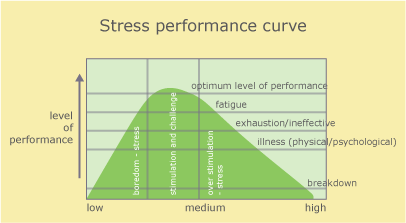
- As pressure increases you become more alert, invigorated and ready for action. When pressure increases tension, increases and if the pressure is maintained consistently high we begin to struggle to cope.
Figure 1. demonstrates how increases in pressure effect our performance, and how when the pressure becomes too much it compromises not only our performance but can also affect our health.
Fig. 1.
So there is a healthy dimension to pressure and stress. It stretches and challenges individuals and can be exciting and fun. Equally it can be a negative force, reducing competence, lowering confidence and making us less effective.
Sources of stress
Stress is not an affliction, it is not even a modern day phenomena, but today’s causes and characteristics certainly are. Holmes and Rahe (1969) [(4)]identified that certain events which are part of everyday life have the potential to raise stress levels and have a cumulative affect particularly when they occur over a short period of time. A selection of the key personal life events of particular relevance are highlighted below, along with aspects of work life that can have a similar affect. The list is by no means complete, you will probably think of many more.
Personal
- Death of loved one
- Divorce/separation
- Personal injury or illness
- Marriage
- Moving house
- Going on holiday
- Birth of a child
Work
- Threat of redundancy
- Work relationships
- Too much or too little work
- Aggressive management
- Work deadlines
- Promotion
- Long working hours
Each of us is vulnerable to pressure and stress in different ways, depending on our perceptions of what happens to us, and the level of control we believe we exercise over such events. This makes the identification of the causes of stress very personal and arbitrary. For example, redundancy can have profound psychological and physical effects on one individual and be seen as a wonderful opportunity by another. Why the difference? We come back to cognitive processes; the way we think and perceive the world. There is a Chinese proverb that says about two thirds of what we see is behind the eyes. In other words our perception and interpretation of situations and events affect how we respond to them. How and why we perceive events in certain ways is complex and due to many things; personality, past experience, internal beliefs, self esteem, confidence, assertiveness.
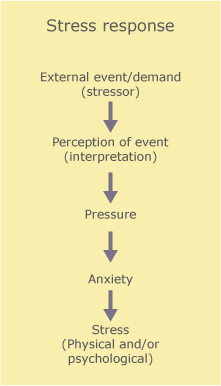
Our view of the world is a mixture of all these things and colours our perceptions of what happens to us. If our personality is generally confident we believe in our capabilities, then we are more likely to perceive adverse events as temporary, manageable and within our control. The problem is viewed as a challenge from a positive perspective. Individuals with low confidence and self esteem, and low perceptions of control may view the same situation in a completely different way, feeling powerless and controlled by events, seeing only the negative aspects. If pressurised to cope, anxiety may build up, leading to feelings of stress. What we are discovering here is the ability and the importance of our thought processes to assimilate and comprehend events. This chain of events is depicted in figure 2.
Figure 2.
Responses to stress
We can see how important our perceptions are in triggering a stress response. Perceptions of stress occur at an emotional level, and we respond in three ways: physical, psychological and behavioural. Let’s explore these further because strategies for stress management are founded on tackling these three response areas.
Physiological response
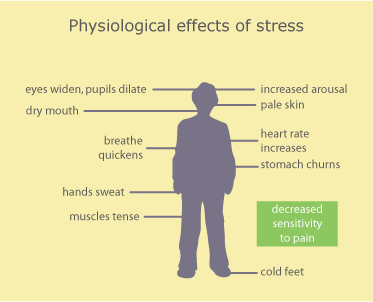
Stress is essentially a biochemical and physiological response. Physiological responses to threats or feelings of danger have changed little since the human race first roamed the earth. Originally our ancestors fought to survive in order to meet very basic human needs which today we take for granted, such as the need for warmth, food and shelter. Dangers were inherent in the environment and along with an instinct for survival, humans were equipped with physiological responses which enabled them to confront the physical dangers. This response is known as the fear, fright and flight response.When we perceive danger, the brain prepares the body for action by sending specific hormones or chemical messengers to various parts of the body. For instance, think about a near miss in your car you may have had. How did you feel physically? Did your muscles tense, heart rate increase, skin go cold? We all know the feeling of that rush of adrenaline. Figure 3 demonstrates how the body physiologically prepares itself to fight the perceived danger.
Figure 3.
Symptom – why?
- Pupils dilate – To improve vision and focus.
- Heart rate increases – To pump blood, glucose and oxygen to vital areas, eg muscles, lungs.
- Breathing increases – To increase oxygen supply to bloodstream to enable clearer thinking, improved mobility, increased strength.
- Dry mouth, pale skin – Blood diverted to muscles and vital organs.
- Muscles tense – In readiness for action.
When the event has passed the body returns to its normal relaxed state in order to recuperate.
Although today we no longer have to fight hairy mammoths, the fear, fight and flight response remains to protect us in dangerous situations. Unfortunately today it is also triggered by events that have nothing to do with physical safety and basic survival.
Psychological threats provoke the same physical response. A job interview, pressure at work or public speaking can all become stress triggers. As we acknowledged earlier this is not necessarily a bad thing as we can see how the above physical reactions enhance our ability to perform. Problems arise when the stressful period is perpetuated and the stress hormones remain circulating in the blood stream, maintaining the body in a high state of arousal.
Major events in our life such as divorce, the threat of redundancy or working to constant deadlines are pressures that can maintain a constant excessive level of stress. It is not appropriate to fight or run away from such stressful situations. Consequently the body remains wound up unable to release energy, increasing not only psychological pressure but also causing wear and tear on key organs of the body. For example prolonged stress on vital organs such as the heart and digestive system can lead to physical problems, weakening the body’s defence mechanisms against disease. Medical research indicates that stress is strongly related to coronary heart disease, ulcers, stroke, skin conditions, even cancer.
Psychological and behavioural responses
Man is not disturbed by events, but by the view he takes of them
Epictetus
Thanks to the wonders of human nature, no two individuals react to circumstances in exactly the same way. How we respond psychologically to pressure depends on a number of variables and how we may be feeling at the time. Being asked to take on extra work while someone is away on holiday may not be a problem if we have few other work pressures. On the other hand it could lead to feelings of tremendous pressure if we already have pressures from other sources, be they work or family related. Psychologically we feel burdened. Consequently we may:
- retreat into ourselves, feeling inadequate, depressed or even angry.
- be unable to concentrate or decide on priorities.
- exert pressure on ourselves, ‘I must be able to do this’, ‘I should be able to cope’, ‘I ought to try and please’.
- evoke changes in behaviour such as increased smoking among smokers, difficulties in sleeping or decreases in activity.
Responses to pressure are learned at an early age. They reflect reward systems, previous experience and our belief in ourselves. We all know that little voice inside our head which appears every now and then to describe and interpret the world. If it perceives the world around you in an accurate and rational way then its working well. If on the other hand it perceives situations in an irrational and negative way it’s becomes destructive, leading to feelings of self doubt and low self esteem. Many of these stressful situations are part of everyday life and generally we have no problems in coping. It is only when they become compounded by other events in our personal or work life, that the increased demands on our personal reserves diminishes our coping ability.
How can you tell if you are stressed
Being aware that you are stressed is not as obvious as it may sound. The signs of stress do not suddenly appear. They manifest themselves slowly over time and increase in intensity. Feelings of stress can become habitual. Perceptions, attitudes and beliefs sustain the pressure, which become a way of life. Prolonged stress reduces our ability to handle what previously might have been regarded as manageable. Symptoms of stress will vary but you may recognise some of the following symptoms :
- Physical
Headaches, constantly tired, neck ache, digestive problems, heartburn, tense muscles, allergies, skin problems, palpitations, blurred vision, loss of appetite.
- Psychological
Feeling anxious, worried, irritated, angry, frustrated, depressed, moody, helpless, tearful, unable to concentrate or make decisions, fear of the future.
- Behavioural
Excessive smoking, increased alcohol intake, aggressive behaviour, loss of interest in work and previous enjoyable activities, absenteeism from work.
These symptoms may be experienced as part of normal everyday life, but become a concern when they have no obvious cause or when they become prolonged over time.
Measuring your stress vulnerability
Try this simple test to discover your vulnerability to stress. Mark yourself on the scale for each of the 20 statements.
1 Once I’ve started something, I must finish it 7 6 5 4 3 2 1 I don’t mind leaving something temporarily unfinished 2 I often interrupt in the middle of a conversation 7 6 5 4 3 2 1 I am a good listener, I let people finish speaking 3 I’m always on the go 7 6 5 4 3 2 1 I consider that I am fairly easy going 4 I feel I am usually the responsible one 7 6 5 4 3 2 1 I feel limited responsibility 5 I don’t mind taking work home or working weekends 7 6 5 4 3 2 1 I don’t feel you should take work too seriously 6 I’m never late for appointments 7 6 5 4 3 2 1 I don’t get worked up over appointments 7 I frequently set deadlines 7 6 5 4 3 2 1 I don’t bother about setting deadlines 8 I pay attention to detail 7 6 5 4 3 2 1 I don’t worry over small details 9 I’m highly competitive 7 6 5 4 3 2 1 I’m not at all competitive 10 I’m a very animated speaker 7 6 5 4 3 2 1 I’m calm and deliberate in speech 11 I’m always in a hurry 7 6 5 4 3 2 1 I never rush things, even when pressurised 12 I like exact information, eg how much, at what time 7 6 5 4 3 2 1 I don’t worry about the precise figures 13 I hate having to wait 7 6 5 4 3 2 1 I don’t mind having to wait 14 I want swift promotion 7 6 5 4 3 2 1 I’m very satisfied in my work 15 I’m always juggling more than one thing at a time 7 6 5 4 3 2 1 I take things one at a time 16 Work is my main interest 7 6 5 4 3 2 1 I enjoy many interests 17 I need recognition for what I do 7 6 5 4 3 2 1 I’m not interested in what others think 18 I generally eat, drink walk quickly 7 6 5 4 3 2 1 I take my time doing things 19 I don’t discuss feelings 7 6 5 4 3 2 1 I can express my feelings well 20 I push hard 7 6 5 4 3 2 1 I’m easy going Add up your score. How did you do?
Your score:
- Score 80 – 140
You certainly have high expectations of yourself and set your sights high, consequently you put a lot of pressure on yourself. Consider those questions where you scored high. What can you do to reduce your score? For instance if work is your main interest, consider those things that you would like to do if only you had more time. What could you do to change the pattern of your work to allow you more leisure time?
- Score 60 – 79
Certain aspects of your lifestyle may need exploring. Look at those questions where you scored highly. What aspects of your life do they cover? Are they aspects of your life you would like to change? What strategies could you employ to reduce your score?
- Score 20 – 59
You have a very relaxed approach to life and not a lot upsets you. Life is not too demanding and you feel able to cope with most things. Nonetheless, are there any scores which you would like to change that you are not happy with?
Stress management
Mechanisms for handling stress will be different for each individual. Knowing what causes you stress and the way you respond to it, will enable you to choose appropriate strategies. Usually it requires a mixture of approaches:
- Prevention – avoiding stress.
- Managing stress – altering responses to stress.
- Coping with stress – palliative.
Avoiding stress is one way of dealing with the problem but it is not always possible, realistic or indeed very positive. Managing stress is a more proactive approach, implying control, responsibility and acceptance over pressure and stress in our lives while employing effective strategies to control it. Coping with stress is a palliative approach that aims to rehabilitate and restore previous functioning, usually incorporating stress management techniques.
Psychological and behavioural approaches to stress management
Recognising stress in oneself can be surprisingly difficult. Stress can be so insidious and feel so normal, that it does not become apparent until a major problem arises.
The first steps in managing stress start when this recognition dawns, for then you can begin to do something about it. Whatever you feel about your circumstances, whatever your problems, whether at home or at work, the good news is you cando something about it. Themost important thing to remember is you have a choice.You have a choice over how you respond to pressures and stress. You have a choice over how you handle time pressures at work, how you respond to redundancy, marital separation, demanding management. The fact is you really are in control. No one is saying it is easy, but just accepting responsibility for our own feelings immediately puts us in control.
Short term panaceas for stress are numerous, eg an evening at home, relaxation techniques, having a massage or indeed a good night’s sleep, but they do not confront the causes. Be wary of insidious panaceas for stress such as alcohol, drugs, comfort eating, excessive smoking. They do not deal with the causes of stress, are potentially harmful and their effects are short lived.
Dealing with the causes of stress in a positive way requires us to challenge the situation in which we find ourselves, review perceptions of who we, consider our personal rights and our ability to control events around us. This needs some shifts in thinking from being a victim of stress to taking control. We have to take the initiative, control stress rather than being controlled by it. It may feel strange, frightening even, and will not happen over night, but you will build upon small successes. Challenging your outlook will be less frightening than living with the feelings of stress than can be so debilitating. It requires moving outside our comfort zone(Figure 4).
Figure 4. Challenging our comfort zone
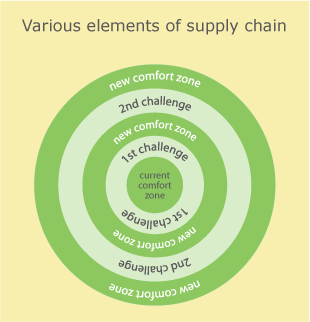
Our comfort zone is the area in which we operate where we feel comfortable, outside of which we begin to feel uneasy or anxious. For instance, you may feel happy about doing a presentation to colleagues at work, but extremely uncomfortable about giving the same presentation to two hundred people at a conference. Equally, learning to be assertive, to say no to demands made upon us can be very uncomfortable when we like to please, but you can do it when you know how. The more you do it the less uncomfortable you will feel.
Ships in harbour are safe – but that’s not what ships are made for’. John Shedd [(5)]
Psychological and behavioural approaches attempt to put events into perspective. Each individual needs to find a balance between finding the appropriate challenges that will allow personal development and control over our responses, while also recognising unrealistic expectations. Do not try to change things you cannot change, over which you have no control. Go with change, accommodate it rather than fight against it. Fighting what is outside our control can be demoralising and exhausting. Look for the opportunities change presents, there are always opportunities but they are not always obvious because we do not choose to look for them.
Assertiveness
A sense of self worth and being master of our own destiny are positive attitudes integral to managing stress. Lack of assertiveness or effective communication skills is a major contributor to stressful situations. Being assertive allows you to express your feelings, attitudes and opinions clearly and firmly without hurting others. You have certain rights. When you give way to pressure or the demands of others you are allowing your rights to be compromised.
Your assertive rights
- I have the right to say no.
- I have the right to make decisions that suit me without justifying them to others.
- I have the right to say state my needs and express my point of view.
- I have the right to be myself, decide my own actions and deal with the consequences.
- I have the right to get it wrong occasionally.
- I have the right to change my mind.
- I have the right to not be expected to know everything.
- I have the right to my own time.
- I have the right not to do things I am uncomfortable with.
- I have the right to be happy.
If this is an area of particular concern to you, have a look at the learning guide on assertiveness.
Self talk
It is amazing how hard we can be on ourselves. We highlighted earlier the little voice inside our head interpreting events and situations. Controlling this voice and making it work for us is an important part of managing our perceptions of stressful events. Our internal chatterbox is amazingly resilient. For instance look at how our self talk can effect perceptions of events.
Changing perceptions
Example of a situation:
You did not get the promotion you hoped
Perception:
I’m useless, not good and they know it.
Alternative perception:
I did my best. I’ll ask for feedback and learn from the situation.
I’m not a failure if I don’t make it – I’m a success because I tried
Think about your internal chatterbox and how it interprets events for you. Does it help or hinder you? If it is positive and reinforcing, great. If not, be aware of your self talk and your thought processes so that you can intervene appropriately when your thoughts interfere in a negative way, with an alternative positive form of self talk. Use positive affirmations – ‘I can…’ ‘I will…’ when you find yourself thinking negatively. The more you use positive affirmations the more automatic they become. Have a go at the exercise on automatic thoughts in the activities section.
Time management
Whatever you read about stress management, it will invariably consider aspects of time management. Time, that precious increasingly elusive commodity that gets less and less. Time management is about planning and using your time in the most effective and efficient way. It is about controlling and scheduling activities so that you are always in control. If time management is a problem for you, try this short exercise.
Look at your diary for the next two weeks and identify the demands on your time :
- What pressures on your time are generated by colleagues, your boss, employees?
- Are there more effective ways of getting things done?
- What problems are generated by you own lack of planning, delegation assertiveness?
- Are you trying to do everything yourself?
- What could be delegated?
- Are you prepared for the unexpected?
- Are time frames realistic?
For more in depth information there is another learning guide specifically on time management.
Physiological approaches to stress management
This approach focuses on raising awareness and reducing the physiological response to stress. There is a variety of techniques available that can be used in a number of different circumstances. Many will need to be practised and used regularly to be effective, others you can use as the situation demands. Psychological and physiological responses to stress are linked, in that psychological perceptions of stress will ultimately affect a physical response, as we saw in the fear, fright and flight response.Methods for reducing physical tension aim to influence this mind-body connection.
Stress management activities which can be learnt include meditation, relaxation techniques, yoga, visualisation, biofeedback, to name but a few. Procedures such as massage, reflexology, aromatherapy can all help to complement stress management strategies. They have many elements in common – finding what best suits you is a matter of trial and error and personal choice.
- Muscle relaxation techniques are used to physically relax major muscle groups, by systematically relaxing parts of the body. Quick relaxation techniques are available along with more lengthy progressive relaxation techniques. To try some of these techniques, try development activities 4 and 5.
- Visualisation uses images to visualise events in a positive way, or as part of a relaxation procedure. Look at development activity 3 and try out the visualisation technique.
- Biofeedback involves using a biofeedback machine, an instrument which provides feedback to individuals on the level of muscle tension within the body. This allows for greater awareness of physical tension, enabling an appropriate relaxation response.
- Meditation as part of a daily routine has been shown to have major physical and psychological benefits. It helps to refocus the mind, relax the body and enhances creativity. Transcendental meditation is the most popular form and is easily learnt.
Lifestyle
Lifestyle activities are equally important, and include physical exercise, a healthy diet, social activities, engaging in enjoyable hobbies and pastimes, to name a few. The learning guide on lifestyle planning gives more information in this area, but below are some general points.
Exercise and diet
There is an abundance of evidence promoting the benefits of exercise on psychological health, including increases in academic performance, assertiveness, confidence, well being and work performance [(6)]. Other benefits include decreased absenteeism from work, alcohol abuse, anxiety and depression. Exercise has both physical and psychological benefits, releasing tension and raising feelings of well being. Athletes have consistently been found to possess more desirable mental health profiles than non-athletes, rating lower than average on fatigue and depression [(7)]. Chemicals in the brain (beta-endorphins) have been implicated in feelings of well being and positive mood state. Literature also exists that establishes the link between physical activity and self esteem [(8)]. The evidence on type and amount of exercise required to promote these benefits is not clear, although low intensity exercise such as brisk walking can be beneficial in people unused to exercise. The benefits of regular exercise are overwhelming. The message seems to be, if it is regular, involves an increase in aerobic activity and is enjoyable then it will have benefits. The importance of diet in relation to stress is less conclusive, nonetheless, the effects of poor diet in relation to energy levels, the immune system and the obvious effects of obesity on health are well documented.
Hobbies and social activities
Think about how often you spend time doing things that you find enjoyable and interest you. Make time to recharge your batteries. These can be anything from listening to music, walking, gardening or simply just being. If you have a demanding work life then you will need to consider what time you have available, but do not say ‘you don’t have time’! Time out is important, even if it is only for a short period. Plan and schedule activities so that they do not become a burden or a pressure in themselves.
To summarise
- Avoid being a victim to stress – take action.
- Learn to recognise the symptoms of stress.
- Identify the sources of stress, what can be changed and what cannot be changed.
- Recognise your strengths and weaknesses but keep a positive outlook, see the challenge.
- Manage tasks, time, pace yourself, delegate
- Learn to say ‘no’.
- Look after your health, exercise regularly.
- Be realistic about what you want to achieve.
- Practise relaxation techniques, meditation, look for the silver lining.
- Do not bottle it up or blame others; identify strategies that work for you.
- Be aware of negative thought processes, replace with positive feelings of self worth, ‘I can…’ ‘I have the right to…’.
- Keep a sense of humour.
- Build support networks.
Organisational stress
It has now become recognised that stress is an occupational health problem. Occupational stress can have a major impact on the individual and on the organisation. Increasingly it is responsible for absenteeism from work, increased staff turnover, opportunity costs, disability, reduced productivity and increased health care costs. Continuous change, downsizing, delayering, redundancy, closures, reorganisations all have effects on both employees and managers. It is estimated that 50% of working days are lost due to stress related illness [(9)].
Sources of stress at work can be many.
- Too much work/too little work.
- Time pressures, deadlines.
- Fear of redundancy.
- Low control over work, lack of role clarity.
- New technology.
- Management style.
- Conflicting demands.
- Long hours.
- Over/under promotion.
- Lack of resources, support.
Stress is commonly perceived as the privilege of managers, coming with job promotion and increased responsibility. In fact this is simply not the case. Managers do of course have their own stressors, targets, deadlines, but stress is no respector of rank. It can effect all individuals within an organisation. Employer responsibility for managing work pressure in employees was highlighted recently in a case where a council worker successfully sued his employer, Northumberland County Council [(10)]. Work related stress was directly implicated in causing the employee two nervous breakdowns.
When organisations face constant change in order to respond to market pressures, they now have an extra responsibility towards those who work for them, ensuring that when an organisation undertakes major change it is managed and communicated in an open and honest way. Staff need to be informed and consulted in order to avoid frustration and insecurity. In openly communicating change, there is an opportunity to promote the positive aspects of the change and the business reasons behind the need for the change.
What can the organisation do to help? The Health Education Authority [(11)] recommend 10 areas for action :
- Overhaul company culture.
- Review management styles and practices.
- Encourage participation and control in all areas of work.
- Assess co-ordination and communication systems.
- Encourage the development of good personal, professional and industrial relations.
- Value and give recognition to employees.
- Make adequate preparation for planned change.
- Clarify job roles.
- Redesign jobs where appropriate.
- Improve the physical environment.
Further to this, the organisations should consider:
- how staff are developed, supported and appraised, eg stress management training, time management, assertiveness, conflict management training, teambuilding and other relevant development programmes.
- what resources are available to employees to prevent or minimise the occurrence of stress at work, eg health promotion programme exploring aspects of health and lifestyle, counselling, occupational health.
References
- Lazarus, R.S. (1966), Psychological Stress and the Coping Process, McGraw-Hill.
- Arroba, Tanya; James, Kim (1992), Pressure At Work : A survival guide for managers, 2nd Ed. McGraw-Hill.
- Atkinson, J. M. (1988), Coping with Stress at Work, Thorsons.
- Holmes, T.H; Rahe R.H. (1967), The social readjustment rating******scale,Journal of Psychosomatic Research, Vol. 11(2), p213 – 218.
- Shedd, John (1987), in Feel the Fear and Do It Anyway, Susan Jeffers, Rider Publications, p78.
- Cramer S. R. et al. (1991),The effects of moderate exercise training on psychological well being and mood state in women, Journal of Psychosomatic Research, Vol. 35, p437-449.
- Weyerer S and Kupfer B. (1994), Physical exercise and psychological health, Sports Medicine, Vol. 17(2), p108-116.
- Hughes J.R. (1984), Psychological effects of habitual aerobic exercise: a critical review,Preventive Medicine, Vol. 13, p66-78.
- MIND (1992), The Mind Survey: Stress at work.
- Industrial Relations Law Reports 35 (1994), Walker v Northumberland County Council, QBD.
- The Health Education Authority(1988), Action on Stress at Work.
Activities
Development activities
PLEASE NOTE: Data entry within the developmental activities of this learning guide cannot be saved or stored to your PC. We recommend that you print this section and complete the activities as suggested.
- Life events
- Problem solving
- Using imagery to relax
- Halt a stress response
- Rapid relaxation
- Challenging automatic thoughts
The following development activities are exercises intended to help you identify stress, and provide an opportunity to practise various relaxation and cognitive techniques.
1. Life events
Fill in the table below thinking about you current situation. Using the following scale:
1 = Not currently affecting you 5 = Affecting you significantly
Event Scale Bought/sold house 1 2 3 4 5 End of long term relationship 1 2 3 4 5 Marriage 1 2 3 4 5 Marital problems 1 2 3 4 5 Divorce 1 2 3 4 5 Problems with family 1 2 3 4 5 Problems at work 1 2 3 4 5 Changed jobs 1 2 3 4 5 Taken on mortgage/bank loan 1 2 3 4 5 Illness in family member 1 2 3 4 5 Death of partner 1 2 3 4 5 Personal emotional or physical Illness 1 2 3 4 5 Personal illness requiring hospitalisation 1 2 3 4 5 Birth of new baby/grandchild 1 2 3 4 5 Problems with friends or neighbours 1 2 3 4 5 Threat of redundancy 1 2 3 4 5 Unemployed 1 2 3 4 5 Legal/insurance problems 1 2 3 4 5 Family members left home 1 2 3 4 5 Death of family member/friend 1 2 3 4 5 Financial problems 1 2 3 4 5 Retirement 1 2 3 4 5 Add up your scores and plot below:
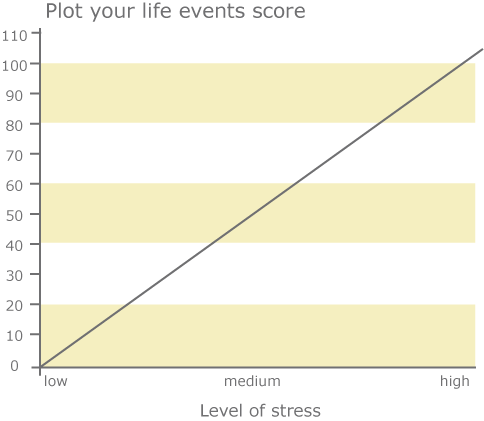
2. Problem solving
Do this exercise to assess how you can influence the causes of pressure in your life.
- Looking at the list of life events above, choose an area which is of particular relevance to you at the moment.
- Describe the problem.
Be specific in describing what the pressure is. For example, ‘Because I always get a job done, I find that I’m the one who is always drafted in to supervise projects, but I’m finding it harder to keep up’.
Can you influence the problem?
Consider what aspects of the problem are under your control, what can you change? List them below.
Totally within my control:
Partly within my control:
Outside my control:
- Looking at the areas within your control, what actions could you take to relieve the pressure?
- What sources of support do I need/are available to me?
3. Using imagery to relax
Recreating pleasant images or visualisation techniques can help you to relax. Try this out somewhere quiet where you will not be disturbed. When you become more used to doing it, you can use it in more distracting situations eg on the train. Think of an image that you find relaxing, that makes you feel good. It could be:
- sitting by a riverbank.
- a garden scene.
- a tropical beach.
- walking in the hills.
While you are visualising the scene, think about the senses. What can you see, hear, smell, touch, taste? Try this:
Find somewhere comfortable to sit or lie down. Imagine that you are sitting under a shaded palm tree on a warm sunny beach. Your eyes are closed and you feel warm and relaxed. You can feel a gentle breeze on your face and gradually you become aware of the sounds of the rhythmic lapping of the waves on the shore, matching your own breathing, effortless, slow and soothing. You feel warm and safe. You slowly open your eyes to look out on to the sea.
You become aware of a sailing boat on the distant horizon, slowly making its way over the sea. The sun is gradually sinking, and as it sets the sky takes on hues of orange and gold. As you sit there watching the sun go down, you feel more and more relaxed. More and more at peace, calm, content and happy. Your body is completely relaxed, warm and light. As the boat slowly disappears over the horizon, the sun sinks lower and lower. As it sinks in the sky you become more aware of the room you are in and where you are sitting. You feel content, happy and relaxed. You feel alert, alive and fully of energy, yet you are calm and relaxed. When you get up and move around, keep this feeling of relaxation with you.
Challenging situations
You can use this visualisation technique to help you cope with stressful or challenging situations. Identify a particular situation that has the potential to make you feel anxious and stressed. Imagine this situation going well. What would it look like?
Get in touch with the feelings and think about how good you feel that it has gone well.
4. Halt a stress response
- Smile.
- Relax your facial muscles, un-crease your forehead.
- Relax your jaw, let your lips part.
- Drop your shoulders and let your arms go loose and heavy.
- Focus on your breathing, which is becoming slower and deeper.
5. Rapid relaxation
Carry this out 6 – 8 times per day if possible. It should take about 30 seconds to complete with practice. Sit in a comfortable chair and tense all your muscle groups at the same time. You can do this by :
- Clenching your teeth, squeezing your eyes shut and pressing your lips firmly together.
- Clench your fists shut hard.
- Hunch your shoulders.
- Straightening your legs, and bring your toes up toward your head.
- Maintain this position for 5 – 10 seconds.
- Then let everything release. Collapse like a rag doll and feel the tension leaving your body. Take a few slow deep breaths and relax.
6. Challenging automatic thoughts
Think about a situation or an event which your internal chatterbox perceived in a negative way. Complete the following exercise.
Describe the situation.
Now New approach What did you say to yourself? Constructive self talk What did you feel? What would you feel now? Would this influence you in similar future situations? How would this make you react? -
5 Life Lessons From The Life-Changing Magic of Not Giving a F*ck
How much of my life do I spend people-pleasing? Turns out, a lot. I realized this upon reading Sarah Knight’s The Life-Changing Magic of Not Giving a F*ck, a new parody of Marie Kondo’s best seller, The Life-Changing Magic of Tidying Up. I go places I don’t want to go and do things I don’t want to do in order to please others, even if it’s to my emotional or financial detriment. Like many women in particular, I apologize when I haven’t done anything wrong and sprinkle “just” into my emails so they don’t come off too strongly worded. Knight’s bottom-line advice for me is explicit: Stop giving a f*ck.
This is self-help with an edge. As the subtitle says, The Life-Changing Magic of Not Giving a F*ck is a primer on “how to stop spending time you don’t have with people you don’t like doing things you don’t want to do.” Though it is a parody, it’s less a takedown of Kondo’s tactical tidying methods and more inspired-by: Shortly after quitting her successful corporate job as a book editor, Knight KonMari’ed (a process of throwing out things that don’t “spark joy” and/or you never use) both her and her husband’s sock drawers and felt a surge of inner peace. Between the socks and the job-quitting, she was inspired to write the truth of her own mental decluttering.
“Even though I’ve always been this type A overachiever, ambitious person, it’s okay to say, ‘I don’t give a f*ck about getting up at 6:30 in the morning and taking the subway to Rockefeller Center to sit at a desk job surrounded by people that I don’t consider my friends, and solve other people’s problems all day instead of solving my own,’ ” Knight told me.
Soon, she began applying the same philosophy to baby shower invites, Thanksgiving with her in-laws, and Kickstarter requests from virtual strangers. But how do you stop people-pleasing and not become a jerk? Here’s what I learned.
Embrace the NotSorry Method.
Knight’s answer to Kondo’s KonMari Method is the NotSorry Method. When assessing if you truly care (translation: give an F) about something, ask yourself: Does it annoy? If the answer is yes, you are to stop giving an F about it “posthaste.” In my case, attempting to make dinner between work and spending time with my toddler had a tendency to annoy, but I felt making dinner was something I or my husband should be doing in the interest of being healthy and not squandering our paychecks on takeout. I recently stopped giving an F about this perceived obligation by picking up healthy and economical Sweetgreen salads for dinner nightly. Until I get sick of the Rad Thai (which is so delicious, I may never), problem solved!Giving fewer f*cks has great benefits.
Embrace the power of “no.”When Knight, for example, stopped giving a f*ck about the little things that annoyed her—RSVP’ing no to baby showers, unfriending annoying people on Facebook, putting on makeup simply to go grocery shopping—she gained more time and money to do what she really enjoyed—e.g., tropical vacations, reading Us Weekly. When you stop doing so many things that annoy and do not bring you joy, “your spirit will be lighter, your calendar will be clearer, and your time and energy will be spent on only the things and people you enjoy,” she says. No longer stressing about what to buy and make for dinner, for example, has afforded me the time and pleasure of coloring with my daughter and playing catch with her Elf on a Shelf. All upside.Draft a F*ck Budget.
I know what you’re probably thinking, because I was thinking it, too, while reading this book: How do you stop doing things you don’t want to do—e.g., attending a kinda-friend’s baby shower—when you’re worried it will hurt someone else’s feelings? Knight’s answer is a F*ck Budget. Nail down the limited group of friends, family members, and coworkers (and which of their showers, homemade jam sales, and Kickstarters) you value the most and whom you will support enthusiastically. They get your f*cks. But those who are not on the list are not guaranteed your time, effort, or funds. This tenet empowered me to RSVP no to a peripheral member of my friend group’s play opening. Most of the group is going, but I’ve decided it simply doesn’t fit into my F*ck Budget.Be honest and polite, but not too honest nor too polite.
Knight uses the example of RSVP’ing “no” to an expensive, vacation day–sucking holiday weekend wedding (with the assumption being that the bride and groom are not VIPs who fit into your F*ck Budget). The honest and polite route, she says, would be to send a gift and a kind decline: “I’m honored to be invited but unfortunately can’t make it.” The too-honest route, however, would be divulging, “We usually go to Miami with friends over Labor Day. Maybe we could bring them to your wedding instead? LMK!” It’s like my mother always said about calling in sick to work: Don’t provide too much detail; don’t suggest you have anything to apologize for. I plan to apply this immediately to my succinct “So sorry I can’t be there but break a leg!” decline to Peripheral Friend’s play.#ZeroF*cks or #NoF*cksGiven is a lie.
These hashtags pervade on Twitter, but even Knight concedes that only sociopaths or flat-out “assholes,” as she says, give “no” or “zero” Fs about work, family, friends, and social obligations. The key is prioritizing the Fs you have to give—and giving them to those who matter most. This includes—lest anyone forget—yourself. “Not giving a f*ck means taking care of yourself first, like affixing your own oxygen mask before helping others,” Knight writes. If that sounds selfish, well . . . I doubt she gives an F. -
How to be good at stress
What does it mean to be “good” at stress? Does it mean you don’t get stressed out? That you stay calm under pressure and bounce back from adversity?
Actually, no. The truth of stress as I’ve researched it shows two important things. Firstly, that trying to avoid it is fundamentally counterproductive. Secondly, that thinking that we can emerge from stressful circumstances unscathed and unchanged is precisely the wrong way of thinking about things.
Instead, we need to start thinking about how to have the courage to grow from stress. This view of resilience was first described by the psychologist Salvatore Maddi, who founded the Hardiness Research Lab at the University of California Irvine. He dedicated his career to identifying what distinguishes people who thrive under stress from those who are defeated by it. The ones who thrive, he concluded, are those who view stress as inevitable, and rather than try to avoid it, they look for ways to engage with it, adapt to it, and learn from it.
The idea that we grow through adversity is not new. It’s present in the teachings of every major religion and many philosophies. It’s even become a cliché to say, “Whatever doesn’t kill you makes you stronger.” But what is new is how psychology and neuroscience have begun to examine this truism. Research is beginning to reveal not only why stress helps us learn and grow, but also what makes some people more likely to experience these benefits.
One of the more recent insights from this science is that the ability to learn from stress is built into the basic biology of the stress response. Of course, you know that the stress response gives you energy by flooding your body with adrenaline. But the stress response doesn’t end when your heart stops pounding. Other stress hormones are released to help you recover from the challenge.
These stress-recovery hormones include DHEA and nerve growth factor, both of which increase neuroplasticity. In other words, they help your brain learn from experience. DHEA is classified as a neurosteroid; in the same way that steroids help your body grow stronger from physical exercise, DHEA helps your brain grow stronger from psychological challenges. For several hours after you have a strong stress response, the brain is rewiring itself to remember and learn from the experience. Stress leaves an imprint on your brain that prepares you to handle similar stress the next time you encounter it.
Psychologists call the process of learning and growing from a difficult experience stress inoculation. Going through the experience gives your brain and body a kind of stress vaccine. This is why putting people through practice stress is a key training technique for NASA astronauts, Navy SEALS, emergency responders and elite athletes, and others who have to thrive under high levels of stress. But stress inoculation doesn’t just transfer to similar stress situations; getting good at one kind of stress often helps in unfamiliar challenges. For example, when people were asked how they are coping with the biggest source of stress in their lives, eighty-two per cent said they were drawing on strengths and confidence developed from past stressful experiences.
Yet not every stressful situation creates the kind of learning that helps us thrive under future stress. As I’ve discovered with almost anything that seems to be “true” about stress, the opposite can also be true. (This is part of what makes the science of stress so fascinating, and also so puzzling.) Stress can also be paralyzing, draining and traumatizing. Sometimes what we learn from stress is fear, not courage, or self-doubt instead of self-confidence.
It would be easy to assume the outcome is determined by the nature of the stressful circumstance—say, that we learn best from manageable stress, while severe stress is more likely to be debilitating. But that assumption doesn’t always hold up; people also commonly report growing from chronic, uncontrollable and even traumatic stress.
One thing that does seem to predict whether a stressful experience is strengthening is the biology of your stress response. In particular, the ratio of hormones you release plays a role in determining whether a stressful experience leads to positive or negative outcomes. Higher levels of cortisol have been associated with worse outcomes, such as impaired immune function and depression. In contrast, higher levels of DHEA—the neurosteroid—have been linked to reduced risk of anxiety, depression, heart disease, neurodegeneration and other diseases we typically think of as stress-related.
The ratio of DHEA to cortisol that you release during stress is sometimes referred to as the growth index of your stress response. A higher growth index — meaning more DHEA relative to cortisol — is associated with thriving during and after stressful experiences. It helps college students persist in the face of academic stress and land higher GPAs; it’s associated with better performance, greater learning, and fewer post-traumatic stress symptoms during military survival training; and it’s even been shown to predict recovery from extreme trauma, such as childhood abuse.
An important question, then, is: How do you influence your own — or somebody else’s — growth index?
One strategy is to choose a more positive mindset toward stress. Make a conscious choice when you’re stressed to view stress as helpful, and the experience as an opportunity to learn and grow. This mindset can actually shift your stress physiology toward a state that makes such a positive outcome more likely, for example by increasing your growth index and reducing harmful side effects of stress such as inflammation.
I learned this firsthand when I participated in a mock study at Columbia Business School to better understand the findings of stress mindset researcher Alia Crum(who is now a professor at Stanford University). In the actual study, Crum put people through a stressful mock job interview that included strongly negative feedback, which the participants were expected to act on immediately. (And yes, even the mock study was stressful—even though I knew it was a scripted experiment and not a real evaluation!)
Before the job interview, every participant was randomly assigned to view one of two videos about stress. The three-minute video I watched opened with the message, “Most people think that stress is negative … but actually research shows that stress is enhancing.” The video went on to describe how stress can improve performance, enhance well-being, and help you grow. The other video, which half of the participants in the study watched, opened with the ominous announcement, “Most people know that stress is negative … but research shows that stress is even more debilitating than you expect.” The video went on to describe how stress can harm your health, happiness and performance at work. Crum found that people who were asked to view stress as enhancing released more DHEA during the interview, resulting in a higher growth index.
Other studies confirm that viewing a stressful situation as an opportunity to improve your skills, knowledge or strengths makes it more likely that you will experience stress inoculation or stress-related growth. Once you appreciate that going through stress makes you better at it, it gets easier to face each new challenge. And the expectation of growth sends a signal to your brain and body: get ready to learn something, because you can handle this.
People who are good at stress allow themselves to be changed by the experience of stress. Embracing our natural capacity for growth can help us change in positive ways, even in circumstances we would never choose.