The Silent Generation, baby boomers, Generation X, millennials, Gen Z — we’re all in the workforce together. How are our assumptions about each other holding us back from working and communicating better? Social psychologist Leah Georges shows how we’re more similar than different and offers helpful tactics for navigating the multigenerational workplace.
Category: Development
-
F*ck being humble!
Sword-Williams created F*ck Being Humble as an online mentoring platform to empower individuals to be proud of their achievements. The idea arose from attending industry events and realizing a lack of celebration of young emerging talent. Sword-Williams has since been commissioned to host workshops at Google, Unilever, Bumble and SmartWorks.
-
The best career path isn’t always a straight line
Conventional wisdom frames the ideal career path as a linear one — a ladder to be climbed with a single-minded focus to get to the top. Career development consultants Sarah Ellis and Helen Tupper invite you to replace this outdated and limiting model with “squiggly” careers: dynamic, open-ended growth paths tailor-made for your individual needs, talents and ambitions. A radical rethink for anyone who feels restricted and defined by the limits of the corporate ladder.
-
The power of believing that you can improve
Carol Dweck researches “growth mindset” — the idea that we can grow our brain’s capacity to learn and to solve problems. In this talk, she describes two ways to think about a problem that’s slightly too hard for you to solve. Are you not smart enough to solve it … or have you just not solved it yet? A great introduction to this influential field.
-
How to recognize privilege – and uplift those without it
Depending on your lot in life, you may see the status quo as a result of unearned privilege or a simple reflection of merit. Backed by statistics and personal stories, lawyer Mariam Veiszadeh offers a much-needed perspective check on the quasi-equality touted in business today, calling for real change in workplace diversity and inclusion that routs out biases rather than replicating them.
-
How diversity makes teams more innovative
Are diverse companies really more innovative? Rocío Lorenzo and her team surveyed 171 companies to find out — and the answer was a clear yes. In a talk that will help you build a better, more robust company, Lorenzo dives into the data and explains how your company can start producing fresher, more creative ideas by treating diversity as a competitive advantage.
-
Multi-Touch Attribution for a Cookie-less world
The truth is: As long as you have first-party data, you can use AI-based MTA to understand what parts of your marketing work and this will still apply post cookie-apocalypse. Standard heuristic methods — first click, last click, linear — apply set patterns to your data whereas AI methods learn patterns from your data.
In this blog we’ll crack open the bonnet of the three most popular MTA algorithms and take a deeper look at how they work in layman’s terms.
Markov Chains (Probability)
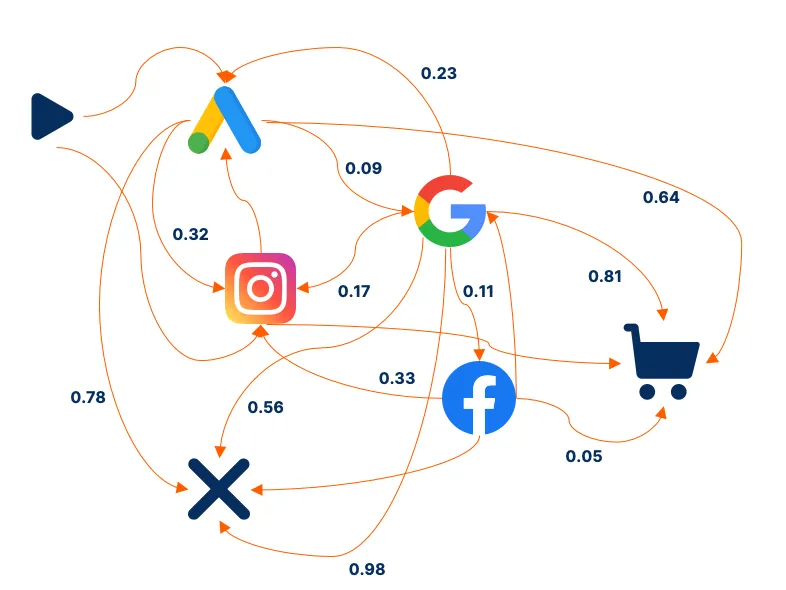
An example of how Markov chains work across multiple marketing channels Markov Chains assign credit to different marketing channels or touchpoints based on their influence in leading to a conversion, like a purchase or a sign-up. They’re a popular concept in weather forecasting, ranking algorithms, and predictive text.
To simplify, imagine a customer’s journey as a series of steps leading to a purchase. Each step is a touchpoint — an interaction with a marketing channel such as a Google ad, a social media post, or an email campaign. The Markov Chain model views this journey as a sequence of transitions from one state (or touchpoint) to another. The goal is to determine the probability of moving from each state to the next, ultimately leading to a conversion.
Here’s how it works:
1. Transition Probability Matrix: Using source data, a transition probability matrix is created. This matrix shows the likelihood of moving from one touchpoint to another.
2. Removal Effect: The model then calculates the ‘removal effect’ by temporarily removing a touchpoint and measuring the impact on conversion rates. This helps in understanding how important each touchpoint is. If removing a touchpoint significantly lowers the conversion probability, it’s considered highly influential.
3. Attribution: Finally, the model assigns an ‘attribution score’ to each touchpoint based on its removal effect. Touchpoints that greatly reduce the likelihood of conversion when removed are given higher scores, indicating their greater importance in the conversion process.
This approach offers a more nuanced view of the customer journey compared to more traditional models like first-touch or last-touch attribution accounting for complex and interconnected nature of modern marketing landscapes, where customers often interact with multiple channels before making a decision.
Shapely Values (Game Theory)
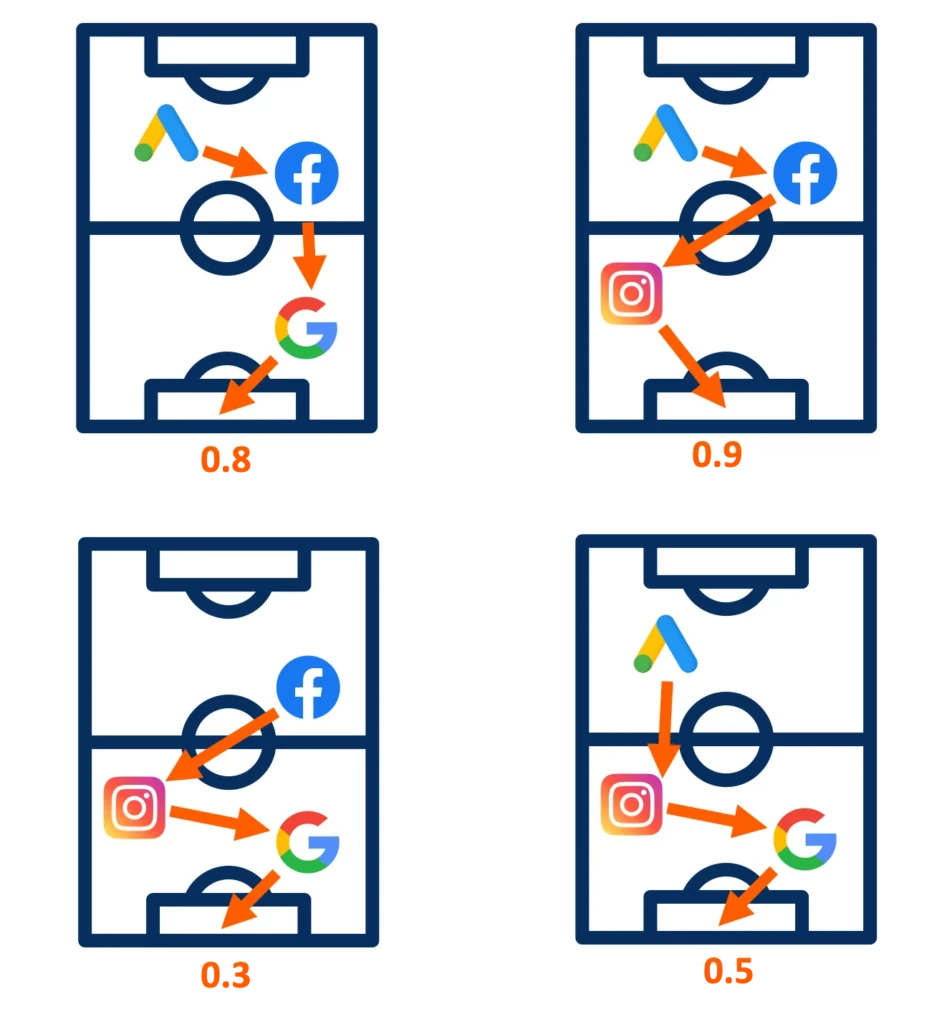
Game theory based SHAP values treat channels as players in a game in order to assign output fairly Shapley Values, originating from cooperative game theory, offer a unique approach to Multi-Touch Attribution (MTA) in marketing analytics. This method provides a fair distribution of credit to various marketing touchpoints in a customer’s journey, ensuring each channel’s contribution towards a conversion is accurately acknowledged.
In the context of MTA, each ‘player’ is a marketing channel, and the ‘payoff’ is the conversion (like a sale or a signup). The Shapley Value formula considers all possible combinations of channels and their respective contributions to conversions.
Let’s break down how Shapley Values are applied:
1. Data Collection: The process starts with collecting detailed data on customer interactions across all marketing channels throughout their journey, leading to conversions.
2. Calculating Contributions: For each conversion, the Shapley Value method calculates the marginal contribution of each channel. It does this by considering every possible order in which the channels could appear in a customer’s journey. For example, if the journey was Email -> Social Media -> Conversion, it would consider Social Media -> Email -> Conversion as well.
3. Fair Attribution: The key aspect of Shapley Values is fairness. It averages out the contributions across all permutations, ensuring that each channel gets credit proportional to its actual impact. This means channels that are consistently helpful will be valued higher, even if they don’t directly precede a conversion.
The Shapley Value approach in MTA acknowledges the intricate and interdependent nature of marketing channels. It avoids biases inherent in other models, providing a more balanced and accurate reflection of each channel’s value in driving conversions.
Additive Hazard (Survival Analysis)
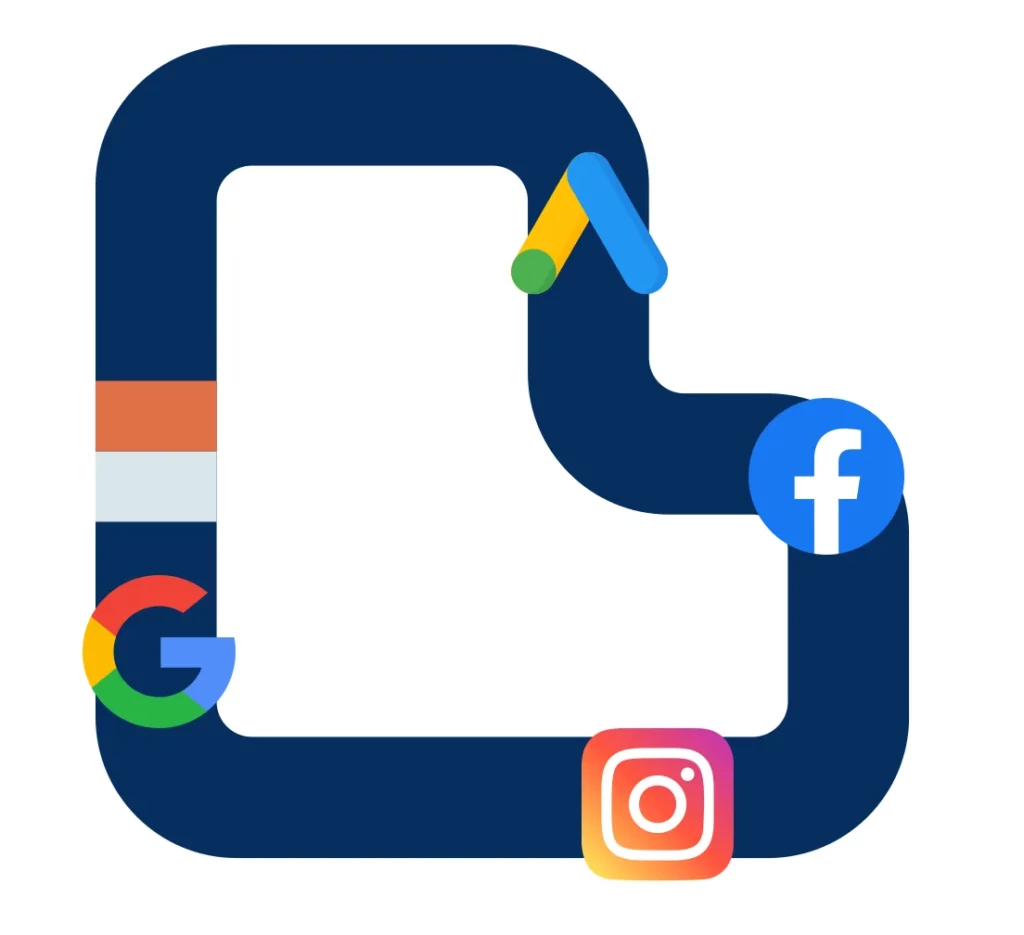
Vroom vroom! Survival analysis offers a unique approach to MTA through incorporating temporal data. Traditionally used in medical research, Additive Hazard, a concept from Survival Analysis, provides a distinctive angle for Multi-Touch Attribution (MTA). This approach focuses on understanding the probability of a conversion event (like a sale or signup) over time via analysing the expected duration until one or more events happen
In the context of MTA, the ‘event’ is a customer’s conversion, and the analysis aims to understand how different channels influence the timing of this conversion.
Let’s delve into how Additive Hazard is applied to MTA:
1. Data Collection and Preparation: Similar to other MTA methods, it begins with collecting comprehensive data on customer interactions across all channels over time. This includes time-stamped data on when each touchpoint occurred in relation to the conversion.
2. Additive Hazard Model: This model assesses the risk (hazard) of a conversion occurring at any given time point, considering the cumulative effect of all prior marketing touchpoints. It’s ‘additive’ because it assumes that each touchpoint adds (or subtracts) a certain amount to the hazard of converting at any given time.
3. Evaluating Touchpoints Over Time: Unlike models that give credit based on the position of a touchpoint in the journey (like first or last-click), the Additive Hazard model assesses how the timing and sequence of touchpoints contribute to the likelihood of conversion. It recognizes that some channels might be more influential at the early stages of the journey, while others might play a crucial role closer to the conversion event.
In summary, an Additive Hazard approach offers a time-sensitive perspective, providing insights into how the timing and sequence of marketing touchpoints impact the likelihood of a conversion.
-
Decision fatigue: what to do when endless choices are sapping your energy
Decision fatigue is incredibly common and surprisingly draining. Here’s why it happens and how you can reignite your energy and focus.
What should you eat for breakfast? What email should you answer first? Who should take the notes in your team meeting? What project will your team prioritize next? Which candidate are you going to hire? What route are you taking home?
Trivial or consequential, we make a lot of decisions – some sources estimate as many as 35,000 choices every single day.
That level of control can sometime feel freeing, but it can also be incredibly taxing. Constantly making selections (whether they’re big or small) can leave you feeling depleted, foggy, and even irritable. So much so that, by the time you need to figure out what’s for dinner, you feel like you can’t make one more gosh darn choice.
Sound familiar? There’s a name for that: decision fatigue.
What is decision fatigue?
Decision fatigue is exactly what it sounds like: you’re tired of making decisions. The premise is that the more decisions you make, the more drained you become, which means you might:
- Put off and procrastinate decisions (“I’ll figure that out later.”)
- Make poor, unsupported, or hasty decisions (“Let’s just do it this way and get it over with.”)
- Overanalyze your decisions to the point of analysis paralysis (“I just need a little more time to think through our options.”)
The basic idea here is that you only have so much energy for decision-making. Every decision you make depletes that energy, until you feel like you’re totally tapped of the mental resources you need to make another choice.
It’s a common psychological phenomenon that’s been observed in a variety of contexts and occupations, including nurses, judges, and credit officers. Put simply, it can happen to anyone.
What causes decision fatigue?
Ego depletion is one term you’ll see come up a lot related to decision fatigue – it theorizes that your willpower is finite, a well that can run dry.
Ego depletion can be both a cause and an effect of decision fatigue. However, the entire theory is contested, with some researchers saying there isn’t enough evidence to support or disprove the fact that motivation and self-control are finite resources.So what’s actually behind your exasperation in making yet another choice? It could be any number of things. You may experience decision fatigue if you:
- Make a lot of decisions: The sheer number of decisions you make can play a role. More decisions usually mean more fatigue, plain and simple. That’s one reason why decision fatigue (and burnout) are more likely in leadership positions.
- Make consequential decisions: The potential impact of your decisions carries some weight too. High-stakes or complicated choices are inherently more stressful and mentally draining, which can compound the stress and exhaustion you’re already feeling.
- Have a higher stress level: Speaking of stress, it can manifest as a vicious cycle in decision-making. Stress impacts your ability to make decisions. And at the same time, decision-making (particularly under pressure) increases your stress and fatigue.
- Are a perfectionist: Decision fatigue may also be felt more acutely by people who have a strong drive toward perfection. An ambition for flawlessness makes every single choice (even small ones) feel make-or-break, which means more stress and more demands on your energy.
- Don’t sleep enough: Physical fatigue and mental fatigue are closely related, so lack of sleep is another factor that can impact how much decision fatigue you experience. Sleep restores your cognitive function, so catching too few z’s at night can make it that much harder to make choices the next day.
The underestimated costs of decision fatigue
If you’ve ever had to make a choice when you’re already feeling zapped and exhausted, then you know it can be a grueling process. But beyond it being a major chore, is decision fatigue really that big of a deal?
It can be. While it might seem obvious, the biggest consequence of decision fatigue is poor decision-making. You make worse choices when you feel spent and unfocused. You can see this take shape in a number of ways both individually and on your team:
- Decision avoidance: You procrastinate or dodge making a choice until you absolutely have to (or the decision is made for you).
- Example: Your team keeps delaying the conversation about whether or not to send a few representatives to an industry trade show. Eventually, the registration deadline passes and you can no longer attend.
- Cognitive biases: When your brain is already tired of making decisions, it’ll look for the easy way out. That’s where biases come in. You’ll default to old perceptions and processes (even if they’re incorrect) simply because they’re accessible and comfortable.
- Example: Your team decides to move forward with an ambitious project timeline, without first confirming whether it’s feasible with key team members and stakeholders (that’s optimism bias, by the way – our tendency to overestimate the likelihood of positive outcomes).
- Decisional conflict and regret: Decision fatigue can also lead to more doubt and debate about a decision, as well as fueling a sense of uneasiness and regret once the decision has been made.
- Example: After a lot of back and forth, your entire team agrees to eliminate a feature from your product roadmap. Almost immediately, several team members voice concerns over whether or not it was the right move.
In short, decision fatigue directly translates to making suboptimal decisions – whether that means they’re slow, rushed, biased, unsupported, or contested.
6 tips to combat decision fatigue on your team
You and your team want to make logical and informed decisions. To do that, you need to keep decision fatigue at bay. Here are a few strategies you can apply both individually and team-wide.
1. Set up some systems
One way to avoid getting tired of making decisions is to make fewer of them. That might feel impossible, but there are relatively small things you can do to minimize the number of decisions you need to make:
- Make a decision once: Mark Zuckerberg says this is the reason he wears the same gray t-shirt every day. It’s also the reason why every Tuesday is taco Tuesday in my house. Making one choice that you can reapply over and over again can reduce your cognitive load.
- Create templates: On a related note, templates can also help you avoid feeling daunted and drained by decisions. These repeatable systems and workflows help you and your team understand what to do or what happens next, without having to make any conscious decisions about it.
Not only do these steps reduce the number of choices you have to make, but they also provide some much-needed comfort. Science says that predictable routines and rituals actually reduce anxiety.
2. Follow a structure or framework
Using a decision-making framework is another way to make decisions feel more manageable and approachable. Even if you’re already feeling tapped out and tired, having a defined structure to follow can help you and your team stay diligent and methodical. Popular options include:
- Decision-making process: These seven steps will guide you and your team as you define the problem, explore your options, and make your choice.
- DACI: This acronym stands for “driver, approver, contributor, informed” which describes the various roles in the group. Designating these responsibilities can help your team collaborate on decisions with less conflict (and, as a result, less exhaustion).
Whether you use one of those frameworks or a different divergent thinking exercise, having a blueprint makes decision-making feel more like a step-by-step task and less like an internal wrestling match.
3. Consider your team’s strengths and expertise
What’s more taxing than having to make a decision? Having to make a decision that you don’t feel equipped or qualified to make.
That’s why delegation can be another effective way to manage decision fatigue. When you’re working as part of a team, people naturally have different strengths and interest areas. That means you can delegate decisions to match those.
For example, maybe the team member who loves event planning can decide where to host your next team off-site. And perhaps the three early-adopter, tech-savvy members of your team want to collaborate and decide on what project management software you’ll use.
To be clear, this isn’t about shirking responsibilities and pushing things off your own plate. Rather, it’s about maximizing the expertise of your team and giving people ownership over decisions that are the most suitable and meaningful to them.
If your team does need to make a decision together, an exercise like Six Thinking Hats can help you explore the decision from all sides and ensure decision-making is a collaborative effort rather than a zero-sum game.
4. Manage stress
Having to make too many decisions increases stress levels. Just think about the thick of the pandemic, when even everyday decisions that used to be simple (should you go to the grocery store?) felt risky and high-stakes.
That constant uncertainty skyrocketed stress, which in turn made it increasingly tough to navigate all of the choices we had to face. Stress alters our decision-making abilities, which is why you want to try to keep your team’s sense of anxiety and overwhelm to a minimum.
Ensuring reasonable workloads, limiting the amount of decisions you need to make under the wire, and providing adequate resources and guidance can make everybody on your team feel supported, less stressed, and more equipped to make solid choices.
5. Prioritize accordingly
Some decisions are weightier than others. And, when decision fatigue means that you’ll lose steam with each additional decision you make, it’s smart to prioritize your choices accordingly.
The ones that are really complex or consequential? It’s probably best to tackle those early in the day when you still feel focused and recharged. Then you can handle any easier or more insignificant choices later when you don’t need to be firing on all cylinders.
It’s similar to the 80/20 rule, which posits that 80% of your results come from only 20% of your efforts. Your goal here is to identify your most impactful decisions and get to those upfront when your energy bucket is full.
Of course, that’s not always doable – big and small decisions come up throughout your workday. But for the ones that you do have a heads up about, it’s smart to be strategic about when you make those choices.
6. Take a break (even a short one)
Irritability, procrastination, exhaustion, and impulsivity are all signs of decision fatigue. If and when you notice them within yourself or on your team, pumping the brakes might be the best thing you can do.
If you have the wiggle room, come back to the decision tomorrow. If not, research shows that a quick break (even a few minutes to take a walk and grab a snack) can be enough time to recharge, shake the cobwebs off, and come back to decisions with some more clarity.
Trade fatigue for fortitude
Whether you realize it or not, you make thousands of decisions on a daily basis, and that relentless game of “this or that” can take its toll on your focus, energy, and ambition.
Fortunately, decision fatigue doesn’t have to be chronic, and there are several steps you can take to ease the burden of endless choices. As far as what ones you should implement? Well, for better or for worse, that’s for you to decide.
-
The power of time off
Every seven years, designer Stefan Sagmeister closes his New York studio for a yearlong sabbatical to rejuvenate and refresh their creative outlook. He explains the often overlooked value of time off and shows the innovative projects inspired by his time in Bali.
-
Why we make bad financial choices — even when we know better
We all know we should spend less and save more, yet many of us struggle to do it and blame ourselves. Turns out, our environment is what we really need to change, and behavioral scientist Wendy De La Rosa explains why.