Tag: Wellbeing

  • Feeling anxious? The way you breathe could be adding to it

    Scrolling social media, amid frantic posts about politics and COVID-19 cases, you may have come across a friend or two reminding everyone to “just breathe.”

    But can just breathing really make a difference?

    In his new book Breath: The New Science of a Lost Art, journalist James Nestor argues that modern humans have become pretty bad at this most basic act of living. We breathe through our mouths and into our chests, and we do it way too fast. There’s even a phenomenon called “email apnea,” where multitasking office workers breathe irregularly and shallowly — or even hold their breath — for half a minute or more while glued to their devices.

    Besides all the worrisome health problems this may cause, which Nestor details in his book, our ineptitude at breathing may have another big consequence — contributing to our anxiety and other mental health problems.

    “The rate and depth we breathe at is a huge determinant of our mental state,” says Elissa Epel, a professor at UC San Francisco.

    Researchers like Epel are exploring how using breathing techniques — some new, some ancient — can help people stave off anxiety. What they’re discovering is that breathing could be an overlooked key to finding more calm and peace.

    How breathing can calm us

    We often try to tame anxiety by changing our thoughts — questioning the worst-case scenarios in our heads, interrupting rumination with some kind of distraction or going to therapy. But breathing offers a different approach, bypassing the complexities of the mind and targeting the body directly. Instead of trying to think yourself out of feeling anxious, you can do something concrete — breathe slow or fast, in a particular rhythm, or through one nostril — and sometimes find immediate relief.

    In a 2017 study, highly anxious people were assigned to take a course in diaphragmatic breathing relaxation and they practiced twice a day at home. Diaphragmatic breathing, or belly breathing, involves breathing deeply into the abdomen rather than taking shallow breaths into the chest. After eight weeks, they reported feeling less anxious compared to a group that didn’t receive the training. They also showed physical signs of reduced anxiety, including lower heart rate, slower breathing and lower skin conductivity.

    So, a regular breathing practice might help you feel calmer in your everyday life. But other studies suggest that focusing on your breathing in moments of acute stress could also be useful.

    In an older study published in the Journal of Personality and Social Psychology, researchers brought participants into the lab and told them they were going to receive electric shocks. Some of the participants practiced breathing slowly before the shocks (which were actually never administered), while others focused on breathing at a normal rate or didn’t regulate their breathing at all. The slow breathers — breathing about eight breaths per minute — not only reported feeling less anxious while anticipating the pain, they also showed lower anxiety on a physical level, as measured by sweat and blood flow to the fingers.

    Another study followed up on this research and tested three different breathing rhythms: fast inhaling with slow exhaling; slow inhaling with fast exhaling; or evenly paced inhaling and exhaling. Here, the fast inhaling with slow exhaling (2 seconds in, 8 seconds out) was the most effective at relieving both the physical and mental experience of anxiety.

    Of course, breathing is a major component of many meditation and Buddhist mindfulness practices, and it may be a key reason why they work. In a small 2017 study, researchers asked people with anxiety disorder to try either alternate nostril breathing or mindful breath awareness for 10 minutes, two days in a row. They found that practicing alternate nostril breathing was about three times as effective at reducing people’s feelings of anxiety.

    These benefits felt profound to the participants in a small, 12-week yoga breathing class in the United Kingdom. According to researchers from the University of Southampton:

    Participants described feeling “more in control,” noting “anxiety doesn’t feel debilitating anymore.” One participant reported marked increases in confidence, mindfulness, and spirituality; [and] greater ability to relax … Three participants returned to paid employment, another was able to secure a long-desired job, and another became able to contemplate a return to work, having been unable to do so for many years.

    The ripple effects of breathing

    The way we breathe can set off a cascade of physical changes in the body that promote either stress or relaxation.

    “If we’re breathing really shallowly and fast, it causes our nervous system to up-regulate and we feel tense and anxious,” says Epel. “If we’re breathing slowly, it actually turns on the anti-stress response.”

    Technically, breathing influences the sympathetic (“fight or flight”) and parasympathetic (“rest and digest”) branches of our nervous system, and certain techniques can promote more parasympathetic calm and relaxation. Some may also cause us to release hormones like prolactin and possibly oxytocin, the feel-good hormone of love and bonding.

    “[Breathing techniques] are allowing you to consciously take control of your breathing so you can take control of your nervous system so you can take control of your anxiety,” says Nestor. “When we breathe in a certain way, we are sending messages to those emotional centers of our brain to calm down.”

    Other techniques, like tummo — a yogic breathing practice that involves forceful or gentle breathing, abdominal contractions during breath holding, and visualization — actually amp up the sympathetic nervous system, spiking our body’s stress to activate a deeper relaxation afterward, similar to how tensing a muscle and then letting it go works.

    This is similar to the kind of breathing that “Iceman” Wim Hof teaches his followers, a method that Epel is currently researching. Hof is famous for his seemingly superhuman feats, like climbing Mount Kilimanjaro in shorts and changing his immune response to E. coli, which he attributes to a finely tuned control over his own physiology thanks to breathing practices and more.

    Fast breathing can be triggering for people with anxiety — causing the tingling limbs and lightheadedness that often accompany panic attacks — but that’s part of the point. When you breathe fast and start to feel symptoms you normally associate with anxiety, it may help you re-interpret those symptoms in a less threatening way. They become less worrisome because they have a clear cause, the same way that an elevated heart rate during exercise doesn’t bother us. And if you can connect anxiety to faulty breathing habits, it means you can change the way you breathe and potentially see some improvement.

    How to breathe better

    If you want to practice breathing for better mental and physical health, there are endless techniques to try. Although these shouldn’t be seen as a replacement for therapy or a cure for severe anxiety, they can be a free and simple tool for both short-term relief and long-term benefit. “Breathing techniques could be used as first-line and supplemental treatments for stress [and] anxiety,” write Ravinder Jerath and colleagues in a 2015 study.

    Many of the techniques that have been formally researched are derived from pranayama, yogic breathing that dates back to ancient India:

    • Ujayyi: Deep breathing with a narrowed throat, creating an ocean-like sound, often recommended while doing yoga asanas.
    • Bhastrika, or “bellows breath”: inhaling and exhaling forcefully.
    • Nadi Sodhan and Anulom Vilom: Types of alternate nostril breathing, where air is inhaled in one nostril and exhaled through the other, sometimes with breath holding.

    There are also a variety of “box breathing” practices, derived from the pranayama Sama Vritti, where you inhale for four seconds, hold for four, exhale for four, hold for four, and repeat. Other timed techniques include 4-7-8 breathing, often recommended to help you fall asleep.

    In the same way that mindfulness practice isn’t just meditation, breathing as a practice isn’t just waking up every morning and doing 10 minutes of box breathing. It’s also important to be aware of the way you breathe in everyday life (or while you’re checking your email).

    In Breath, Nestor’s tips boil down to a short list of general principles, including make sure to breathe through your nose and not your mouth, slow your breathing down (to five or six seconds in and five or six seconds out), and extend your exhales for even greater relaxation.

    Now so much talk about breathing might have you feeling anxious — that’s how I felt, at least, while reading about all the ways that our breathing habits are faulty. In one study, the researchers noted that anxious people were skeptical in the beginning of the experiment and had some difficulty practicing. But this group still went on to feel better at the end of 12 weeks of practice.

    All this research illustrates just how much influence our body has on our mind. Modern life brings many things to be worried about, but, as Nestor writes, not being able to breathe remains one of our deepest and most primal anxieties. If somehow the way we’re breathing is signaling to our brains that something is wrong, it’s no wonder we feel anxious — and it’s no wonder all these breathing techniques can bring such profound healing.

    This article was originally published on Greater Good, the online magazine of the Greater Good Science Center at UC Berkeley.
  • How to escape the cynicism trap

    Some days, it’s hard to be optimistic. But cynicism — the idea that people are inherently selfish, greedy and dishonest — is making humanity lonelier and more divided, says psychologist Jamil Zaki. Presenting fascinating research on cooperation, empathy and trust, Zaki makes the scientific case for optimism and shows us how to break out of the cynicism trap.

  • 5 exercises to help you build more empathy

    Empathy — or understanding the thoughts and feelings of the people around us — is one of the most important and most trying parts of being social creatures. But what exactly is empathy? And crucially, can we have more?

    Stanford psychology professor Jamil Zaki PhD, director of the Social Neuroscience Laboratory there, studies these very questions. In a TEDxMarin talk, he says that human empathy is actually a skill that can be developed rather than a fixed trait. “Empathy is a simple word for a complex idea,” he explains. “Research psychologists understand empathy as an umbrella terms for multiple ways that we respond to other people’s emotions.”

    Why is empathy so important? Some of the reasons are more obvious: “It inspires us to help family members, friends, and strangers,” says Dr. Zaki. “It helps us see past differences and allows us to see others who are of a different race or a generation or ideology from our own, without the lens of stereotyping, prejudice, or bias.”

    But he also believes it’s not just others that benefit from empathy — so does the person feeling it. “People who experience empathy also tend to be less stressed and depressed, more satisfied with their lives, happier in their relationships, and more successful at work,” he says.

    Dr. Zaki distinguishes between three types of empathy: cognitive empathy, emotional empathy, and empathic concern or compassion. To unpack these types, imagine that you’re having lunch with a friend when they get a phone call. You don’t know who they’re talking to, but at some point, your friend starts to cry.

    “As you see your friend break down, you might start to feel lousy yourself,” Dr. Zaki says. “Taking on their feelings — which we’d call emotional empathy — is that vicarious sharing of what someone else is going through. You also might try to figure out what they’re feeling and why, and that’s what we’d call cognitive empathy. And if you’re a good friend, you probably care about what they’re going through and wish for them to feel better, and we’d call that empathic concern or compassion.”

    Of course, empathy is not always possible nor is it always the wisest response. Dr. Zaki is quick to point out that we do not owe anyone our empathy. If you find yourself unable to empathize with a person or people who actively seek to destroy or disparage the group you’re in, for example, it’s not a failure. He says, too, that “empathy can run counter to justice and can sometimes give us tunnel vision, in wanting to help some people over others.” The empathy you have for a good friend may convince you that they should be allowed to jump the line for a COVID vaccine ahead of someone who actually needs it more.

    Still, Dr. Zaki believes that we all have a responsibility to cultivate empathy in “the same way that we try to take care of our bodies or of our mental health,” he explains. “I think of building empathy as a way to take care of our social health.” Through his introductory seminar at Stanford on empathy (and from where the below exercises are from) and in his book The War for Kindness: Building Empathy in a Fractured World, he helps people train to become more empathic.

    Here, he lays out five exercises to help build your empathy:

    Exercise #1: Strengthen your internal resources

    For this exercise, think about something you’re struggling with and how it makes you feel. Then imagine a friend coming to you with that same problem and how you’d respond to them. Doing this can highlight the chasm between the kindness we give to the people in our lives and the kindness (or lack of) that we show ourselves. You’ll probably find a significant difference in how you’d treat your friend — most likely with patience, generosity and forgivness — versus how you’d react to yourself — perhaps with blame, harshness and self-criticism. High-achieving people like Dr. Zaki’s students, he says, often struggle to do this exercise.

    What does this have to do with empathy? “Empathy has to start at home,” points out Dr. Zaki. “You can’t just give of yourself emotionally until there’s nothing left.” By building self-compassion, we are increasing our capacity for empathy.

    Exercise #2: Feeling spent? Spend kindness on others

    At some point in your day, especially when you’re stressed or feel like you don’t have any spare bandwidth, spend in some small way — whether it’s in time, energy or money — on someone in your life. Send a text message of support to someone who’s having a hard time. When you’re running errands, pick up your partner’s favorite coffee. Carry an older neighbor’s groceries upstairs. “Building empathy isn’t necessarily about donating half of your salary to charity. It’s about the little things that we do each day,” says Dr. Zaki. “It’s about habits of mind.”

    In an attempt to conserve energy for ourselves, we tend to turn inwards when under pressure. While it may seem counterintuitive, Dr. Zaki has seen that performing these tiny acts — especially at moments when we feel like we can’t — can be energizing and enlivening. “Students are happily surprised to find that when they give to others, they don’t end up depleting themselves,” he says. “Happiness and well-being are not a zero-sum situation.”

    Exercise #3: Disagree without debating

    Have a conversation with someone you disagree with. But rather than debating or discussing the contentious issue, share your story of how you came to form your opinion and then listen to how they arrived at theirs.

    This is likely to be the most uncomfortable of the exercises, but it’s worth doing given our current social climate in which a person’s ideology can be equated with their personality.
    Note: Do not do this exercise with someone who harms or denigrates you or the group you belong to.

    This exercise is based on what’s called “deep canvassing,” a strategy that’s used by some activists where they have 10-15-minute, two-way, emotionally-engaged conversations with the people they’re trying to persuade. Although deep canvassing has the intention of trying to change someone else’s mind, that’s not the aim of doing this exercise. Its point is to show us that it’s possible to disagree with another person without disliking them or seeing them as the enemy. “Empathy does not mean condoning — but it can mean understanding,” says Dr. Zaki. When his students do this exercise, he reports, “They’re often surprised at how respectful and human conversation across difference can be.”

    Exercise #4: Use technology to connect, not just to click and comment

    For this exercise, think of how you currently use your phone and rethink how you might use it differently. “Try to be intentional about technology as a medium in which human connection can exist and which you can try to pursue that connection,” says Dr. Zaki.

    Many of us pick up our phones only to look up an hour later to realize we’ve spent the time doing a whole lot of aimless scrolling and clicking and not much else. For a few days, do an internal audit each time you catch yourself looking up from your phone. Take notice of how you feel, what (if anything) you’ve gained, and what you’ve retained. By asking yourself basic questions — “What am I thinking? Is this what I want to be doing? What do I feel right now?” — you have the chance to look at its impact on you and your well-being.

    This exercise is not designed to build empathy itself but rather to help us bring kindness and humanity to the online platforms where we spend much of our time. When you can, try to use your digital interactions as a chance to better connect with others. This could mean having more real-time interactions and conversations. Instead of just leaving an emoji on a friend’s Instagram post, why not directly text or call them? “The worst thing you can do for your sense of human connection,” Zaki says, “Is to just lurk on various platforms and let anger and other negative feelings seep into you like a young Darth Vader.”

    Exercise #5: Praise empathy in others

    Just like we’re conditioned to compliment other people on a great style choice or work accomplishment, let’s make it a habit to shout out empathic behavior when we see it, says Dr. Zaki. For this exercise, take a moment in your meetings — whether online or in person — to recognize the people on your team whenever they help others achieve their goals. “A lot of our attention tends to go towards the loudest voices, which are not necessarily the kindest voices,” he points out. “When we notice the good around us, it balances our attention a little bit.”

    Feel free to do these exercises in any order you’d like and for as long as you’d like. In fact, why not turn them into a lifelong practice? The more that we can cultivate our own empathy and encourage it in others, the more we’ll be contributing to an overall culture of kindness. “There’s a fair amount of research on kindness contagion — the idea that when we see it, we’re more likely to engage in it ourselves,” adds Dr. Zaki. “By calling kindness out, we’re more likely to make it magnetic through that social force.”

  • 3 secrets of resilient people

    Resilience researcher Lucy Hone shares three hard-won strategies for developing the capacity to brave adversity, overcome struggle and face whatever may come head-on with fortitude and grace. These three techniques are something I try too practice (not always successfully in the moment) and find incredibly valuable.

  • How To Get Better At The Things You Care About

    Working hard but not improving? You’re not alone. Eduardo Briceño reveals a simple way to think about getting better at the things you do, whether that’s work, parenting or creative hobbies. And he shares some useful techniques so you can keep learning and always feel like you’re moving forward.

  • The Real Cost of Burnout — And How to Avoid it

    While it can be tempting to push through feeling run-down in the name of getting stuff done, that road can push us closer to burnout.

    It’s 4:00 PM, and your project is due by the end of the day. But no matter how you try, you can’t seem to keep your mind focused for more than a few minutes at a time.

    The stress of the workday presses down like a weight — one that keeps getting heavier. It feels like you have little left to give. In short, you’re burning out.

    But while we’re all familiar with the term “burnout,” what does it actually mean? How do we know when we’re suffering from it? What measures can we take to recharge and avoid burnout before it’s too late, or deal with the consequences once we’re caught in the middle?

    Interestingly, researchers haven’t yet agreed upon a clinical definition of burnout, but many characterize it as having three main types of symptomsthat we can look out for:

    • Exhaustion — feeling depleted, having lowered concentration, being especially forgetful
    • Alienation — wanting to avoid social situations, feeling pessimistic, feeling cynical

    We’ve all had moments when we’ve felt one or more of those things, and like our list of responsibilities might exceed our ability to handle them. Now, picture feeling that way for weeks on end, or even longer. That’s what feeling burned out can look like.

    The real costs of burnout

    Being burned out is far more serious than just “having a bad day” or “being stressed out.” It can cost us health, happiness, and achievement, with serious, long-term effects ranging from depression and insomnia to gastrointestinal issues, and even increased mortality.

    And that’s to say nothing of the profound impact burnout has on those around us: our family, friends, and colleagues. When we burn out, it places deep stress on our personal relationships and businesses as well as damaging our own psyches and bodies.

    Many of the symptoms of burnout overlap with feelings of depression, but the phenomena are different. More research is needed, but burnout is especially related to the pressures of work life, while with depression they can be related to several areas (for example romantic relationships, family dynamics, and socio-political issues). In both cases, we’re dealing with internal states that can be difficult to recognize and talk about, so developing self-awareness is key.

    Worth heeding the signs

    How do we know if we’re on the road to burnout?

    Signals differ, but in general, we can watch for those three types of symptoms listed above: exhaustion, alienation, and reduced performance.

    Exhaustion-wise, we might find ourselves “running out of gas” earlier in the day or week, eventually reaching the point where we can’t seem to focus no matter how hard we try. We might notice ourselves performing tasks out of logical order, becoming forgetful, or getting stuck on simple tasks.

    If we’re feeling more alienated than usual, we may become irritable, cynical, or frustrated with people. Getting out of bed and going to work becomes a chore, then something worse — a stressful, anxiety-filled situation we can’t bring ourselves to face. We might find ourselves cancelling plans simply because we don’t have the energy and taking out our emotions on others.

    Last, reduced performance might mean we are no longer fully engaged with our work. We approach our jobs with a lack of enthusiasm or apathy, miss deadlines, and perhaps fall into a cycle of guilt, where the stress of not doing our work well harms our performance even more.

    Reclaiming control

    When we take charge of a situation that may have seemed beyond our control, we’re giving ourselves an opportunity to pull back and rejuvenate.

    While some factors that contribute to feeling burned out are out of our control, there are steps we can take to renew ourselves. Here are five self-care strategies for avoiding burnout:

    1) Reach out to your community

    There’s no need to go it alone. Sometimes, the symptoms of burnout can be hard to detect. And when life feels like it’s moving too fast, it can be easy to forget to ask for help, feedback, and support from friends, family, and trusted mentors. These people can help make us more self-aware, pointing out when we seem to be on the road to burnout.

    Sometimes, simply sharing how we feel can be a reminder that we’re not alone, and be cathartic in itself. When in doubt, consider teaming up with a therapist to process these feelings.

    2) Prioritize good quality sleep

    Getting better sleep can help the exhaustion aspect of feeling burned out. While sleep disturbance can be a symptom of burnout, working towards having a consistent sleep schedule will be helpful. Most adults function best on 7.5 to 9 hours per night, with total darkness in the bedroom, and screen-free time before laying down. Developing a winding down ritual, when you might consider dimming the lights, lighting a candle, writing in a journal, or reading. These simple steps can help you relax and fall asleep faster.

    3) Take care of your body

    Like sleep, wholesome nutrition and regular exercise can help mitigate exhaustion symptoms. Having adequate protein, lots of veggies, and healthy fats promotes stable blood sugar, which is tied to heightened mood, better focus, and better awareness. Exercise promotes blood flow, releases endorphins, and increases focus — all factors that can help us feel more like ourselves.

    Yoga may also help. In a two-year study of workers on sick leave from burnout, researchers found that participants who practiced yoga for seven hours per week for 20 weeks showed significant symptom improvements.

    Interesting side note: regular exercise can also improve sleep quality, creating positive momentum in regards to the tip above.

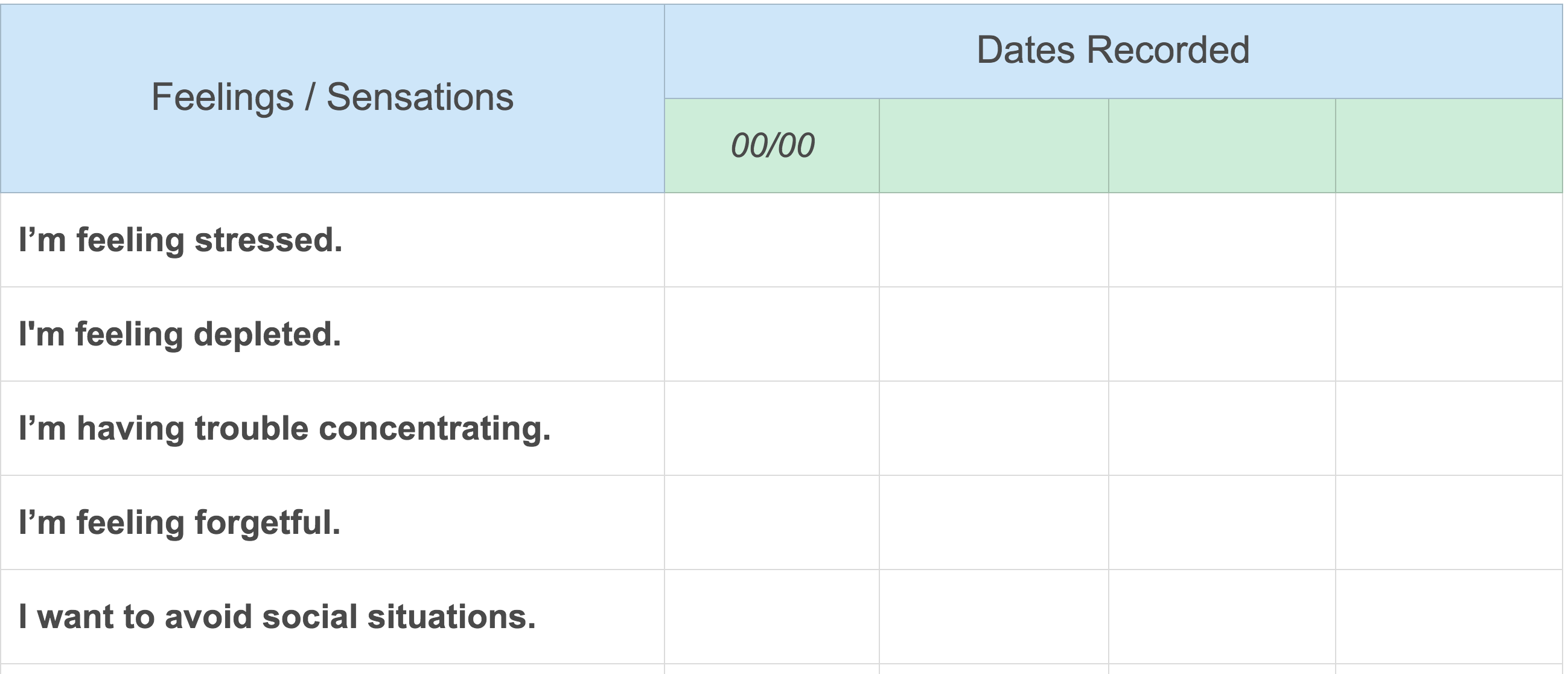
    4) Keep a stress log

    Because burnout symptoms are often challenging to recognize and heed, it can be helpful to evaluate your feelings by creating a stress log, using a journal or a digital tool such as Evernote.

    A couple of times a week, and definitely whenever you’re stressed, consider ranking the following burnout symptoms on a 1–10 scale (1 = this feeling is hardly present; 10 = this feeling is all consuming):

    Level of stress:

    Level of feeling depleted:

    Level of lowered concentration:

    Level of forgetfulness:

    Level of wanting to avoid social situations:

    Level of pessimism:

    Level of cynicism:

    Level of apathy:

    Level of lowered engagement:

    You can also rank your overall amount of energy on a scale of 1–10, with 1 being totally depleted and 10 being the Energizer Bunny.

    These are uncomfortable feelings, and being honest with ourselves about them can be difficult or feel slightly demoralizing. But we can also see it as empowering. When we notice those numbers creeping higher, we are taking charge of a situation that may have seemed beyond our control, giving ourselves an opportunity to pull back and rejuvenate.

    If you want to keep your stress log in Evernote, we’ve created a simple template you can use.

    5) Manage workplace stress

    Since burnout is primarily associated with our work, that is one place we can definitely make an impact. We don’t have to accept the notion that jobs are inherently stressful and there’s nothing we can do about it. Find ways to structure your day to incorporate short breaks and maximize your peak energy times. Work with your employer and teammates to reduce meeting overload and focus your working hours on the things that matter.

    In today’s “always on” world, stress can be overwhelming, and we often feel like it’s our fault if we can’t stay on top of everything. While it can be tempting to push through feeling run-down in the name of getting stuff done, that road can push us closer to burnout. Taking the time to assess, wind down, and rejuvenate instead can make us healthier, happier, and yes, more productive, in spades.

  • How to be your best self in times of crisis

    So given everything going on at the moment it seemed poignant to share this talk from Susan David about how to be your best self in times of crisis. About 28 minutes in there’s a bit around social distancing and working from home and something that stood out for me was the idea that we do not need to practice ‘social’ distancing but ‘physical’ distancing, the terminology can conjure ideas of being alone rather than just physically apart.

  • It’s okay to feel overwhelmed, here’s what to do next

    Especially at the moment, an hour might feel like a heavy time commitment, it’s worth considering especially because of the current climate it might be even more important than normal to find that time. This profound talk from the author of “Eat, Prey, Love” about anxiety, fear and grief in the current climate offers some hope and reflects on how to stay present. Some of the highlights I took away were:

    • “There is no more species more anxious than humans”, unlike most species we have such vast imaginations we can picture the future, and we often picture the worst.
    • Humans are great at adapting, while we create a great amount of anxiety thinking about the future, often when it comes we just get on with it.
    • The difference and importance of empathy vs. compassion.

    The above resonate with a favourite quote of mine by Sceneca (sorry for the Greek philosophy), “We suffer more in imagination than in reality”, this is me all over, I spend a huge amount of time stressed and anxious because of what I ‘imagine’ and when it eventually comes, better or worse, it’s rarely that bad.

  • Under stress at work? Just remember: Don’t believe what you think.

    Here’s how you can take control of your brain’s knee-jerk reactions to distressing situations, says psychology researcher Lisa Penney.

    This post is part of TED’s “How to Be a Better Human” series, each of which contains a piece of helpful advice from people in the TED community; browse through all the posts here.

    Question: When you’re under stress at work, are you able to do your best thinking?

    For almost all of us, the answer is No.

    In fact, for many, we might go one step further and say we end up doing some of our worst thinking when we’re under pressure.

    But there’s a big problem: When you’re under stress, that’s often the time when you need to be at your best — to think clearly and critically.

    Lisa Penney, a business-school professor at the University of South Florida, Sarasota-Manatee, has been looking into this phenomenon. She specializes in studying stress, a key element of the business world. When she began, she focused on trying to identify the causes of stress because she wanted to figure out how to dispel them. “What I learned is, that’s not realistic,” she says in her TEDxUFSM Talk. “We can’t make it all go away and even if we could, that’s not a good thing — we need challenges to learn and grow.”

    In the course of her research, she has realized that when we’re distracted or distressed, our thoughts can get distorted. “Some of the more fundamental assumptions you make on a daily basis about the world you experience and the people in it, including yourself, can’t always be trusted,” Penney says. In numerous lab experiments, it’s been shown, as she puts it, “sometimes we see things that aren’t there, and sometimes we fail to see things that are in plain sight … This happens because we are hardwired to make fast decisions not accurate ones.”

    As Nobel Prize-winning economist (and TED speaker) Daniel Kahnemanrevealed, our brains process information in two ways: fast and slow. ”Our fast brain is highly efficient, and it makes decisions automatically by focusing on a few details that it thinks are important, based on past experience,” explains Penney. “Our slow brain, on the other hand, uses control processing in order to make decisions, and it takes into account far more information and it thinks critically.”

    Our brains spend almost all of their time in fast mode — more than 95 percent of our thoughts are believed to be unconscious and automatic. “The fact that our thoughts and decisions become automatic is really helpful and it works great in situations that closely match our past experiences,” says Penney. “But it gets us in trouble when we have new experiences and when we’re under stress.” (Our fast brains are also the ones responsible when we fall for phishing emails and other scams.)

    The next time you’re in a tense situation at work, here are a few things you can do to counteract your fast brain.

    Pay attention

    “Be aware that your brain will default to making fast decisions, not accurate ones, “ says Penney. “Pay attention the next time you find yourself telling a familiar story about what’s happening at work.”

    For example, let’s say you just sent your boss a detailed proposal that you’ve spent a considerable amount of time on. She replies to your lengthy email with this word: “OK.” You start to worry that she didn’t like it. Worse, maybe she dislikes you. But before you begin to fall into a spiral of rumination and worry, check yourself. Tell yourself something like: “I know I’m under stress right now, and it’s affecting my thinking.”

    Take some deep breaths

    “Once you notice that story, breathe,” suggests Penney. “Remember, when we’re stressed, part of our brain goes offline as our bodies go into fight or flight, and we can’t see clearly. Taking a deep breath tells your body you’re safe.”

    You can try what’s called “coherent breathing,” which has been shown to help calm the nervous system. Here’s how to do it: breathe in, letting your inbreath last five to six seconds. Pause for a moment. Breathe out, letting your outbreath last five to six seconds. Repeat. To feel its full effects, some experts recommend practicing coherent breathing for 10 minutes (or more) every day.

    Be curious

    “Ask yourself: ‘What’s the story I’m telling myself? Is it true?’” says Penney. She cautions, “Remember, thoughts that are familiar will feel true, so don’t stop there. Ask yourself: ‘What evidence do I have? Do I have other stories that might also make sense?’”

    With the “OK” email from your boss, consider the many other possibilities: she’s really busy, she’s going to look at it later, she just wanted to reply and acknowledge she received it, she’s walking into another meeting, she’s really busy, etc.

    With practice, according to Penney, you can learn to disrupt your fast thinking before it runs away from you. But there’s one important thing you should keep in mind — having those automatic thoughts in the first place doesn’t make us bad or gullible or weak. “It makes us human,” says Penney. “We just have to be willing to be aware of and question those thoughts so we can decide which thoughts we want to drive [us].”

    The more that we can take the time to question our thoughts, the wiser decisions we’ll be able to make for ourselves and our organizations. As Penney puts it, ““We live in overwhelming and stressful times and face very real and serious challenges in our personal lives, at work, and in our communities. In order to effectively meet these challenges, we need to be able to see clearly.”

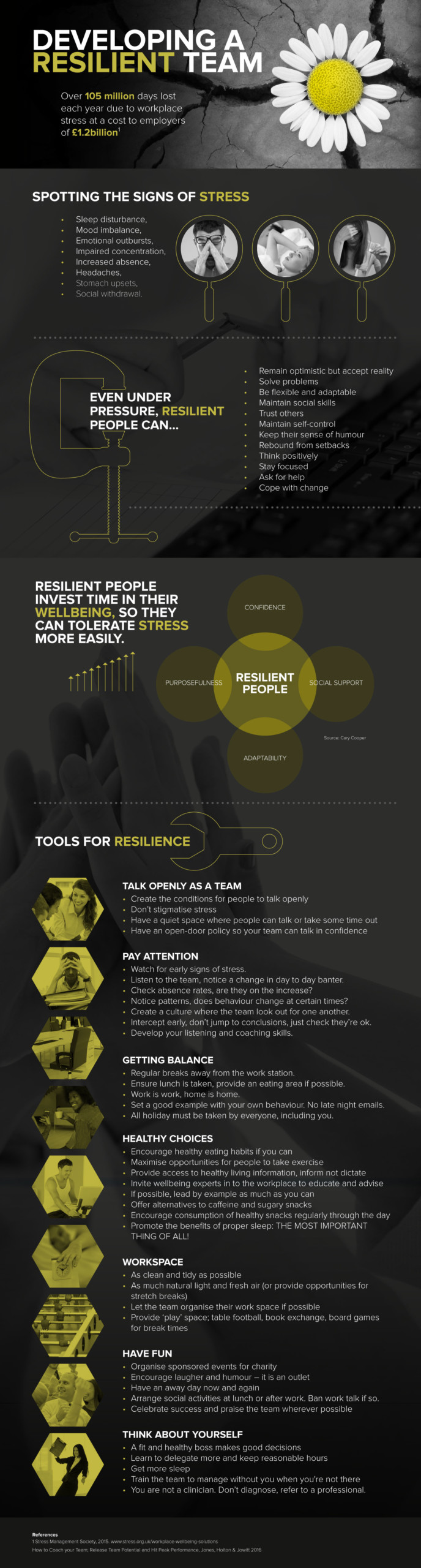
  • Developing a resilient team

    A great infographic highlighting the signs of stress, what resilience means and some tools to improve it.