Are diverse companies really more innovative? Rocío Lorenzo and her team surveyed 171 companies to find out — and the answer was a clear yes. In a talk that will help you build a better, more robust company, Lorenzo dives into the data and explains how your company can start producing fresher, more creative ideas by treating diversity as a competitive advantage.
Blog
-
Multi-Touch Attribution for a Cookie-less world
The truth is: As long as you have first-party data, you can use AI-based MTA to understand what parts of your marketing work and this will still apply post cookie-apocalypse. Standard heuristic methods — first click, last click, linear — apply set patterns to your data whereas AI methods learn patterns from your data.
In this blog we’ll crack open the bonnet of the three most popular MTA algorithms and take a deeper look at how they work in layman’s terms.
Markov Chains (Probability)
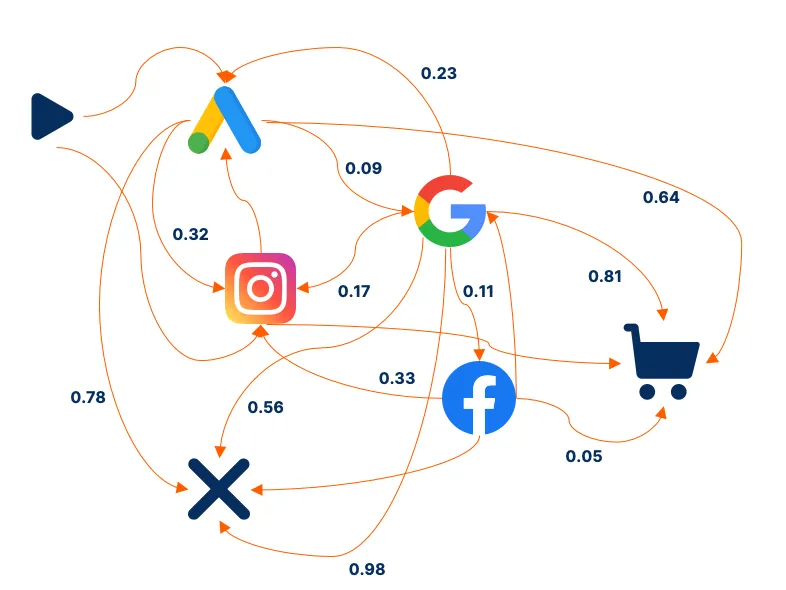
An example of how Markov chains work across multiple marketing channels Markov Chains assign credit to different marketing channels or touchpoints based on their influence in leading to a conversion, like a purchase or a sign-up. They’re a popular concept in weather forecasting, ranking algorithms, and predictive text.
To simplify, imagine a customer’s journey as a series of steps leading to a purchase. Each step is a touchpoint — an interaction with a marketing channel such as a Google ad, a social media post, or an email campaign. The Markov Chain model views this journey as a sequence of transitions from one state (or touchpoint) to another. The goal is to determine the probability of moving from each state to the next, ultimately leading to a conversion.
Here’s how it works:
1. Transition Probability Matrix: Using source data, a transition probability matrix is created. This matrix shows the likelihood of moving from one touchpoint to another.
2. Removal Effect: The model then calculates the ‘removal effect’ by temporarily removing a touchpoint and measuring the impact on conversion rates. This helps in understanding how important each touchpoint is. If removing a touchpoint significantly lowers the conversion probability, it’s considered highly influential.
3. Attribution: Finally, the model assigns an ‘attribution score’ to each touchpoint based on its removal effect. Touchpoints that greatly reduce the likelihood of conversion when removed are given higher scores, indicating their greater importance in the conversion process.
This approach offers a more nuanced view of the customer journey compared to more traditional models like first-touch or last-touch attribution accounting for complex and interconnected nature of modern marketing landscapes, where customers often interact with multiple channels before making a decision.
Shapely Values (Game Theory)
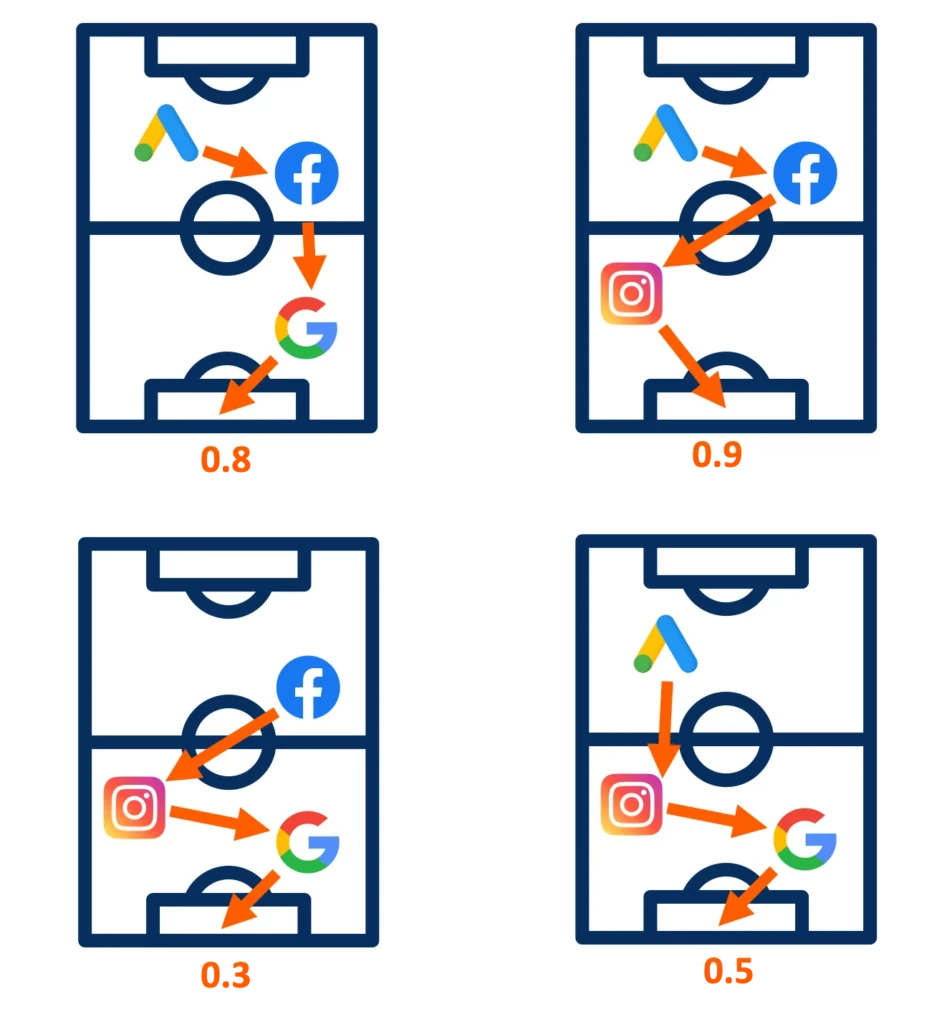
Game theory based SHAP values treat channels as players in a game in order to assign output fairly Shapley Values, originating from cooperative game theory, offer a unique approach to Multi-Touch Attribution (MTA) in marketing analytics. This method provides a fair distribution of credit to various marketing touchpoints in a customer’s journey, ensuring each channel’s contribution towards a conversion is accurately acknowledged.
In the context of MTA, each ‘player’ is a marketing channel, and the ‘payoff’ is the conversion (like a sale or a signup). The Shapley Value formula considers all possible combinations of channels and their respective contributions to conversions.
Let’s break down how Shapley Values are applied:
1. Data Collection: The process starts with collecting detailed data on customer interactions across all marketing channels throughout their journey, leading to conversions.
2. Calculating Contributions: For each conversion, the Shapley Value method calculates the marginal contribution of each channel. It does this by considering every possible order in which the channels could appear in a customer’s journey. For example, if the journey was Email -> Social Media -> Conversion, it would consider Social Media -> Email -> Conversion as well.
3. Fair Attribution: The key aspect of Shapley Values is fairness. It averages out the contributions across all permutations, ensuring that each channel gets credit proportional to its actual impact. This means channels that are consistently helpful will be valued higher, even if they don’t directly precede a conversion.
The Shapley Value approach in MTA acknowledges the intricate and interdependent nature of marketing channels. It avoids biases inherent in other models, providing a more balanced and accurate reflection of each channel’s value in driving conversions.
Additive Hazard (Survival Analysis)

Vroom vroom! Survival analysis offers a unique approach to MTA through incorporating temporal data. Traditionally used in medical research, Additive Hazard, a concept from Survival Analysis, provides a distinctive angle for Multi-Touch Attribution (MTA). This approach focuses on understanding the probability of a conversion event (like a sale or signup) over time via analysing the expected duration until one or more events happen
In the context of MTA, the ‘event’ is a customer’s conversion, and the analysis aims to understand how different channels influence the timing of this conversion.
Let’s delve into how Additive Hazard is applied to MTA:
1. Data Collection and Preparation: Similar to other MTA methods, it begins with collecting comprehensive data on customer interactions across all channels over time. This includes time-stamped data on when each touchpoint occurred in relation to the conversion.
2. Additive Hazard Model: This model assesses the risk (hazard) of a conversion occurring at any given time point, considering the cumulative effect of all prior marketing touchpoints. It’s ‘additive’ because it assumes that each touchpoint adds (or subtracts) a certain amount to the hazard of converting at any given time.
3. Evaluating Touchpoints Over Time: Unlike models that give credit based on the position of a touchpoint in the journey (like first or last-click), the Additive Hazard model assesses how the timing and sequence of touchpoints contribute to the likelihood of conversion. It recognizes that some channels might be more influential at the early stages of the journey, while others might play a crucial role closer to the conversion event.
In summary, an Additive Hazard approach offers a time-sensitive perspective, providing insights into how the timing and sequence of marketing touchpoints impact the likelihood of a conversion.
-
Decision fatigue: what to do when endless choices are sapping your energy
Decision fatigue is incredibly common and surprisingly draining. Here’s why it happens and how you can reignite your energy and focus.
What should you eat for breakfast? What email should you answer first? Who should take the notes in your team meeting? What project will your team prioritize next? Which candidate are you going to hire? What route are you taking home?
Trivial or consequential, we make a lot of decisions – some sources estimate as many as 35,000 choices every single day.
That level of control can sometime feel freeing, but it can also be incredibly taxing. Constantly making selections (whether they’re big or small) can leave you feeling depleted, foggy, and even irritable. So much so that, by the time you need to figure out what’s for dinner, you feel like you can’t make one more gosh darn choice.
Sound familiar? There’s a name for that: decision fatigue.
What is decision fatigue?
Decision fatigue is exactly what it sounds like: you’re tired of making decisions. The premise is that the more decisions you make, the more drained you become, which means you might:
- Put off and procrastinate decisions (“I’ll figure that out later.”)
- Make poor, unsupported, or hasty decisions (“Let’s just do it this way and get it over with.”)
- Overanalyze your decisions to the point of analysis paralysis (“I just need a little more time to think through our options.”)
The basic idea here is that you only have so much energy for decision-making. Every decision you make depletes that energy, until you feel like you’re totally tapped of the mental resources you need to make another choice.
It’s a common psychological phenomenon that’s been observed in a variety of contexts and occupations, including nurses, judges, and credit officers. Put simply, it can happen to anyone.
What causes decision fatigue?
Ego depletion is one term you’ll see come up a lot related to decision fatigue – it theorizes that your willpower is finite, a well that can run dry.
Ego depletion can be both a cause and an effect of decision fatigue. However, the entire theory is contested, with some researchers saying there isn’t enough evidence to support or disprove the fact that motivation and self-control are finite resources.So what’s actually behind your exasperation in making yet another choice? It could be any number of things. You may experience decision fatigue if you:
- Make a lot of decisions: The sheer number of decisions you make can play a role. More decisions usually mean more fatigue, plain and simple. That’s one reason why decision fatigue (and burnout) are more likely in leadership positions.
- Make consequential decisions: The potential impact of your decisions carries some weight too. High-stakes or complicated choices are inherently more stressful and mentally draining, which can compound the stress and exhaustion you’re already feeling.
- Have a higher stress level: Speaking of stress, it can manifest as a vicious cycle in decision-making. Stress impacts your ability to make decisions. And at the same time, decision-making (particularly under pressure) increases your stress and fatigue.
- Are a perfectionist: Decision fatigue may also be felt more acutely by people who have a strong drive toward perfection. An ambition for flawlessness makes every single choice (even small ones) feel make-or-break, which means more stress and more demands on your energy.
- Don’t sleep enough: Physical fatigue and mental fatigue are closely related, so lack of sleep is another factor that can impact how much decision fatigue you experience. Sleep restores your cognitive function, so catching too few z’s at night can make it that much harder to make choices the next day.
The underestimated costs of decision fatigue
If you’ve ever had to make a choice when you’re already feeling zapped and exhausted, then you know it can be a grueling process. But beyond it being a major chore, is decision fatigue really that big of a deal?
It can be. While it might seem obvious, the biggest consequence of decision fatigue is poor decision-making. You make worse choices when you feel spent and unfocused. You can see this take shape in a number of ways both individually and on your team:
- Decision avoidance: You procrastinate or dodge making a choice until you absolutely have to (or the decision is made for you).
- Example: Your team keeps delaying the conversation about whether or not to send a few representatives to an industry trade show. Eventually, the registration deadline passes and you can no longer attend.
- Cognitive biases: When your brain is already tired of making decisions, it’ll look for the easy way out. That’s where biases come in. You’ll default to old perceptions and processes (even if they’re incorrect) simply because they’re accessible and comfortable.
- Example: Your team decides to move forward with an ambitious project timeline, without first confirming whether it’s feasible with key team members and stakeholders (that’s optimism bias, by the way – our tendency to overestimate the likelihood of positive outcomes).
- Decisional conflict and regret: Decision fatigue can also lead to more doubt and debate about a decision, as well as fueling a sense of uneasiness and regret once the decision has been made.
- Example: After a lot of back and forth, your entire team agrees to eliminate a feature from your product roadmap. Almost immediately, several team members voice concerns over whether or not it was the right move.
In short, decision fatigue directly translates to making suboptimal decisions – whether that means they’re slow, rushed, biased, unsupported, or contested.
6 tips to combat decision fatigue on your team
You and your team want to make logical and informed decisions. To do that, you need to keep decision fatigue at bay. Here are a few strategies you can apply both individually and team-wide.
1. Set up some systems
One way to avoid getting tired of making decisions is to make fewer of them. That might feel impossible, but there are relatively small things you can do to minimize the number of decisions you need to make:
- Make a decision once: Mark Zuckerberg says this is the reason he wears the same gray t-shirt every day. It’s also the reason why every Tuesday is taco Tuesday in my house. Making one choice that you can reapply over and over again can reduce your cognitive load.
- Create templates: On a related note, templates can also help you avoid feeling daunted and drained by decisions. These repeatable systems and workflows help you and your team understand what to do or what happens next, without having to make any conscious decisions about it.
Not only do these steps reduce the number of choices you have to make, but they also provide some much-needed comfort. Science says that predictable routines and rituals actually reduce anxiety.
2. Follow a structure or framework
Using a decision-making framework is another way to make decisions feel more manageable and approachable. Even if you’re already feeling tapped out and tired, having a defined structure to follow can help you and your team stay diligent and methodical. Popular options include:
- Decision-making process: These seven steps will guide you and your team as you define the problem, explore your options, and make your choice.
- DACI: This acronym stands for “driver, approver, contributor, informed” which describes the various roles in the group. Designating these responsibilities can help your team collaborate on decisions with less conflict (and, as a result, less exhaustion).
Whether you use one of those frameworks or a different divergent thinking exercise, having a blueprint makes decision-making feel more like a step-by-step task and less like an internal wrestling match.
3. Consider your team’s strengths and expertise
What’s more taxing than having to make a decision? Having to make a decision that you don’t feel equipped or qualified to make.
That’s why delegation can be another effective way to manage decision fatigue. When you’re working as part of a team, people naturally have different strengths and interest areas. That means you can delegate decisions to match those.
For example, maybe the team member who loves event planning can decide where to host your next team off-site. And perhaps the three early-adopter, tech-savvy members of your team want to collaborate and decide on what project management software you’ll use.
To be clear, this isn’t about shirking responsibilities and pushing things off your own plate. Rather, it’s about maximizing the expertise of your team and giving people ownership over decisions that are the most suitable and meaningful to them.
If your team does need to make a decision together, an exercise like Six Thinking Hats can help you explore the decision from all sides and ensure decision-making is a collaborative effort rather than a zero-sum game.
4. Manage stress
Having to make too many decisions increases stress levels. Just think about the thick of the pandemic, when even everyday decisions that used to be simple (should you go to the grocery store?) felt risky and high-stakes.
That constant uncertainty skyrocketed stress, which in turn made it increasingly tough to navigate all of the choices we had to face. Stress alters our decision-making abilities, which is why you want to try to keep your team’s sense of anxiety and overwhelm to a minimum.
Ensuring reasonable workloads, limiting the amount of decisions you need to make under the wire, and providing adequate resources and guidance can make everybody on your team feel supported, less stressed, and more equipped to make solid choices.
5. Prioritize accordingly
Some decisions are weightier than others. And, when decision fatigue means that you’ll lose steam with each additional decision you make, it’s smart to prioritize your choices accordingly.
The ones that are really complex or consequential? It’s probably best to tackle those early in the day when you still feel focused and recharged. Then you can handle any easier or more insignificant choices later when you don’t need to be firing on all cylinders.
It’s similar to the 80/20 rule, which posits that 80% of your results come from only 20% of your efforts. Your goal here is to identify your most impactful decisions and get to those upfront when your energy bucket is full.
Of course, that’s not always doable – big and small decisions come up throughout your workday. But for the ones that you do have a heads up about, it’s smart to be strategic about when you make those choices.
6. Take a break (even a short one)
Irritability, procrastination, exhaustion, and impulsivity are all signs of decision fatigue. If and when you notice them within yourself or on your team, pumping the brakes might be the best thing you can do.
If you have the wiggle room, come back to the decision tomorrow. If not, research shows that a quick break (even a few minutes to take a walk and grab a snack) can be enough time to recharge, shake the cobwebs off, and come back to decisions with some more clarity.
Trade fatigue for fortitude
Whether you realize it or not, you make thousands of decisions on a daily basis, and that relentless game of “this or that” can take its toll on your focus, energy, and ambition.
Fortunately, decision fatigue doesn’t have to be chronic, and there are several steps you can take to ease the burden of endless choices. As far as what ones you should implement? Well, for better or for worse, that’s for you to decide.
-
Norway
Cruising from Southampton around Norway on P&O’s Ioana for 7 nights my rough itinerary is below followed by a custom map I created.
Sat 4th May – Embarkation
Sun 5th May – At Sea
- 09:00 – Spa Access
- 12:00 – Massage
- 19:00 – Celebration Night, Formal Attire
Mon 6th May – Stavanger, Norway
Will also cruise by Innvikfjorden and Nordfjord. Would be nice to hike Pulpit rock but probably a whole day excursion and not sure Barry or dad would be up for it! There is also a hop-on hop-off bus (here) which operates from the cruise terminal for ~£40.
- 10:00 – Stavanger by Segway.
- 11:30 – Wonder around Øvre Holmegate (the colourful street).
- 12:00 – Grab a coffee at Sirkus Renaa.
- 13:30 – Checkout the Audhild Viken Christmas shop.
Tue 7th May – Olden, Norway
- Loen Skylift with lunch on top of the mountain.
- Available for £104pp as an excursion via P&O at 09:30 or 13:30 or,
- Available for ~£68pp by booking at oldencruise.com running every 30 minutes.
- Booking required for the Hoven restaurant.
Wed 8th May – Alesund, Norway
There is a hop-on hop-off bus (here) which operates from the cruise terminal when a ship is in port for ~£50 and covers the main Fjellstua/Aksala viewpoint. For coffee there are a few spots like Dråpe Ålesund Kaffehus, Racoon Coffee, Green Garden (in the beautiful 1904 hotel) or Maru Cha if you fancy a bubble tea instead. For more of a ‘beer and burger’ vibe Molo Brew has a massive selection of beer and some great food.
Thu 9th May – Haugesund, Norway
In terms of excursions the best options seem to be doing a RIB (rigid inflatable boat) ride available through P&O for £109 however you can book direct with who I expect will be the actual local tour provider for closer to £92 here.
Potentially stop for a coffee and a cake at Naturbakst bakery, Jablom cupcake shop or Hos Carlos kaffebar. If you’re after a slightly bigger lunch there is Samson Bar on the quay.
Fri 10th May – At Sea
Sat 11th May – Disembarkation
-
The power of time off
Every seven years, designer Stefan Sagmeister closes his New York studio for a yearlong sabbatical to rejuvenate and refresh their creative outlook. He explains the often overlooked value of time off and shows the innovative projects inspired by his time in Bali.
-
Why we make bad financial choices — even when we know better
We all know we should spend less and save more, yet many of us struggle to do it and blame ourselves. Turns out, our environment is what we really need to change, and behavioral scientist Wendy De La Rosa explains why.
-
What makes a good life? Lessons from the longest study on happiness
What keeps us happy and healthy as we go through life? If you think it’s fame and money, you’re not alone – but, according to psychiatrist Robert Waldinger, you’re mistaken. As the director of a 75-year-old study on adult development, Waldinger has unprecedented access to data on true happiness and satisfaction. In this talk, he shares three important lessons learned from the study as well as some practical, old-as-the-hills wisdom on how to build a fulfilling, long life.
-
A 5-step guide to the strategic planning process (+ tips for success)
Enterprises spend significant time, effort, and money on the strategic planning process. And yet, an overwhelming number of business strategies fail.
So after weeks or months of hard work, you unveil a strategic plan with elaborately crafted long-term goals. If it’s like most strategic plans, at best, the plan might gather dust in the cloud. At worst, the plan confuses, frustrates, and divides teams.
But that doesn’t mean you should scrap strategic planning. In fact, the process is vital for helping companies figure out how to get from where they are now to where they want to go. But for a company strategy to excel, strategic planning has to be carried out intentionally across the entire org.
Unfortunately, if your strategic plan looks more like a beautiful vision board of your end destination—without a concrete and aligned plan detailing how to get there—chances are you’ll never reach your goals.
The right path starts by creating a strong, actionable strategic plan that everyone is on board with so it doesn’t get forgotten with time.
What is strategic planning?
Strategic planning lays out what you would like the business to look like and how you plan to get there.
Think of strategic planning like mapping out a cross-country road trip. First, you have to decide on the final destination. Then you have to plan the route you’ll take to get to that destination—asking questions like:
- Which route has the stops you want to make along the way?
- Which is the safest route that avoids poor road conditions?
- Which route will help you get to your destination on time?
The route you choose is your strategic business plan.
A step-by-step guide to the strategic planning process
Effective strategic planning doesn’t happen overnight. Through a series of detailed steps, your organization achieves its goals over time. And for this strategy to be successful, your entire org has to be involved in the process.
1. Evaluate the current state of the business
For a clear vision of the business’s direction in the next few years, you have to evaluate where you are now.
Atlassian recommends a SWOT analysis, which takes a look at four things:
- Strengths: What is your company doing well? And what competitive advantage does it have over others?
- Weaknesses: What are the areas of your business that could use improvement? What do you lack that competitors have?
- Opportunities: Are there new opportunities in the market that your business can take advantage of?
- Threats: Are there potential hurdles your business may encounter in the near or distant future that you need to be prepared for? Are there any competitors that might emerge and jeopardize your market share?
Check out Atlassian’s SWOT analysis example to get started.
2. Determine business objectives
Once you’ve finished your SWOT analysis, you can use the findings to determine the best objectives for the company strategy. These are the long-term goals your org will work toward for the foreseeable future.
But these goals have to be actionable. Break down your action plan into concrete organizational goals for each quarter of the coming year that follow the SMART goal-setting framework:
- Specific: Your goal has to specifically outline what you’re hoping to achieve and the steps you’ll take to get there.
- Measurable: Your goal has to be numerically measurable so you have the metrics to track progress, celebrate milestones, and know when the goal has been achieved. This is the number you base your key performance indicators (KPIs) on.
- Achievable: Your goal has to be realistic and attainable.
- Relevant: Your goal has to be relevant to what your company actually needs at this time.
- Time-bound: Your goal has to have a designated time frame and deadline by which it should be met.
This strategic framework will help you set company goals that are actually achievable and move you toward your larger vision in baby steps.
Say you’re hoping to improve customer retention. A SMART goal would be something like:
Decrease company churn rate by X% by the end of Q4 in 2023. To achieve this, we will run customer satisfaction surveys to determine areas for improvement and build a knowledge base to better support customers (and encourage usage). Customer engagement is key to retaining customers, which will help us maintain profitability.
3. Map out the strategic plan
With clear company objectives, it’s time to map out the strategic plan. This will be your blueprint for achieving the business goals you set.
Most strategic plans include the following basic points:
- A company description (your elevator pitch)
- Your organization’s mission statement
- Your value and vision statements
- An analysis of your business’s strengths, weaknesses, opportunities, and threats (aka the SWOT analysis we mentioned earlier)
- An analysis of the current internal and external environments and how they each affect your company
- Your business goals
- Your action plan to achieve those goals

A work management tool (like Trello) can function as a planner to help you map out your strategic plan. With this strategic planning template, you can break down your strategic objectives into specific deliverables, then explain the steps you’ll take each quarter to help you get there.
Within each card in the Q1 column, you can break down quarterly goals even further—identifying the general actions different departments need to take to make progress toward each goal.
Then you can tag team leads and the person responsible into cards so that they know the goals and deliverables they’re responsible for.
The end result is your strategy map for success.
4. Roll out and adopt the plan org-wide
The strategic plan is finalized, and the strategy execution can begin. It’s time to launch the plan across your company and start working toward those carefully mapped-out goals. Here are some best practices to keep the momentum going on your strategic plan:
- Host an all-hands meeting to officially roll out the strategic plan with specifics—including goals, timelines, and how it will be implemented. Follow that up with an office hours session where team members have the opportunity to ask questions about the plan.
- Tie everything you’ll be working on back to the strategic plan. For example, if you’re building a new location, elaborate on how this effort fits into the business plan and why it needs to happen now.
- Get all your teams aligned on the strategic plan. Offer a detailed breakdown of what role each team member will play in the strategy—so they are clear on exactly what they’re responsible for. And regularly check in with each team to offer senior leadership support.
5. Assess progress and make updates to the plan
The strategic planning process doesn’t end at implementation. In order to actually follow through on the strategy, it’s important to regularly track progress and make updates to the plan as needed.
While regular, clear communication is a great way to monitor team progress against your organization’s goals, you can also use your usual work management tools to stay informed.
In Trello, for example, teams can tag cards on their boards with the strategic goal the work aligns to. Then you can sort cards per label and use the Dashboard view to see how much of each team’s day-to-day work is rolling back up to your company’s strategic plan.
With the Dashboard view, your progress data is presented visually through charts and graphs that make decisions around updates to the strategy simple.

You can regularly check your teams’ Dashboards to keep a temperature check on goals.
Say you look at a pie chart on the Dashboard that shows progress on tasks tied to specific strategic goal labels. There you find that employees are prioritizing some goals at the expense of others. You can bring that up at the next team meeting and help them reprioritize to focus on tasks that need attention.
You might also discover that team members are getting caught up in routine work that doesn’t make progress against strategic initiatives. From there, you can work with their managers on how to take some tasks off their plates.
Or these insights may just show you that it’s time to update the strategic plan based on the goal progress data. If you realize that an initiative isn’t progressing as quickly as you anticipated, you may have to modify timelines or set more short-term goals to reach the finish line.
Tips to make your strategic plan successful
Your strategic plan is now set and in motion. But for the plan to be successful, you have to ensure teams actually make meaningful progress toward end goals in their day-to-day work.
Here are some tips that can help:
Get buy-in from team members
The first step to making sure a strategic plan is actually implemented is to get buy-in from employees when you set each department’s quarterly directions. Of course, leadership will likely decide on the company’s roadmap without having its hundreds—or thousands—of employees weigh in. But when it comes to deciding how different departments can help reach those goals, employees should be involved in brainstorming—for two good reasons.
First, engaging employees in the strategic planning process has consistently shown better results than simply mandating tasks from the top down. According to Gartner, using an open-source change management strategy—where employees are actively involved in designing change processes—can increase your chances of succeeding by up to 24%. (Involving employees in deciding the processes of your change management strategy can also increase employee engagement by up to 38%.)
Second, since many employees are also on the frontline of your business, involving them in strategic decision-making at the brainstorming stage can help you test assumptions about your strategy. Considering that 83% of company strategies don’t succeed because of wrong assumptions, this step is critical. As leaders climb the ladder, they can often become removed from customers’ day-to-day requests, feedback, and struggles.
Make frontline employees active contributors in developing your strategy implementation plans. Host strategy brainstorming sessions with each department in which team members have a voice in how they’ll contribute to each goal. This will offer opportunities for you to test your assumptions and brainstorm with colleagues who are actually dealing with these issues daily.
Communicate early and often
Just as it takes sales reps eight touchpoints before a prospect finally takes action and sets a meeting—you must keep strategic goals and initiatives top of mind for employees. Far too many companies will hand over an outsized check to a consulting company for a new strategy, only to poorly communicate it to employees and let it fade into the background.
To make sure your strategic plan’s initiatives are getting prime time in employees’ workdays, keep a plan document with concrete tasks and deadlines. After a team settles on how they’ll achieve a quarterly goal, that project should be broken down into tasks and documented, too. A work management tool, like Trello, can help.
With Trello’s project management board, it’s easy to outline specific deliverables, research needs, and lay out tasks with relevant stakeholders tagged and deadlines set.
Trello’s Timeline view can also be a helpful tool to use in this case. The Timeline view lets you view all cards on a board on a timeline, which you can toggle to monthly, quarterly, or yearly views (depending on your needs). This lets you plan backward in order to meet deadlines and ensure goals are being met.

But don’t stop at simply putting together a project board. Have teams regularly talk through strategic initiatives, opportunities, and roadblocks during daily or weekly team standups, and add these initiatives to your team-wide and company-wide meetings and updates. With everyone on board and consistent reminders of teams’ strategic priorities, it’ll be easier to meet your goals come year-end.
Unlock the teams’ capacity to tackle new goals
Last—but certainly not least—it’s important to look at employees’ schedules and clear out room for them to tackle new strategic initiatives. If you treat teams like they’re at a buffet and simply add more to their plates, you risk having tasks slip through the cracks or harming employees’ wellbeing.
If team members already have plates full of their usual projects and tasks, they won’t have the capacity to make progress against your new strategic objectives. Make sure managers are addressing employees’ individual workloads in one-on-one meetings and that priorities are discussed. (The Dashboard view mentioned earlier is also good for this type of team management.)
If non-essential work can be paused until later in the year, do so. If any routine tasks—such as email follow-ups, inbox monitoring, or project updates—can be automated, consider layering automation into teams’ daily workflows. According to Automation Anywhere, that simple act could free up to three hours a day for your average employee.
Stay focused on initiatives that matter with Trello
Implementing a new strategy is never easy, and it takes alignment all the way from the top tiers of leadership down to your frontline employees.
Hiccups and setbacks are natural as you figure out how to steer your ship from point A to point B as a company. After all, when a ship is set off course by just a couple of degrees, it can end up meaning thousands of miles.
But with strong communication, engagement, and strategic management practices that allow you to better track progress, you can make sure that your strategic plan functions as a compass to your destination.
-
User-Fudged Experiences Push UX 2022
A bit of an insight into the world of customer behaviour and user experience. Customers can interact with businesses in weird and wonderful ways but there’s usually a reason. Understanding those reasons and designing experiences and tools to better support them can drive significant increases in performance and satisfaction.
-
Learn the perfect hormonal time to sleep, eat and have sex
We all have a chronotype – a rhythmic pattern in our body that determines the best time for us to sleep, eat, exercise, have sex and so much more says sleep expert Dr. Michael Breus. In his informative and humorous talk, Michael describes the four primary chronotypes and the positive impact that living according to our type can have on our daily lives.