Using paychecks, perks and carefully worded mission statements plastered on posters, companies are on a never-ending quest to find what drives morale at work. An underappreciated solution lies in the answer to one simple question, says management researcher David Burkus. With notable examples backed by decades of success, he presents a clear path to inspiring your team — and finding your purpose at work.
Tag: Leadership
-
Forget the pecking order at work
Organizations are often run according to “the superchicken model,” where the value is placed on star employees who outperform others. And yet, this isn’t what drives the most high-achieving teams. Business leader Margaret Heffernan observes that it is social cohesion — built every coffee break, every time one team member asks another for help — that leads over time to great results. It’s a radical rethink of what drives us to do our best work, and what it means to be a leader. Because as Heffernan points out: “Companies don’t have ideas. Only people do.”
-
How to speak so that people want to listen
Have you ever felt like you’re talking, but nobody is listening? Here’s Julian Treasure to help. In this useful talk, the sound expert demonstrates the how-to’s of powerful speaking — from some handy vocal exercises to tips on how to speak with empathy. A talk that might help the world sound more beautiful.
-
Why great leaders take humor seriously
There’s a mistaken belief in today’s working world that leaders need to be serious all the time to be taken seriously. The research tells a different story. Based on the course they teach at Stanford’s Graduate School of Business, behavioral scientist Jennifer Aaker and corporate strategist Naomi Bagdonas delve into the surprising power of humor: why it’s a secret weapon to build bonds, power, creativity and resilience — and how we can all have more of it.
-
How to save the world (or at least yourself) from bad meetings
An epidemic of bad, inefficient, overcrowded meetings is plaguing the world’s businesses — and making workers miserable. David Grady has some ideas on how to stop it.
-
Why you think you’re right — even if you’re wrong
Perspective is everything, especially when it comes to examining your beliefs. Are you a soldier, prone to defending your viewpoint at all costs — or a scout, spurred by curiosity? Julia Galef examines the motivations behind these two mindsets and how they shape the way we interpret information, interweaved with a compelling history lesson from 19th-century France. When your steadfast opinions are tested, Galef asks: “What do you most yearn for? Do you yearn to defend your own beliefs or do you yearn to see the world as clearly as you possibly can?”
-

20 team meeting ideas that will help your team bond in 2023
Did you know that your team meetings can be a great opportunity to build psychological safety?
Why does that matter? It turns out that psychological safety is a key factor in boosting team performance. In a recent study published in the peer-reviewed journal Frontiers in Psychology, researchers stated the importance of psychological safety like this:
Psychological safety is the engine of performance, not the fuel.
People who feel psychologically safe at work are more willing to be vulnerable in terms of contributing ideas or pointing out potential problems. Because they have plenty of support and encouragement to speak up, these folks are more comfortable taking risks without fear of judgment, finger-pointing, or punishment.
Your team meetings are a frequent and reliable outlet to create a foundation of psychological safety by helping your team form strong bonds. When people have a chance to get to know each other on a more personal level and form a closer connection, they don’t only build familiarity—they build trust.
Curious about how to go about incorporating a few bonding opportunities into your team meetings—without trust falls, human knots, and random questions about desert islands? Look no further.
Team meeting ideas for new or new(ish) teams
Whether you have a group of long-standing colleagues starting a new project or a cross-functional team of people who don’t know each other all that well, these team meeting ideas will break the ice, loosen people up, and help them feel a little more comfortable before you get into the nuts and bolts of your meeting.
1. Ask a few non-cringey icebreaker questions
We get it—icebreaker questions can sometimes inspire some groans and eyerolls. But there are some creative ones you can ask to help everybody learn something new about each other. For example:
- Given the choice of anyone in the world, whom would you want as a dinner guest?
- For what in your life do you feel most grateful?
- If you could wake up tomorrow having gained any one quality or ability, what would it be?
- In the event of a zombie apocalypse, what three items would you grab from your home? (This is actually one of our favorites.
You could even ask team members to submit icebreaker questions ahead of your meetings so that they have some control over what they share and learn.
2. Do a quick show-and-tell
This game reignites your childhood enthusiasm and also helps team members find out more about what everyone values.
If you meet in-person, give team members a heads up that they should bring in an object to your next meeting and be prepared to explain what it is and why it’s important to them. This meeting idea works just as well (or maybe even better) remotely, when people can easily grab and showcase something from their own home.
3. Play “name that tune”
Nothing brings people together quite like music. In your next meeting, play the first few seconds of a couple of different tunes and challenge team members to name the song.
You could even set a theme for each week, like holiday songs or ’90s hits. Prepare for it to become a beloved team tradition that quite literally gets people moving in their chairs.
4. Switch up your introductions
Tired of meetings that start with the same old, “Tell us your name and what you do…”? Flip introductions on their head by having people introduce someone else in the group, rather than themselves.
You can pair people up (ideally, they should already know each other) or ask team members to volunteer to introduce someone else. It’s sure to be a far more interesting spiel—and likely filled with some glowing compliments the person never would’ve shared about themselves.
5. Share some photos
Personal photos give team members a more intimate glimpse at the lives of the people they work with.
Set a theme for each meeting—like your favorite vacation photo, your most embarrassing yearbook photo, or a photo of your pet—and challenge team members to share a relevant snapshot.
Team meeting ideas for motivation
Of course, your team meetings are about more than fun and games. When it’s time to get down to business, these team meeting ideas for motivation will inspire everybody to buckle down for a productive conversation.
6. Plan a thoughtful agenda
A worthwhile meeting starts before the actual meeting. Your agenda loops people in on what you’ll discuss so that they can come prepared with their best ideas and burning questions. Then you can use your meeting time for meaningful conversations rather than getting everybody up to speed.
7. Celebrate your wins
Kick off your meeting on a high note by using a few minutes to highlight recent wins and accomplishments—whether you call attention to them yourself or ask other people to chime in.
Not only does this set a positive tone, but it also gives motivation a boost. It’s called the progress principle, which states that “of all the things that can boost emotions, motivation, and perceptions during a workday, the single most important is making progress in meaningful work.”
8. Understand team priorities
If you want everybody to walk out of your team meeting with a clear idea of what they should focus on, try the 5 things workflow.
Joel Spolsky, co-founder of Trello, came up with this format. Every team member is asked to share five things—either directly in a meeting or on the Trello board:
- Two tasks they’re currently working on
- Two tasks they plan to work on next
- One task that people might expect them to be working on but they weren’t actually planning on doing
It’s a straightforward way to cut through the noise and understand exactly what everybody is (and should) be working on.
9. Encourage fidgeting
Think intense motivation means sitting still in your chair? Think again. Research shows that fidgeting can actually help people feel more calm, creative, and even more focused.
Bump up the motivation level in your meetings by giving people opportunities to use their hands—like putting small toys, trinkets, doodle pads, or even Play-Doh in the middle of the table. Have a remote team? Gifting everybody a branded fidget spinner could be a good surprise.
10. Keep a detailed history
It’s tough to feel motivated if every single meeting feels like Groundhog Day—like all you’re doing is constantly rehashing a previous conversation.
Prevent this repetitive feeling by setting up a weekly team meetings board. Not only will it help you plan a successful meeting, but it also has space for you to keep a log of all of your previous meetings. That means everybody can get the context of what’s already been discussed, so you don’t need to keep hitting the “replay” button.
Team meeting ideas for communication
For your meetings to be as positive and productive as possible, people need to know how to successfully interact with each other.
These team meeting ideas for communication can help your team members understand how to better relate to one another—and how to more effectively share their message.
11. Clarify roles
If your meetings currently involve a lot of toe-stepping, it’s time for you to clarify who’s responsible for what. The DACI framework requires that you categorize your team members by:
- Driver: Who’s leading the team, project, or decision
- Approver: Who has ultimate sign-off
- Contributors: Who is involved or chipping in
- Informed: Who needs to be kept in the loop
This straightforward system helps people understand where and how they fit in so they can communicate more effectively.
12. Identify your 4 L’s
Understanding and empathy are crucial for successful communication. The 4Ls retrospective asks team members to identify what they loved, loathed, learned, and longed for in a recent project, event, or sprint of work.
This exercise is a simple way to reflect back on your work together, get better insight into other peoples’ experiences, and improve as a team moving forward.
13. Create team user manuals
Personal user manuals are another effective way to increase understanding. This isn’t about a technical booklet to help you unjam the printer—these user manuals help team members understand what makes each other tick.
Use this template from Confluence to get started.
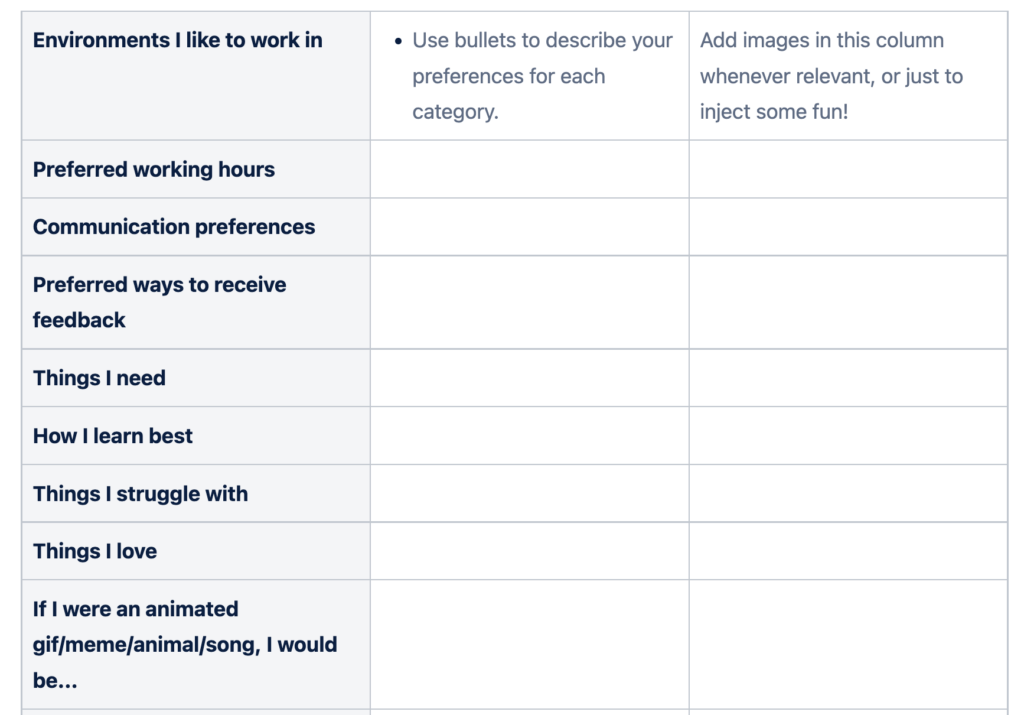
Everybody can fill out their own document, listing everything from their communication preferences to how they prefer to receive feedback.
Have everyone discuss their pages during a team meeting. Then, retain the pages on Confluence to create a handy reference for new teammates, as well as longtime coworkers.
14. Understand strengths and weaknesses
All of your team members are unique. Figuring out what everybody brings to the table helps build even more shared understanding.
With this Superpowers and Kryptonite exercise, each team member adds their name to the list. Then they write down two or three of their superpowers and one to three things that prevent them from performing their best. It’ll help them relate to the experiences of other team members and approach conversations with more empathy.
15. Run an experiment (or several)
The way your team communicates is as unique as your team members themselves. It might take you some trial and error to find the best ways to facilitate productive conversations—so it can be helpful to maintain an experimental mindset.
Maybe you’ll try asking everybody to close out Slack during your meeting time. Or perhaps you’ll test out a meeting where everybody needs to ask at least one question about an idea before providing any constructive criticism. When your meeting is done, send out a quick survey to find out if people thought it was more valuable. You might’ve landed on an idea worth repeating.
Team meeting ideas for Zoom
Nearly all of the above team meeting ideas can be used or adapted for video conference meetings.
But if you’re looking for some remote-specific suggestions, here are a few tips and exercises you could incorporate into existing meetings—as well as ideas for a few additional meetings that can help your distributed team connect even more.
16. Measure the mood
Remote meetings don’t always lend themselves to nonverbal cues, and it’s challenging to get a sense of how team members are feeling. Yet, our emotions provide important context, as research shows our emotions bias our perception.
There are simple ways you can get a feel for the overall mood of your team members ahead of a meeting, like asking them to share a GIF to describe their day or use an emoji reaction to summarize their current frame of mind.
Fun fact: The same part of our brain that processes human facial expressions also processes emojis.
17. Set up a collaborative space
Your remote team might not gather around a physical whiteboard, but they still need a centralized spot where they can plan meetings and work through conversations together.
This remote team meetings template brings focus and transparency to your team meetings with a collaborative approach (anybody can add cards to the “this week” list), a structured agenda, and helpful notes.
18. Encourage casual watercooler chat
Small talk might seem pointless on the surface, but that friendly chit-chat is exactly what helps your team members feel connected to one another. Unfortunately, that casual chatter often gets lost on remote teams.
At Trello, we set up specific Slack channels just for non-work chat. We also utilize Zoom to connect team members who may not know each other during a regular meeting we call “Mr. Rogers,” (yes, as in the TV show “Mr. Rogers’ Neighborhood”).
Want to try it? Use this watercooler video chat planner to regularly assign people to groups for an impromptu call where they can talk about anything they want. Groups can take a screenshot of their call and add comments about the random things they discussed so everybody can see what topics are bringing people together.
19. Unite distributed team members
You might not be able to walk past someone’s desk and see their recent vacation photo as their screensaver, but that doesn’t mean there’s no way for your team to share their travels.
The remote team bonding template offers a board where team members can add a card to highlight a recent excursion. They can share a photo and even offer some tips or must-see spots as a comment on the card. It helps unite your team, even if they’re spread across the globe.
20. Switch up locations
People probably have their default spots for your team meetings, but a change of scenery can help boost motivation and creativity. So, ahead of your next team chat, encourage everybody to sign in from a new place.
Whether they head out to a local coffee shop or soak in some afternoon sun on their own patio, that change can reignite their inspiration and give a fresh backdrop to your team Zoom calls. You could even ask people to share more about where they’re joining from, if they’re willing to.
Better meetings, better team
Your team meetings are your most frequent and regular chance to pull everybody together into one conversation. Don’t waste that opportunity on roll call and bland status updates.
Put these team meeting ideas into practice to build stronger bonds, boost motivation, and improve communication. You’re well on your way to not only better meetings, but a better team.
-
The likability dilemma for women leaders
When women lead, bias often follows. Documentarian Robin Hauser dives into the dilemma between competence and likability faced by women in leadership roles, detangling the unconscious beliefs and gendered thinking that distort what it means to be a good leader.
-
Bad meetings drain time and energy — here are 6 ways to lead ones that engage and inspire

Steven Rogelberg, who studies meetings, shares 6 simple ways they can be improved. The next time you’re in a useless one, print this out afterwards and leave it on the chair of the person who led it.
This post is part of TED’s “How to Be a Better Human” series, each of which contains a piece of helpful advice from someone in the TED community; browse through all the posts here.
“Why do they care so little about our time? Don’t they realize we have work to do?”
If you’ve ever been
held prisonerin an unnecessary meeting, those are some of the thoughts that may have gone through your mind. Another thought that might have emerged: “If I’m ever in charge, I’m getting rid of all meetings!”But that’s going too far, contends Steven G. Rogelberg, professor of organizational science, management and psychology at the University of North Carolina – Charlotte and author of The Surprising Science of Meetings.
“Elimination of meetings is a false goal,” he says in a TEDxUNCCharlotte talk. “Without meetings, cooperation, communication, coordination, consensus, and decision making are all compromised. In fact, in many regards organizational democracy takes place in meetings … The elimination of bad meetings is the true goal.”
Meetings are Rogelberg’s area of research. He says, “In one of my first studies, I had individuals maintain a diary of how many meetings they were having each day and how they felt about their day at work. Interestingly, the more meetings people had, the more they reported feeling drained and fatigued.” However, he adds, “When the meetings were high quality, the negative effects of having so many meetings were mitigated.”
Of course, there’s one person who holds the key to eliminating bad meetings: Its leader. “Excellent meeting leaders think differently,” says Rogelberg. “They recognize that when you call a meeting, you are a steward of others’ time.” Being a responsible steward means, he adds, “you care. You want to honor the time of others. So while research shows that 50 percent of agendas are recycled, you would not do that, because you will not dial it in. You want to honor people’s time, so you actively make choices.”
In his work, Rogelberg has found some basic strategies that we can implement to improve our meetings.
1. Go for the smallest number of participants possible.
In other words, no spectators, no people who are there “just to listen.” One way to contain a gathering, suggests Rogelberg, is to “consider inviting people for part of the meeting but not all of it, so you can keep the meeting lean and not waste people’s time.”
Sometimes, overstuffed meetings are the result of the leader not wanting to leave out people, even when they’re not essential. This impulse is well-intentioned. Rogelberg says, “One of the things we find in our research is that when people are not invited to a meeting, they find that just as worrisome because they worry they’re being excluded.”
How to handle this quandary? Don’t invite them, but share meeting notes with them afterwards — they’ll feel connected and they can read the notes and contribute their input as they see fit. The caveat: Be sure to circulate meeting notes within 24 hours if you want people to truly feel in the loop. The more time that elapses, the more they’ll feel like they’re afterthoughts.
2. Be a good host for the meetings you lead.
Make people feel appreciated and welcomed. Greet the attendees, and introduce people who don’t know each other. And there’s one easy ingredient that can instantly improve morale: Food. “One of the best predictors of meeting satisfaction around the globe are snacks,” says Rogelberg. “It’s not the snacks in and of themselves, but the fact that you took some time to think and consider others.”
3. Break out of the one-hour box.
At too many organizations, 60 minutes is the default length for meetings. But, as Rogelberg points out, work has a funny way of expanding to fill the time that it’s allocated. Which means if you scheduled it for a shorter amount of time, you’d most likely still get everything done.
What’s more, he adds, “psychological research suggests that when teams are under a little bit of pressure, they perform optimally and they’re more focused.” Go for 20-, 30-, or 40-minute meetings that have clear agendas and goals.
Another way to trim meeting length is to do a standing-up meeting instead of a sitting-down one. Rogelberg says, “The quality of the outcomes is the same, but standing-up meetings take half as much time.”
4. Switch up meeting formats.
For example, go for a walk. “Research shows that when you do a walking meeting, people report higher satisfaction and even more creativity,” says Rogelberg. He provides a few rules of thumb to ensure their success: Limit them to two or three participants (including you); warn people in advance so they’re dressed to take a walk; and make sure — ahead of time — that the meeting content doesn’t require laptops or presentations.
Another twist: Change how brainstorming happens. “If you have individuals brainstorm in silence in meetings — recording their ideas on paper or through an app — they generate nearly twice as many ideas, and those ideas tend to be more creative and innovative because people aren’t filtering,” says Rogelberg.
5. Shake up the agenda — instead of organizing it by topic, organize it by questions.
“Now you have a litmus test for determining who actually needs to be there because their fundamental task is answering the questions. You also have a better sense of when to end the meeting because the questions have been answered,” explains Rogelberg. “And you know what meeting success looks like — the questions have been answered in a compelling way. If you can’t generate questions, that’s your clue the meeting does not need to happen.”
6. Periodically evaluate meetings.
The people who lead meetings tend to be biased, according to Rogelberg; they invariably think they’ve gone well even when they haven’t. As host and steward, you have an obligation to check in regularly with attendees and ask: “What’s going well in our meetings? What could be done better? Do you have any specific ideas to improve them?”
Asking these questions isn’t enough, of course. You need to listen openly to the answers (no getting defensive), and respond with appropriate changes. By just making a few tweaks, you could drastically change your meetings — and change people’s days. “While we often think about meetings as being places of drain, meetings can be places of gain when done right,” says Rogelberg.
-

Why Being Vulnerable And Sharing More Of Yourself Will Inspire Your Team
There are some things you’re probably fairly open about at work. Your go-to coffee order. The fact that public speaking makes you nervous. Maybe even your plans for your upcoming vacation.
But, for many of us, that’s the extent of just how much we let our team members in—we’re hesitant to go much deeper than that.
In fact, 41% of Americans say their coworkers are just that: coworkers. They’re people we’re on the clock with, but not necessarily the ones we’ll readily open up to.
Things are even more “strictly business” between managers and direct reports. 20% of managers admit that they’re uncomfortable demonstrating vulnerability. And, while 80% of leaders think they’re still able to be transparent with their teams, only 55% of their employees agree.
You’re A Whole Human: The Benefits Of Being Vulnerable At Work
Why the reluctance? Well, “vulnerable” is sort of a scary word. Evolution tells us that vulnerability means we’re fragile—we’re defenseless against attacks.
Here’s the truth: Vulnerability is no longer a sign of weakness or an invitation for people to walk all over us. Quite the opposite. Being even a little more open and honest with your team can lead to a number of advantages.
1. Vulnerability Builds Trust
Being vulnerable requires a certain level of honesty. You can’t sweep things under the rug or sugarcoat them—you need to be upfront about them.
It makes sense that transparency would boost trust between people, and research backs this up. One study concluded that vulnerability is an essential element of trust, although the researchers admitted that they’d need to dig in further to understand the full impacts.
Need more convincing? Research professor and author Dr. Brené Brown argues that vulnerability is at the very root of social connection. “In order for connection to happen, we have to allow ourselves to be seen—really seen,” she said in her well-known TED Talk.
So, showing more of yourself to the people you work with can be the catalyst you need to forge stronger, more trusting, and more beneficial bonds at work.
2. Vulnerability Boosts Psychological Safety
A high degree of psychological safety means that employees are willing to speak up about their opinions, ideas, and criticisms without any fear of reprimands or embarrassment. They’re encouraged to chime in—there are no stupid questions or dumb ideas.
It sounds like a dream for most teams, but how do you get there? While there’s no simple answer, demonstrating vulnerability certainly doesn’t hurt.
When employees see their leaders owning and learning from their failures, admitting their uncertainty, or opening up about challenges, they feel empowered to follow suit. That can shift the entire team culture to be one of openness and acceptance rather than criticism and competition.
3. Vulnerability Increases Engagement And Performance
A high degree of trust? Close and honest relationships? The support to confidently voice an opinion or an idea? All of them contribute to another major benefit: increased engagement and improved performance.
Our own research here at Atlassian found that among high-achieving teams, 55% have a culture of sharing who they are and what’s going on outside of work. And, employees whose managers are open and approachable are more engaged in their jobs.
Of course, there’s a lot that goes into both engagement and performance—from clear expectations to leadership styles. But, even so, focusing on being a little more unguarded can lead to a more committed and productive team.
How To Be More Vulnerable At Work: 3 Steps You Can Take
So, gone are the days when being “vulnerable” means being exposed and unsafe. Today, the opposite can be true—being vulnerable is seen as a positive trait that leads to ultimate authenticity.
Even so, it can feel unnatural, especially for people who are used to compartmentalizing their professional and personal identities and keeping their colleagues, leaders, or direct reports at arm’s length.
Rest assured that being vulnerable at work doesn’t have to mean opening up about your deepest insecurities and baldly stating every thought or emotion you have. Here are three manageable steps you can take to be a little more authentic and forthcoming with the people you work with—without feeling cringey about it.
1. Own Your Wins (And Your Failures Too)
Chances are, you and your team already have a number of built-in times for connection and reflection with each other. Retrospectives. Team meetings. Performance reviews. One-on-ones.
Those are great times to recognize and celebrate successes (which is important to do!), but they’re also an opportunity for you to model humility and vulnerability by openly admitting any of your own mistakes and disappointments—as well as what you learned from them.
Need an example? Let’s say that a recent team project managed to get over the finish line by the deadline, but it ran behind schedule nearly the entire time. Here’s how you could own the role you played in that:
“While I’m thrilled we ended up getting this done in time, I do want to acknowledge that I was a major bottleneck during the review process. This project showed me that I need to build more of a buffer in my own schedule and proactively allocate time for feedback so I don’t slow us down moving forward.”
It seems simple and is admittedly harder to do in practice (hey, calling out our own shortcomings is sort of brutal). But, proactively taking this accountability shows your team that you’re willing to be honest and forthright with them—even when it doesn’t present you in the best light.
2. Consider Your Audience And Your Intent
It’s easy to confuse vulnerability with relentless disclosure—as if you need to verbally state everything you think, feel, or struggle with. Not only does that feel uncomfortable for a lot of us, but it can also push you right into “oversharing” territory.
Effectively demonstrating vulnerability isn’t about no-holds-barred honesty and word-vomiting your way through every interaction. As Dr. Brené Brown explains, much like any other type of communication, it requires some boundaries.
“Vulnerability minus boundaries is not vulnerability,” she explains in an interview with TED Conferences. “Are you sharing your emotions and your experiences to move your work, connection, or relationship forward? Or are you working your s—t out with somebody? Work is not a place to do that.”
Before sharing something in the interest of being vulnerable—whether it’s a challenge you’re facing or even a personal problem you’re dealing with—Dr. Brown recommends taking a step back and asking yourself:
- What’s my intention behind sharing this?
- Why am I sharing it with this specific person?
- Is sharing this with this person the right thing to do?
In short, vulnerability doesn’t have to mean being an unstoppable open book. You can (and should) still be strategic about how, when, and with whom you communicate certain messages.
3. Ask Questions
What’s one of the easiest ways to demonstrate vulnerability? That was a hint. It’s asking questions.
That’s because seeking clarification is inherently a somewhat humbling activity. It requires that we call attention to the fact that we don’t know everything—that we need more information in order to understand a concept.
When a colleague or direct report shares something with you, you might ask:
- I’m not sure I’m grasping where you’re coming from. Could you elaborate?
- Could you provide an example or two to help me put that in context?
- Do you have resources where I could learn more about this?
Asking follow-up questions is a seemingly small change that can make a big impact in terms of showing that you’re more than willing to admit when you don’t have all of the answers. That is, in and of itself, an exercise in vulnerability—particularly when we often view knowledge as power and social currency at work.
Vulnerability: The Not-So-Secret Sauce For Deeper Relationships
You might’ve groaned or rolled your eyes at the first mention of vulnerability. That’s natural—it’s a word that still has some anxiety-inducing connotations, especially when we feel like we need to have it “all together” at work. But, take comfort in a couple of things.
First, being vulnerable doesn’t mean dragging your coworkers into your deep-seated tensions with your family or giving them the play-by-play of every emotion you experience throughout the workday. There’s still a line here, and there are certain issues and concerns that are better reserved for close friends, the HR department, or even a mental health professional.
Secondly, in the world of work, vulnerability is no longer synonymous with breakable and defenseless. Instead, it’s correlated with far more positive terms like authenticity and trustworthiness.
So, take a deep breath and figure out some ways that you can (comfortably, of course) share a little more of yourself—your feelings, experiences, goals, and challenges—with the people you work with. It might just be the push you need to unlock greater trust, more meaningful relationships, and ultimately, a high-performing team.