Tag: Leadership

  • 5 exercises to help you build more empathy

    Empathy — or understanding the thoughts and feelings of the people around us — is one of the most important and most trying parts of being social creatures. But what exactly is empathy? And crucially, can we have more?

    Stanford psychology professor Jamil Zaki PhD, director of the Social Neuroscience Laboratory there, studies these very questions. In a TEDxMarin talk, he says that human empathy is actually a skill that can be developed rather than a fixed trait. “Empathy is a simple word for a complex idea,” he explains. “Research psychologists understand empathy as an umbrella terms for multiple ways that we respond to other people’s emotions.”

    Why is empathy so important? Some of the reasons are more obvious: “It inspires us to help family members, friends, and strangers,” says Dr. Zaki. “It helps us see past differences and allows us to see others who are of a different race or a generation or ideology from our own, without the lens of stereotyping, prejudice, or bias.”

    But he also believes it’s not just others that benefit from empathy — so does the person feeling it. “People who experience empathy also tend to be less stressed and depressed, more satisfied with their lives, happier in their relationships, and more successful at work,” he says.

    Dr. Zaki distinguishes between three types of empathy: cognitive empathy, emotional empathy, and empathic concern or compassion. To unpack these types, imagine that you’re having lunch with a friend when they get a phone call. You don’t know who they’re talking to, but at some point, your friend starts to cry.

    “As you see your friend break down, you might start to feel lousy yourself,” Dr. Zaki says. “Taking on their feelings — which we’d call emotional empathy — is that vicarious sharing of what someone else is going through. You also might try to figure out what they’re feeling and why, and that’s what we’d call cognitive empathy. And if you’re a good friend, you probably care about what they’re going through and wish for them to feel better, and we’d call that empathic concern or compassion.”

    Of course, empathy is not always possible nor is it always the wisest response. Dr. Zaki is quick to point out that we do not owe anyone our empathy. If you find yourself unable to empathize with a person or people who actively seek to destroy or disparage the group you’re in, for example, it’s not a failure. He says, too, that “empathy can run counter to justice and can sometimes give us tunnel vision, in wanting to help some people over others.” The empathy you have for a good friend may convince you that they should be allowed to jump the line for a COVID vaccine ahead of someone who actually needs it more.

    Still, Dr. Zaki believes that we all have a responsibility to cultivate empathy in “the same way that we try to take care of our bodies or of our mental health,” he explains. “I think of building empathy as a way to take care of our social health.” Through his introductory seminar at Stanford on empathy (and from where the below exercises are from) and in his book The War for Kindness: Building Empathy in a Fractured World, he helps people train to become more empathic.

    Here, he lays out five exercises to help build your empathy:

    Exercise #1: Strengthen your internal resources

    For this exercise, think about something you’re struggling with and how it makes you feel. Then imagine a friend coming to you with that same problem and how you’d respond to them. Doing this can highlight the chasm between the kindness we give to the people in our lives and the kindness (or lack of) that we show ourselves. You’ll probably find a significant difference in how you’d treat your friend — most likely with patience, generosity and forgivness — versus how you’d react to yourself — perhaps with blame, harshness and self-criticism. High-achieving people like Dr. Zaki’s students, he says, often struggle to do this exercise.

    What does this have to do with empathy? “Empathy has to start at home,” points out Dr. Zaki. “You can’t just give of yourself emotionally until there’s nothing left.” By building self-compassion, we are increasing our capacity for empathy.

    Exercise #2: Feeling spent? Spend kindness on others

    At some point in your day, especially when you’re stressed or feel like you don’t have any spare bandwidth, spend in some small way — whether it’s in time, energy or money — on someone in your life. Send a text message of support to someone who’s having a hard time. When you’re running errands, pick up your partner’s favorite coffee. Carry an older neighbor’s groceries upstairs. “Building empathy isn’t necessarily about donating half of your salary to charity. It’s about the little things that we do each day,” says Dr. Zaki. “It’s about habits of mind.”

    In an attempt to conserve energy for ourselves, we tend to turn inwards when under pressure. While it may seem counterintuitive, Dr. Zaki has seen that performing these tiny acts — especially at moments when we feel like we can’t — can be energizing and enlivening. “Students are happily surprised to find that when they give to others, they don’t end up depleting themselves,” he says. “Happiness and well-being are not a zero-sum situation.”

    Exercise #3: Disagree without debating

    Have a conversation with someone you disagree with. But rather than debating or discussing the contentious issue, share your story of how you came to form your opinion and then listen to how they arrived at theirs.

    This is likely to be the most uncomfortable of the exercises, but it’s worth doing given our current social climate in which a person’s ideology can be equated with their personality.
    Note: Do not do this exercise with someone who harms or denigrates you or the group you belong to.

    This exercise is based on what’s called “deep canvassing,” a strategy that’s used by some activists where they have 10-15-minute, two-way, emotionally-engaged conversations with the people they’re trying to persuade. Although deep canvassing has the intention of trying to change someone else’s mind, that’s not the aim of doing this exercise. Its point is to show us that it’s possible to disagree with another person without disliking them or seeing them as the enemy. “Empathy does not mean condoning — but it can mean understanding,” says Dr. Zaki. When his students do this exercise, he reports, “They’re often surprised at how respectful and human conversation across difference can be.”

    Exercise #4: Use technology to connect, not just to click and comment

    For this exercise, think of how you currently use your phone and rethink how you might use it differently. “Try to be intentional about technology as a medium in which human connection can exist and which you can try to pursue that connection,” says Dr. Zaki.

    Many of us pick up our phones only to look up an hour later to realize we’ve spent the time doing a whole lot of aimless scrolling and clicking and not much else. For a few days, do an internal audit each time you catch yourself looking up from your phone. Take notice of how you feel, what (if anything) you’ve gained, and what you’ve retained. By asking yourself basic questions — “What am I thinking? Is this what I want to be doing? What do I feel right now?” — you have the chance to look at its impact on you and your well-being.

    This exercise is not designed to build empathy itself but rather to help us bring kindness and humanity to the online platforms where we spend much of our time. When you can, try to use your digital interactions as a chance to better connect with others. This could mean having more real-time interactions and conversations. Instead of just leaving an emoji on a friend’s Instagram post, why not directly text or call them? “The worst thing you can do for your sense of human connection,” Zaki says, “Is to just lurk on various platforms and let anger and other negative feelings seep into you like a young Darth Vader.”

    Exercise #5: Praise empathy in others

    Just like we’re conditioned to compliment other people on a great style choice or work accomplishment, let’s make it a habit to shout out empathic behavior when we see it, says Dr. Zaki. For this exercise, take a moment in your meetings — whether online or in person — to recognize the people on your team whenever they help others achieve their goals. “A lot of our attention tends to go towards the loudest voices, which are not necessarily the kindest voices,” he points out. “When we notice the good around us, it balances our attention a little bit.”

    Feel free to do these exercises in any order you’d like and for as long as you’d like. In fact, why not turn them into a lifelong practice? The more that we can cultivate our own empathy and encourage it in others, the more we’ll be contributing to an overall culture of kindness. “There’s a fair amount of research on kindness contagion — the idea that when we see it, we’re more likely to engage in it ourselves,” adds Dr. Zaki. “By calling kindness out, we’re more likely to make it magnetic through that social force.”
  • Mass Influence – the habits of the highly influential

    Mass Influence is an innovative exploration into the key elements for influencing change by creating viral “wildfire word-of-mouth epidemics”. What is that “thing” that creates a leader so compelling and influential that the world turns when they speak? Mass Influence explores the identifiable habits and unspoken etiquette of the highly influential that are a mystery to most successful entrepreneurs and business leaders, yet that anyone can obtain.

    Teresa de Grosbois is an International speaker and 4-time international best-selling author. Her latest bestseller Mass Influence – the habits of the highly influential, hit bestseller in pre-sales a month before it was scheduled to hit the bookstands. She has been featured on television, radio and print media across the globe. She is passionate about teaching others to play bigger and to generate wealth by creating more powerful relationships with others, both locally and internationally. Teresa is an expert on growing influence and generating positive word of mouth. Teresa teaches you how create positive change by building a relationship with and gain endorsement from influential people, and even become influential yourself. Discover Teresa’s energy and passion for teaching the principles of influence and success at the upcoming Canmore TedX.

  • Psychological Safety

    At the Adobe Summit I saw a great talk around the importance of psychological safety in the workplace and how critical it is to high performing teams. So important in fact that Google launched a 2 year investigation that lead to it.

    Over two years they conducted 200+ interviews with Googlers (their employees) and looked at more than 250 attributes of 180+ active Google teams. They were pretty confident that they’d find the perfect mix of individual traits and skills necessary for a stellar team — take one Rhodes Scholar, two extroverts, one engineer who rocks at AngularJS, and a PhD. Voila. Dream team assembled, right?

    They were dead wrong. Who is on a team matters less than how the team members interact, structure their work, and view their contributions. So much for that magical algorithm.

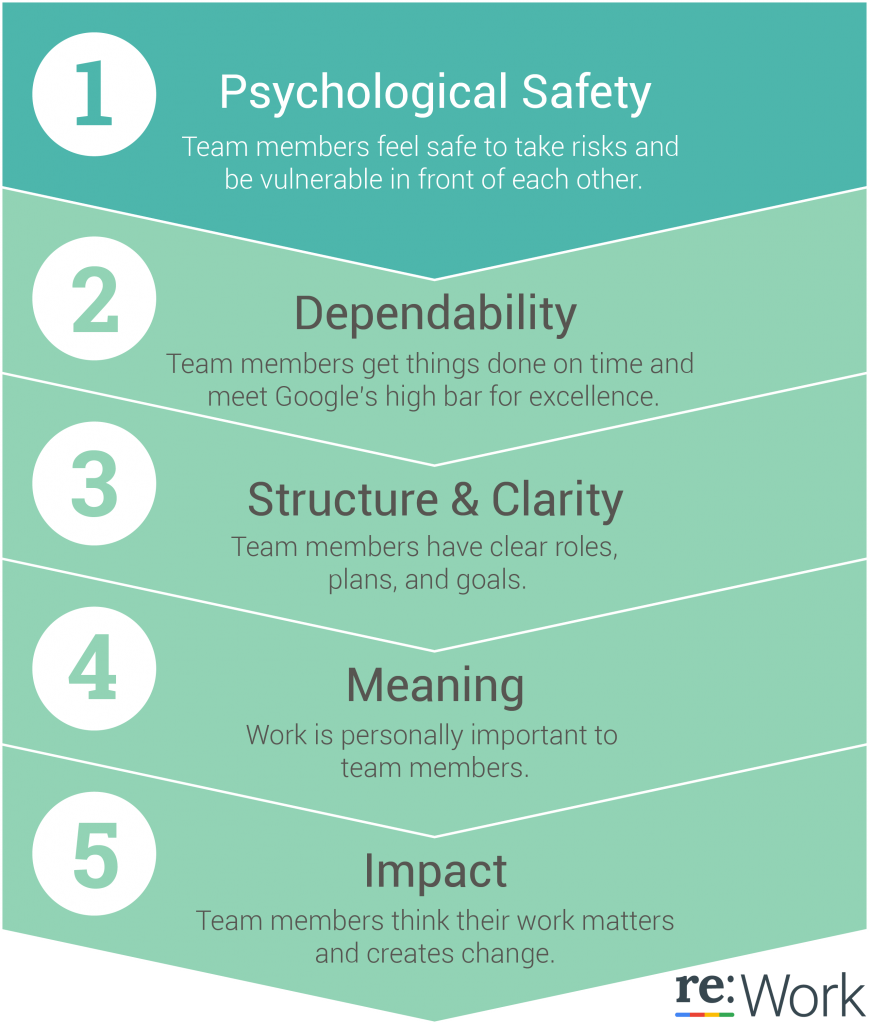
    They learned that there are five key dynamics that set successful teams apart from other teams at Google:

    1. Psychological safety: Can we take risks on this team without feeling insecure or embarrassed?
    2. Dependability: Can we count on each other to do high quality work on time?
    3. Structure & clarity: Are goals, roles, and execution plans on our team clear?
    4. Meaning of work: Are we working on something that is personally important for each of us?
    5. Impact of work: Do we fundamentally believe that the work we’re doing matters?

    If you answered “yes” to the five questions above, congrats! You’re probably on a high-performing team. And if not, not all hope is lost. This is a shortcut to help you figure out where to focus, how to get better, and a way to talk about this concept with your teammates in a structured way.

    Psychological safety was far and away the most important of the five dynamics they found — it’s the underpinning of the other four. How could that be? Taking a risk around your team members seems simple. But remember the last time you were working on a project. Did you feel like you could ask what the goal was without the risk of sounding like you’re the only one out of the loop? Or did you opt for continuing without clarifying anything, in order to avoid being perceived as someone who is unaware?

    Turns out, we’re all reluctant to engage in behaviors that could negatively influence how others perceive our competence, awareness, and positivity. Although this kind of self-protection is a natural strategy in the workplace, it is detrimental to effective teamwork. On the flip side, the safer team members feel with one another, the more likely they are to admit mistakes, to partner, and to take on new roles. And it affects pretty much every important dimension we look at for employees. Individuals on teams with higher psychological safety are less likely to leave Google, they’re more likely to harness the power of diverse ideas from their teammates, they bring in more revenue, and they’re rated as effective twice as often by executives.

  • Boss vs Leader: 12 Defining Characteristics of a Leader

    There seems to be a lot of these type of artwork around and they can paint a bit of a black and white picture but can be an interesting test when thinking about your own behaviours.

    12. Leaders Focus on Sustainable Solutions – Not Quick Fixes.

    A boss will teach you what to do. A leader will show you how and why to do it.

    A focus on the why is one of the most critical leadership approaches because it makes learning sustainable and transferable to other situations. Sustainable learning and self-reliance are huge deterrents of toxic leadership and micromanaging.

    Boss vs Leader: One of the key characteristics of a leader is to teach.

    11. Leaders Have a High Emotional Quotient (EQ).

    A boss is a subject matter expert. A leader is an emotional and people expert. Great leaders are very sensitive, albeit not emotional which is why they have fantastic strategies for conflict resolution in teams.

    There is a difference. Sensitive is how in tune you are with feelings. Emotional is your reaction to those feelings or a situation. Although we can’t control our feelings, we can certainly control our reaction to those feelings which is our emotional display.

    Leader versus boss: Leaders are people experts. Bosses are SMEs.

    10. Leaders Want You to Feel Successful.

    Bosses need you to perform well for their success. A leader wants you to feel successful even if you failed.

    One of the incredible characteristics of a leader is linking individual success to the success of those they lead. If those people do not succeed, the leaders have failed in both their minds – and hearts.

    Boss vs Leader: One of the characteristics of a leader is making you feel – and be – successful.

    9. Leaders Build Self-Accountability.

    A boss holds you accountable. A leader grows the confidence and passion from within you to build self-accountability.

    It is an incredible process to watch unfold and supports sustainable success all around. This is one the many differences between leadership and management.

    Boss vs Leader: Leaders build an inner desire to hold yourself accountable.

    8. A Leader Measures Success Differently Than a Boss.

    Bosses determine their success by a title position or hierarchy in the business. A leader – especially a born leader – influences anywhere and everywhere.

    Leaders define their success by the passion and impact of the people they influence. This is why I believe great leaders are born.

    One of the delineating characteristics of a leader is how success is measured.

    7. Bosses Depend on Authority. Leaders Depend on Influence.

    One of the biggest delineators of the boss vs leader is authority dependency. A boss depends on positional power to have an impact. Leadership influence in not dependent on power or position.

    Some of the most fantastic leaders I have encountered had no authority over the people they influenced.

    Leader vs Boss: A leader does not need the power to control.

    6. Leaders Focus on What’s Right.

    A boss focuses on what is right now – putting out the daily fires. A leader stays focused on doing what is right.

    Out of all the characteristics of a leader, the ability to force your decisions past the chaos at the moment is the difference between success and failure.

    Characteristics of a Leader: Do what’s right, not what’s right now.

    5. Leaders Operate by Their Legacies. Bosses Operate By Their Competition.

    A boss focuses decisions on the competition. Leaders stay aware of their competition but operate with a legacy definition in mind. This also supports not making potentially bad decisions at the moment and focusing on the future.

    Have you ever noticed an Olympian swimmer? The swimmer on either side is not their focus. Their focus stays on what they need to do to nail their legacy – winning the gold.

    Boss vs Leader – A leader understands the competition but operates with a legacy in mind.

    4. Leaders are Motivated by Passion and Purpose. Bosses are Driven by Fear.

    Bosses – and bad leaders – are driven by fear and reaction. A leader stays driven by passion and purpose – even during the challenging times of business change and transformation.

    Boss vs Leader: One of the characteristics of a leader is a drive for passion and purpose – always.

    3. Leaders Want You to Be More Successful Than They Are. A Boss Always Wants to Be the Boss.

    This is a HUGE definer of a boss vs leader. A boss always wants to stay your boss. A leader – much like a parent – wants you to do better.

    A leader would proudly build you to ‘the boss’ and build your career progression plan to make it a reality.

    Leader vs Boss: A boss always wants to be – your boss.

    2. Leaders Get Joy From Others’ Successes.

    No – I am not talking about Janet Jackson. A boss gets pleasure from being recognized for doing a great job. Leaders get pleasure out of seeing others rewarded for the fantastic results of their passion.

    Imagine living in a world where everyone had the same pleasure principle as a leader. Amazing.

    Leader versus Boss: Getting joy and being motivated by the success of others – that is one of the supporting characteristics of a leader.

    1. Leaders Build Your Confidence. Bosses Build Your Fear.

    Bosses keep you wondering or in fear just enough so that you tell them what they want to hear. At the least, bosses condition you not to say what they do not want to hear. This is why bosses don’t need a conflict management strategy – they just expect for everyone to agree with them.

    Leaders build your confidence and trust so you will tell them what they need to hear. They know leadership and trust are necessary to be influential.

    It may not be fun, but getting the full picture – the good and the bad – and being objective about it is one of the characteristics of a leader that fosters continuous growth, happiness, and success.

    Leader versus Boss: One of the top characteristics of a leader is to build your confidence – and success.

  • Everyday Leadership

    This TED Talk was shared with me by somebody in Digital Trading about leadership. For me though a bigger part of this was about recognition and a call to action around recognising people regardless of hierarchy, how big or how small, if somebody does something you think is good, why not tell them?

  • 50 Essential Management Tips

    For those of you that prefer a digital version of the booklet from The Academy around the top 50 tips for line managers you can download or read a copy below.

  • 8 Teamwork Myths To Tackle At Your Office

    teamwork tips

    When was the last time you stopped to think about one of the most important relationships in your life? One that consumes a huge portion of your time, energy, and has a huge impact on your future? That’s right, we’re talking about the one you have with your team at work.

    With long to-do lists and non-stop meetings, you might not have enough time in any given day to stop and really think about your co-workers. In fact, the whole point is to get the job done.

    But what if we told you that thinking about how your team members relate to each other would make all the difference to your bottom line?

    As we’ve discovered in a recent survey, professionalism isn’t a patch to cover up a team’s underlying emotional connections. In fact, there are a number of assumptions about teamwork out there that might be getting in the way of better performing teams.

    The Survey Says…

    We set out to explore what teamwork in modern offices is all about, in partnership with join.me and HipChat.

    After surveying over 1,000 knowledge workers across the United States, we discovered team truths we weren’t expecting.

    For example, people feel twice the emotional reward when given recognition as an individual rather than as a team. Additionally, Millennials love working in teams, but they’re not so keen on texting with colleagues. Furthermore, it’s still the case that (gasp) phone calls are used more between colleagues than video meetings or chat apps.

    Here are some more notable truths we uncovered:

    • Teamwork may or may not inspire co-workers: One-third of surveyed professionals prefer to work on a team, one-third prefer to go solo, one-third are fine either way!
    • Remote work doesn’t hinder teamwork: 32% of professionals we surveyed work remotely at least once a week, and the vast majority (83%) said it had little-to-no negative impact on their teamwork.
    • But communication is the biggest team improvement wish: Over 20% of respondents would like to communicate with their team members more often, and an additional 20% would like to communicate more efficiently in meetings.

    Are any of these insights making you look differently at how your team works?

    Perspective starts with knowledge, so we’ve collected the most valuable data and key lessons from the survey in one office-friendly presentation.

    Take a look, share with your team, and discuss what you think about these eight biggest teamwork myths of the modern office:

    Collaborate For Extra Credit

    We partnered with two other collaborative companies on this initiative to help teams explore better ways to work together. The tool tips in the above presentation outline ways you can use project collaboration (Trello), chat communication (HipChat), and video connections (join.me) to create a teamwork structure that works regardless of time, location, or device.

    Check out these additional ideas on how to build a collaborative toolset for your team:

    If we’ve learned anything, it’s this oh-so-golden rule: Keep your team connected in a positive, well-balanced way in order to keep your work, and work relationships, at their best.

  • Why the best hire might not have the perfect resume

    Given the choice between a job candidate with a perfect resume and one who has fought through difficulty, human resources executive Regina Hartley always gives the “Scrapper” a chance. As someone who grew up with adversity, Hartley knows that those who flourish in the darkest of spaces are empowered with the grit to persist in an ever-changing workplace. “Choose the underestimated contender, whose secret weapons are passion and purpose,” she says. “Hire the Scrapper.”

  • What it takes to be a great leader

    The world is full of leadership programs, but the best way to learn how to lead might be right under your nose. In this clear, candid talk, Roselinde Torres describes 25 years observing truly great leaders at work, and shares the three simple but crucial questions would-be company chiefs need to ask to thrive in the future.