Blog

  • Boss vs Leader: 12 Defining Characteristics of a Leader

    There seems to be a lot of these type of artwork around and they can paint a bit of a black and white picture but can be an interesting test when thinking about your own behaviours.

    12. Leaders Focus on Sustainable Solutions – Not Quick Fixes.

    A boss will teach you what to do. A leader will show you how and why to do it.

    A focus on the why is one of the most critical leadership approaches because it makes learning sustainable and transferable to other situations. Sustainable learning and self-reliance are huge deterrents of toxic leadership and micromanaging.

    Boss vs Leader: One of the key characteristics of a leader is to teach.

    11. Leaders Have a High Emotional Quotient (EQ).

    A boss is a subject matter expert. A leader is an emotional and people expert. Great leaders are very sensitive, albeit not emotional which is why they have fantastic strategies for conflict resolution in teams.

    There is a difference. Sensitive is how in tune you are with feelings. Emotional is your reaction to those feelings or a situation. Although we can’t control our feelings, we can certainly control our reaction to those feelings which is our emotional display.

    Leader versus boss: Leaders are people experts. Bosses are SMEs.

    10. Leaders Want You to Feel Successful.

    Bosses need you to perform well for their success. A leader wants you to feel successful even if you failed.

    One of the incredible characteristics of a leader is linking individual success to the success of those they lead. If those people do not succeed, the leaders have failed in both their minds – and hearts.

    Boss vs Leader: One of the characteristics of a leader is making you feel – and be – successful.

    9. Leaders Build Self-Accountability.

    A boss holds you accountable. A leader grows the confidence and passion from within you to build self-accountability.

    It is an incredible process to watch unfold and supports sustainable success all around. This is one the many differences between leadership and management.

    Boss vs Leader: Leaders build an inner desire to hold yourself accountable.

    8. A Leader Measures Success Differently Than a Boss.

    Bosses determine their success by a title position or hierarchy in the business. A leader – especially a born leader – influences anywhere and everywhere.

    Leaders define their success by the passion and impact of the people they influence. This is why I believe great leaders are born.

    One of the delineating characteristics of a leader is how success is measured.

    7. Bosses Depend on Authority. Leaders Depend on Influence.

    One of the biggest delineators of the boss vs leader is authority dependency. A boss depends on positional power to have an impact. Leadership influence in not dependent on power or position.

    Some of the most fantastic leaders I have encountered had no authority over the people they influenced.

    Leader vs Boss: A leader does not need the power to control.

    6. Leaders Focus on What’s Right.

    A boss focuses on what is right now – putting out the daily fires. A leader stays focused on doing what is right.

    Out of all the characteristics of a leader, the ability to force your decisions past the chaos at the moment is the difference between success and failure.

    Characteristics of a Leader: Do what’s right, not what’s right now.

    5. Leaders Operate by Their Legacies. Bosses Operate By Their Competition.

    A boss focuses decisions on the competition. Leaders stay aware of their competition but operate with a legacy definition in mind. This also supports not making potentially bad decisions at the moment and focusing on the future.

    Have you ever noticed an Olympian swimmer? The swimmer on either side is not their focus. Their focus stays on what they need to do to nail their legacy – winning the gold.

    Boss vs Leader – A leader understands the competition but operates with a legacy in mind.

    4. Leaders are Motivated by Passion and Purpose. Bosses are Driven by Fear.

    Bosses – and bad leaders – are driven by fear and reaction. A leader stays driven by passion and purpose – even during the challenging times of business change and transformation.

    Boss vs Leader: One of the characteristics of a leader is a drive for passion and purpose – always.

    3. Leaders Want You to Be More Successful Than They Are. A Boss Always Wants to Be the Boss.

    This is a HUGE definer of a boss vs leader. A boss always wants to stay your boss. A leader – much like a parent – wants you to do better.

    A leader would proudly build you to ‘the boss’ and build your career progression plan to make it a reality.

    Leader vs Boss: A boss always wants to be – your boss.

    2. Leaders Get Joy From Others’ Successes.

    No – I am not talking about Janet Jackson. A boss gets pleasure from being recognized for doing a great job. Leaders get pleasure out of seeing others rewarded for the fantastic results of their passion.

    Imagine living in a world where everyone had the same pleasure principle as a leader. Amazing.

    Leader versus Boss: Getting joy and being motivated by the success of others – that is one of the supporting characteristics of a leader.

    1. Leaders Build Your Confidence. Bosses Build Your Fear.

    Bosses keep you wondering or in fear just enough so that you tell them what they want to hear. At the least, bosses condition you not to say what they do not want to hear. This is why bosses don’t need a conflict management strategy – they just expect for everyone to agree with them.

    Leaders build your confidence and trust so you will tell them what they need to hear. They know leadership and trust are necessary to be influential.

    It may not be fun, but getting the full picture – the good and the bad – and being objective about it is one of the characteristics of a leader that fosters continuous growth, happiness, and success.

    Leader versus Boss: One of the top characteristics of a leader is to build your confidence – and success.
  • Everyday Leadership

    This TED Talk was shared with me by somebody in Digital Trading about leadership. For me though a bigger part of this was about recognition and a call to action around recognising people regardless of hierarchy, how big or how small, if somebody does something you think is good, why not tell them?

  • What is Blockchain?

    Let’s address the elephant in the room; the misconceptions people have about what blockchain means in general. Simply put –

    Blockchain ≠ Bitcoin

    Bitcoin or Altcoins (bitcoin alternatives) are digital currencies, also called as ‘Cryptocurrencies’. These are a digital token that allows users to pay for goods and services. Blockchain is the technology that enables the transfer of these digital assets. Though the launch of Bitcoin was the reason behind the conception of Blockchain, this technology has much more to offer, the applications of which we would delve further into detail in our subsequent posts.

    So the first question, what is blockchain?

    “Blockchain is an incorruptible digital ledger of economic transactions that can be programmed to record not just financial transactions but virtually everything of value.”
    – Don & Alex Tapscott, authors: Blockchain Revolution

    Simply put, it’s a digital ledger. But unlike a bank/financial institution/governing body’s ledger, it is not centrally controlled but is distributed across a network. This distributed ledger shared across a peer-to-peer network, stores transaction data and balances as well as validates transactions.

    In a typical everyday scenario, we keep our transaction data private, only sharing it with certain people close to us. In a public blockchain, the transactions in the ledger are open and public, but at the same time, users are pseudonymous (hidden). This means that though the record is public, the names of parties involved in the transaction are not, which is fundamentally revolutionizing.

    Now, you might have these questions:

    1. What is a distributed ledger?
    2. How does it work?
    3. What are the different components of the network?
    4. Why is it so secure and immutable?

    Let us try to answer these :

    1. Distributed ledger

    A distributed ledger allows the database of transactions to be available at multiple locations, unlike a traditional centralized database, where a central authority is involved. To illustrate this difference, let us look at the traditional method of a digital ledger –

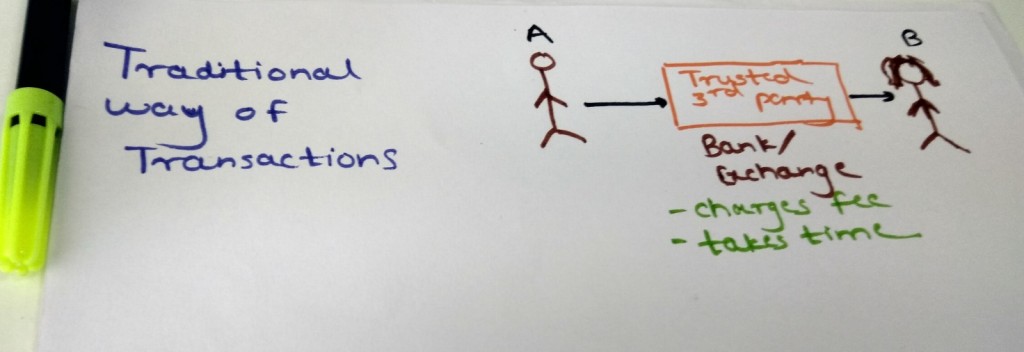
    A transfers money/stocks to B through centralized authority like Banks/Exchanges

    Let’s consider an example wherein A wants to transfer $100 to B. Typically, A requests for the transfer through a bank which is a trusted third party overseeing this transaction. In return, bank verifies the credibility and charges some fee for conducting this operation.

    From this example, we can recognize the following characteristics of Traditional Ledgers:

    1. Centralization: It has a central authority that governs the data and user access permissions, thus, ensuring security.
    2. Single point of Failure: If the governing authority is compromised, the database is exposed to huge risk and failure.
    3. Validity of transactions: The central authority is responsible for validation of all transactions, thus, being the only gatekeeper of trust.

    Now, let us see how this process works from bitcoin’s perspective-

    A Typical transaction in a peer to peer network

    For ease of understanding, let us take an example of a 4 member peer-to-peer network, with no central authority. A has $100 and wants to transfer $20 to B. First, members of the network (either C and D) verify whether A has sufficient balance in his ledger. The digital ledger is present on everyone’s computer and the transaction gets updated in all the ledgers in the network. i.e., The transaction of $20, with A being left with $80 balance and B getting $20 gets updated on the network with each peer. (Our description here is simplified, we will talk more about roles like buyers/sellers/miners below)

    From this we can derive the characteristics of Decentralized Blockchain Database:

    1. Open and Public: Everyone in the network has access to the ledger and transaction data as it’s stored at all nodes in the network. Hence, it is public and the information is easily accessible.
    2. Distributed risk: The power and access are distributed across all the participants in the network making it difficult for hackers to tamper with data.

    Now let’s address the second question.

    2. How does it work?

    Here’s an infographic by Blockgeeks that explains the transaction flow-

    Source: Blockgeeks

    Now, going deeper, let us take the same example as before –

    • A wants to transfer $20 to B. (Same example from above)
    • B announces this to the network. At this point, the transaction is not validated yet.
    • C and D play the same role as above, i.e., they check A’s balance against the network ledger, authenticate the transaction at their nodes on the blockchain and progress it forward.

    3. To validate the transaction, the concept of mining is being used. Let us look at the various components in this system-

    • Buyer: This member bought some product/service from the seller, so is paying the seller. In our case, it is A.
    • Seller: This member is selling his product/service. In this case, it is B. He is getting paid $20 from A for his product/service.
    • Miners: Here, C and D are the miners. Miners are the members in the network who validate and establish the proof of work, by solving a mathematical problem. To solve this, they employ their computational resources. In mining, the person who solves this problem first gets a reward for investing his computational power for this transaction. In this case, let’s say D becomes successful in mining, so he publishes the hash value of the transaction, other peers in the network verify it and a block is added to the digital ledger at every node. This system rewards the first person to solve the problem.
    • Consensus: Other members need to be on the same consensus after the update. Thus, tampering is prevented.

    4. Why is it so secure and immutable?

    The nature of blockchain is open, public and distributed across all the nodes. If one wants to verify any transaction details, then he/she can check all of the transactions all the way till genesis (first) block across all nodes. Hence any effort to tamper it would require changing all the subsequent data, present on every single node. This makes it more of a ‘system of record’ as compared to mere ‘database’. Also, adding any data in the blockchain needs a consensus from the peers in the network. Hence, it’s secure and immutable.

    5. Do you really need blockchain?

    This is perhaps the most important question. Before investing in the concept, you need to understand its merits and limitations. There are certain Decision Trees developed by multiple people and organizations to help you out.We will explore this direction in further detail in the next article of the series, looking into applications of blockchain. As an overview –

  • Marketers Agree: Humans Are The Most Important Ingredient of Martech Success

    A recent Wipro Digital survey found that CMOs and their organizations aren’t satisfied with results from their martech investments. Andy Coghlan, Global Head of Martech and eCommerce, Wipro Digital, delves into the steps marketing teams need to take to bring martech to full potential 

    When it comes to marketing technology, CMOs and their teams have been on a shopping spree. In the United States alone, CMOs are expected to spend over $122 billion on marketing-related technology by 2022. While the promise of martech and its spending goes up, organizations are failing to realize its full potential.

    According to an April 2018 Wipro Digital survey of enterprise senior executives in the U.S. and U.K., more than one-third of marketing executives report that fewer than half of their team has the necessary expertise to deploy martech effectively. Worse, while the survey found that 75% of marketing executives are confident in their own martech proficiency, only 6% believe that most of their marketing team is martech conversant. Yet, while more than half of executives noted that this lack of martech competency was a “barrier to success” a full 62% reported that they plan to increase martech spending in 2019.

    If spending is set to increase but marketing teams remain ill-equipped or unprepared, are organizations falling into a trap of throwing money at tech to solve a fundamentally human problem?

    Martech is not a panacea, nor is it something that marketers can set-and-forget; organizations achieve the best results when they understand that marketing technologies are tools and that marketers must be properly educated in order to use deploy and leverage those tools effectively.

    Increasingly, organizations are becoming aware that while next-generation marketing technologies are critically important to success, so too are the drivers behind the wheel. It’s these people and their ability to understand and operate these technologies that are creating the biggest value centers in the organizations. On the flip side, it’s becoming increasingly apparent that lacking these mission-critical martech skillsets is no longer an option. Here’s what savvy organizations are doing to ensure that they’re maximizing the potential of their martech investments:

    1. Technology experience is no longer optional

    As traditional (e.g. non-digital) marketing shrinks in relation to online and digital marketing efforts driven by technology, the lines between marketing savviness and technology savviness continue to blur. In fact, the survey found that more than half of marketing leaders report a technology-related degree. Marketers with technology experience or a technology background are better equipped to understand data analytics and how to use data for marketing initiatives; how sales and marketing automation can rapidly increase results; how to A/B test; and much more. Seeking candidates with these skills can help organizations maximize their martech spend.

    2. Reskilling marketers to become fluent in marketing technology

    As with hiring tech-savvy workers, organizations must also support existing marketing teams that have the depth of knowledge about the product, customer, company, and industry but less knowledge about the technology tools that they can use to maximize their efforts. The survey revealed that 84 percent of enterprises have reskilling programs already in place, indicating that executives know that simply throwing money at tech will not increase results — they must help ensure its proper use. In tandem with tech investments, CMOs must invest in educating marketers — many of whom may not be tech-savvy — about how to use the latest generation of technologies.

    3. Ensuring a martech advocate at the highest level

    With martech tech expenditures becoming a larger line item every year — combined with reskilling programs and an increased focus on hiring (expensive) tech talent — it’s understandable that C-level leadership will want to know how martech works, its importance, and how results map to spend. Perhaps that’s why 8 in 10 executives reported that CMOs should have martech qualifications and why a majority of CMOs reported that they have at least two years of martech experience. Martech isn’t simply tactical, it’s operational at every level and executives across the spectrum should have a good understanding of how it works, why it’s valuable, and how to create successful strategies that leverage martech to achieve company-wide results.

    Martech investments can only be optimized when the teams using them know how to properly utilize and generate creative initiatives. Organizations must invest equally in their marketing teams and the CMOs leading them so that they’re fully-equipped to choose, deploy, and operate the most suitable marketing technologies for their organization. By reskilling marketing teams, bringing on more tech-centric talents, and creating advocacy for marketing technologies at every level of the organization, organizations will be able to better realize its full potential.

  • The weirdest driving laws around the world

    The best thing about these strange driving laws is that you just know that someone had to have done something odd for lawmakers to decide they need to make things official. While most of the wacky laws you’ll hear about elsewhere are nothing more than urban legends, these ones are very real.

    I have no idea why some of these laws were created, but if the goal was our amusement, they’re definitely accomplishing that.

    You’re not allowed to drive for one day every week – Manila, Philippines

    Manila’s infrastructure wasn’t initially built to accommodate the amount of people that live in the densely populated bustling city today, so traffic became a major issue. In response, Metro Manila started their “vehicle volume reduction program” in 1995, restricting everyone to driving only six days a week. Since making everyone stop driving on the same day would only increase the traffic during the other six, the day of week on which you can’t drive is determined by the last digit of your license plate. Violating this law will incur a fine of 300 Pisos (around $5.70 USD) for your first three offenses.

    You’re not allowed to pump your own gas – Oregon and New Jersey, USA

    It took until January of this year for it to become legal for Oregonians in counties of less than 40,000 people to fill up their own tanks. This means that up until this new law passed, 18 counties were not allowed to have self-serve gas stations. Oregon’s legislature apparently had 17 reasons for banning the practice in the first place, most of which are safety-related. The wildest thing about this law is that the one in New Jersey is still in effect!

    You have to keep a breathalyzer in your vehicle – France

    This regulation is a weird one because it is technically a legal requirement, but the fine for not following it was postponed indefinitely by the French government in 2013. Basically, there is no consequence to disobeying this rule, though it could be reinforced in the future. It seems like this law is more of a symbolic gesture to remind drivers not to drink and drive. That, or law enforcement was just running low on breathalyzers. Either way, if you’re driving in France, you should probably have one in case they start enforcing this one again (also because it’s the right thing to do).

    Horse-drawn sleighs must have at least two bells – Ontario, Canada

    The idea behind this law is that two bells are better than one when it comes to warning other vehicles of your presence. While that is accurate, these days an extra bell isn’t going to do much against a dozen roaring engines. It also begs the question, what happened to the one-belled sleigh that must have sparked the creation of this law? We hope no horses were harmed in the making of this law.

    No swearing – Rockville, Maryland, USA

    If you’re driving in Rockville, you’d better keep any road rage under control. Cursing or using “obscene language” anywhere near a street or sidewalk is a misdemeanor. Now this is a law we can get behind. It’s natural to get a little frustrated from time to time, but cussing won’t make the person in front of you a better driver. This also means fewer people blasting expletive-heavy music so loud it rattles your teeth. Wait… maybe that’s why they made this law in the first place!

    Taxi drivers have to pay to play – Finland

    Finland doesn’t joke around with their copyright laws. In 2002 Finland’s Supreme Court decided that turning on the radio in a taxi constitutes as a public performance. Cab drivers now have to pay royalties (an annual fee around 18 USD) to be able to play music for their passengers, so, unsurprisingly, some cabbies now opt to drive in silence.

  • Analytics Maturity Model

    The below diagram illustrates a generally agreed maturity model for analytics. You may find you don’t exactly fit in any of the below boxes but the purpose is to highlight what basic and strong analytics are and unsurprisingly the most successful organisations are often at the higher end of this model.

    It’s often easier for smaller or newer businesses to get there as they have a greater degree of agility but it’s worth recognising the value of pushing the business forward on this curve. It’s especially challenging to get business buy in for analysts to focus on where they can add the most value rather than spending their time working on basic reporting which anybody could learn with a degree of training.

  • Eisenhower Matrix

    I suspect most of you will have seen this grid before but I wanted to write something you had to refer back to and some detail around the model for those of you who could do with a hand managing your workload, which we all need from time to time.

    The Eisenhower Matrix, which is also known as the Urgent-Important Matrix, helps you prioritize your tasks based upon their urgency and importance. It also allows you to identify tasks that you should either delegate or leave undone.

    You can even build this in to a Trello board to help you manage your workload. There’s some more detail at the bottom but you may also want to checkout http://www.eisenhower.me/ which has a web app, iPhone app, links to buyable notepads on Amazon with the matrix. I’ve also put a link here to a downloadable PDF template of the grid as a tick box sheet for those of you who love paper!

    How President Eisenhower Used This Matrix

    Prior to becoming the 34th President of the US, Dwight Eisenhower served as a general in the army, and as the Allied Forces Supreme Commander during World War II. During his time in the army, Eisenhower was faced with many tough decisions concerning the tasks he had to focus on every day. This led him to invent a principle that helps us prioritize our tasks by urgency and importance.

    Using the Eisenhower Matrix

    This Eisenhower matrix results in four quadrants with various strategies. Stephen Covey, author of The Seven Habits of Highly Effective People, further popularized Eisenhower’s concept of this time management matrix by supporting Eisenhower’s use of four quadrants to determine the urgency of one’s tasks.

    Here is how the four quadrants work:

    Quadrant 1: Do First

    Quadrant 1 contains tasks that are both urgent and important. These are “do first” tasks because they are critical for your life or career in some way and need to be finished right away. You want to get these tasks done as soon as possible.

    These are the tasks that need to be done in order to avoid negative consequences. It is important to be able to manage the tasks that are in quadrant 1.

    An example of a quadrant 1 task in your career may be answering a time-sensitive email from a client. This matrix can also be used in your personal life. An example of a quadrant 1 task in your personal life may be a crying baby, a medical emergency, or something burning in the oven.

    Quadrant 2: Decide When

    The tasks in quadrant 2 are important, but not urgent. This is where you want to invest the majority of your time. Quadrant 2 tasks are in line with your long-term goals.

    What are some examples of these tasks? Well, exercising is important to your health, but you can decide when that can be done. It is also important to spend time with your family, but again, that can be aligned with your schedule. When it comes to your career, it may benefit you to obtain another degree or get a certificate of some sort. These things are important to your career, but they do not need to be done immediately.

    It is important to remember here that everyone has different goals and objectives, so just because something falls into quadrant 2 for you, it may not for the next person. Also, just because these tasks are not urgent does not mean that they are not important. People often associate urgent matters with being important, which is not always true. Because your goals will stay constant, anything that will be beneficial to you in the long term will fall into the second quadrant.

    Quadrant 3: Delegate It

    Do you ever feel that you put too much importance on a task that in hindsight was not very important? Or think something has to be done right away, and it actually doesn’t?

    If so, you are in good company.

    This common mistake often occurs when someone asks you to do something that does not directly benefit you or get you closer to achieving your goals. For quadrant 3 tasks, it is important to learn and remember how to delegate certain things.

    When you think something is urgent but it actually is not, it is usually an outside source of distraction. This may include constantly checking your email or phone, or responding to people as soon as they try to contact you. You may think it is urgent at the moment, so you stop what you are doing to tend to the matter. But in reality, it could wait.

    If you are in the middle of working on a project and the phone rings, it is not important for you to answer it. So, you can delegate this task to someone else. It may seem urgent at the time while it is happening, but these little things can be handled by other people.

    Quadrant 4: Delete It

    Honestly, you want to avoid quadrant 4 tasks. These tasks are simply a waste of your time, and they should be eliminated. If you are able to identify and eliminate all of your quadrant 4 tasks, you will free up some much-needed time to invest in your quadrant 2 tasks.

    Some examples of quadrant 4 tasks are playing video games, watching television shows that you have already seen, or mindless web browsing.

    Does that mean nothing in quadrant 4 should be a part of your life? No. Having a balance between your professional and personal life is important, and downtime helps you regain your energy. The challenge here is to spend most of your time in quadrant 2, and just enough time in quadrant 4 to get by.

    Procrastination and the Eisenhower Matrix

    Sometimes it is easy to mistake the differences between your tasks. Maybe you have a list of things you have to do that seem equally urgent and important, but can’t seem to get them all done. Part of procrastination is figuring out why you are procrastinating. Without doing this and addressing the matter, you are likely to spend a lot of time on quadrant 3 and quadrant 4 tasks that don’t really matter.

    It is easy to procrastinate on quadrant 2 tasks because, while they are important, they do not need to be done right away. If something more urgent comes your way, like a phone call or even just a favor for a co-worker, these are likely to take precedence in your mind, but end up being just another form of procrastination.

    How to Use the Eisenhower Matrix to See If You Are Procrastinating

    To see if you are spending the bulk of your time in the first two quadrants, do a one-week assessment. To do this, make six copies of a blank grid, and use one grid per day, listing the tasks you accomplished or the activities you did, and the time spent on each thing. When all of the grids are full, combine the Monday-Friday data onto your sixth summary grid and calculate how much time you spent in each grid, then break those numbers down into percentages. Evaluate how effectively you spent your time and whether your process needs to be reorganized.

    Brain Dump

    Why is this important? We live in a time-pressured world where you are likely to have multiple overlapping commitments that feel like they need to be done right away. This means that true urgency is not reserved for special instances, because urgent matters seem to be an everyday occurrence.

    You will not succeed in your career if you are constantly missing deadlines or letting truly urgent matters just sit on your desk. Instead, you have to learn how to manage your constant reception of responsibilities while still doing excellent work. The Eisenhower Matrix is an effective method to use to organize your priorities.

    As previously mentioned, this spills over into your personal life as well. For example, you may get a personal phone call at work that seems urgent but in reality is really not very important. That needs to fall into the appropriate quadrant in order for this strategy to be effective.

    If you see something that is urgent and important, and that will have a large impact on your future, set aside an entire half day to focus on it. Get rid of any possible distractions, turn off your email and phone, close your door, or even take the project to a remote office area where no one can distract you. Complete the task so you can cross it off your list.

    It is easy to spend the bulk of your time in quadrants 1 and 3, and very little time in quadrant 2. Quadrant 3 is popular because it makes you look and feel busy. However, in order to be productive and effective in the long-term, quadrant 2 should be where you put your main focus.

    You can also look at the matrix like this: Live most of your life in the upper part of the matrix. Work on quadrant 1 to get by and use the rest of your time in quadrant 2. Use quadrants 3 and 4 only when necessary.

    Eisenhower.me

    So this all sounds like a great idea in theory, but where do you get started? Eisenhower.me is a website that is created with simplicity in mind to make the process easy for you. They are able to let you know where your tasks fall in the quadrant grid through apps and strategies. This will then help you focus and work on the most important tasks. Eisenhower.me helps you prioritize and plan your schedule easily, while minimizing any stress and increasing your productivity.

    You may be thinking that this tool sounds old-fashioned, since it is associated with Dwight Eisenhower. It is an old idea, but it is widely accepted, and has been used successfully for decades.

    Following the guidelines presented on Eisenhower.me will benefit you by saving you time. Time cannot be purchased, and is often mismanaged by people. This tool gives you the opportunity to think about the time that you unconsciously waste every day.

    When you apply these practices to your professional and personal life, you are able to plan ahead, increase your effectiveness, and boost your efficiency. You want to be able to manage your work with your available time to avoid procrastinating, which will then help decrease stress. Improper time management can easily lead to stress and job burnout.

    Learning the principles of planning, prioritizing, delegating, and scheduling will help you see the right things to do in order to be successful. This is a simple matrix to help you achieve your goals and be successful in life.

  • What is NLP?

    NLP or Neuro Linguistic Programming in summary is the process of recognising a behaviour and creating a pre-programmed action. I’ve found it incredibly helpful in learning where I don’t react to a situation in the best way how to react in the ideal way. I’ve also coached people on it and they’ve found it effective too so worth giving it a go if you’d like to change the way you react to certain situations. It’s also a technique that can be effective for people who struggle with mental health or anger management. Please come and talk to me if you’d like anymore information.

    NLP is the practice of understanding how people organise their thinking, feeling, language and behaviour to produce the results they do. NLP provides people with a methodology to model outstanding performances achieved by geniuses and leaders in their field. NLP is also used for personal development and for success in business. A key element of NLP is that we form our unique internal mental maps of the world as a product of the way we filter and perceive information absorbed through our five senses from the world around us.

    Neuro

    Each individual has established their own unique mental filtering system for processing the millions of bits of data being absorbed through the senses. Our first mental map of the world is constituted of internal images, sounds, tactile awareness, internal sensations, tastes and smells that form as result of the neurological filtering process. The first mental map is called ‘First Access’ in NLP.

    Linguistic

    We then assign personal meaning to the information being received from the world outside. We form our second mental map by assigning language to the internal images, sounds and feelings, tastes and smells, thus forming everyday conscious awareness. The second mental map is called the Linguistic Map (sometimes known as Linguistic Representation)

    Programming

    The behavioural response that occurs as a result of neurological filtering processes and the subsequent linguistic map.

  • Number of years it took each product to gain 50 million users

    This is something I saw on the Digital Engineering teams Slack channel which gave me a laugh!