Blog

  • Why You Should Create a “Shadow Board” of Younger Employees

    I recently read a great article from the Harvard Business Review (HBR) on why you should create a “shadow board” to help tackle some of the increasing challenges around adapting to changes in your market.

    A lot of companies struggle with two apparently unrelated problems: disengaged younger workers and a weak response to changing market conditions. A few companies have tackled both problems at the same time by creating a “shadow board” — a group of non-executive employees that works with senior executives on strategic initiatives. The purpose? To leverage the younger groups’ insights and to diversify the perspectives that executives are exposed to.

    They seem to work. Consider Prada and Gucci, two fashion companies with a good track record of keeping up with — or shaping — consumer tastes. Until recently, Prada enjoyed high margins, a legendary creative director, and good growth opportunities. But since 2014, it has witnessed declining sales. In 2017, the company finally admitted that it had been “slow in realizing the importance of digital channels and the blogging online ‘influencers’ which are disrupting the industry.” Co-CEO Patrizio Bertelli said, “We made a mistake.”

    Over the same period, under the direction of CEO Mario Bizzarri, Gucci underwent a comprehensive transformation that made the company more relevant to today’s marketplace. Gucci created a shadow board composed of Millennials who, since 2015, have met regularly with the senior team. According to Bizzarri, the shadow board includes people drawn from different functions; they’re “the most talented people in the organization — many of them very young.” They talk through the issues that the executive committee is focused on and their insights have “served as a wakeup call for the executives.” Gucci’s sales have since grown 136% — from 3,497 million Euro (FY2014) to 8,285 million Euro (FY2018) — a growth driven largely by the success of both its internet and digital strategies. In the same period, Prada’s sales have dropped by 11.5%, from 3,551 million Euro (FY2014) to 3,142 million Euro (FY2018).

    HBR researched companies that use shadow boards, trying to understand what they really contribute to the organization and what best practices look like. HRB focus here on three companies’ experiences.

    Business model reinvention. Facing increasing pressure from Airbnb, French AccorHotels needed a new business model. Top management asked marketing to develop a brand for Millennials. However, after two years marketing came up empty. Arantxa Balson, chief talent and culture officer, decided to turn the project over to a shadow board. In 2018, the Jo&Joe brand was born. Considered “an urban shelter for Millennials,” the brand communicates creativity, flexibility, and a strong sense of community. According to Balson, the shadow board succeeded in part because they focused on their vision and developed their point of view “regardless of all internal and cost constraints.” The shadow board then gave birth to another innovation, the Accor Pass, a hotel subscription that provided people under 25 with a place to stay while they hunted for a permanent residence.

    Process redesign. Stora Enso, a Finnish paper and packaging company, used their shadow board (which they call Pathfinders and Pathbuilders) to revise how the executive committee assigned work. Until this shift, work was assigned to groups that the executives considered experts and therefore best suited to the assignment. The shadow board convinced them to assign certain tasks to non-experts, arguing that an unbiased view would increase the chance of breakthroughs. One project, aimed at reducing supply-chain lead time, had stumped a supposedly expert team. The new team came up with a workable plan within six months. No team members came from the business unit in question, nor had they any prior supply chain experience.

    Organizational transformation. CVL Srinivas, the CEO of GroupM India, needed to implement a three-year digital and cultural transformation. With that end in mind, he created the YCO (Youth Committee). Since its inception in 2013, the YCO has led GroupM’s Vision 3.0, making digital the centerpiece for driving future growth. Working across departments, the shadow board also led a scoping initiative focused on the digitalization of contracts. It strengthened GroupM’s ecosystem by increasing the number and improving the nature of partnerships with media owners, data providers, consultants, auditors, and start-ups. Additionally, the group noticed that there wasn’t much cross-agency interaction. To promote meaningful conversations, the YCO developed a social media platform (Yammer) that facilitated conversations between management and lower-level employees across agencies.

    Increased visibility for Millennials. Research suggests that Millennials crave more visibility and access, which shadow boards deliver. This visibility often results in significant career progression for shadow board members. At Stora Enso, a female shadow board member was a group-level financial controller when she began the program. As a result of her impressive work on a project involving one of their legacy businesses (paper), she was promoted to be the sales director of the largest paper segment a few months after the program’s end. As HR director Lars Haggstrom stated, “This [promotion] would never have happened had it not been for the shadow board program.”

    What are the best practices for implementing a shadow board?

    Look beyond the “high-potential” group. Many companies staff shadow boards exclusively through executive-committee nominations or with already identified high potentials. Millennial participants tend to prefer a more open process. Stora Enso’s Haggstrom pushed for an open-application process — allowing anyone who fit certain criteria to apply. Doing so not only created a more diverse cohort; it also allowed the company to discover some hidden gems who would not otherwise have been on the radar. Interestingly, they tested the performance of the company’s top forty high potentials (who were clear shoo-ins for the program) against the employees chosen via open enrollment. On abilities such as data analytic skills, sense-making, and teamwork, the open-enrollment members outperformed the high-potentials.

    Make it a CEO-sponsored program. In order for the program to have maximum impact, support needs to come from the top of the organization (though most are coordinated on a procedural level by HR). For example, AccorHotels’ shadow board program succeeds because CEO Sebastian Bazin plays an active role by interviewing potential members and regularly interacting with existing members. At Stora Enso, members reported directly to the CEO on issues related to the Pathfinders and Pathbuilders work.

    Keep evaluating and iterating. All of the companies HBR profiled adjusted the programs as they learned what worked (and what didn’t). For example, Stora Enso’s leaders reviewed the program annually and as a result added resources to better capitalize on diversity within the shadow board and interactions between the shadow board and executive committee. And while GroupM’s YCO program originated as a 12-month program, the organization extended it by one year in order for the YCO to maximize potential contributions.


  • 3 Ways to Spot a Bad Statistic

    In this delightful, hilarious talk, data journalist Mona Chalabi shares handy tips to help question, interpret and truly understand what the numbers are saying in a straight forward way.

  • John Szilagyi’s Multi-Billion $ Idea

    So something I often think about within the analyst community is what the role of creativity and ideas play. As analysts it can be uncommon to think creatively and often think more more logically.

    The unfortunately side effect of this however is if one of us can’t solve a problem the rest, faced with the same facts and logical rationale, can’t solve it either. Additionally we can sometimes fail to seek out and be open to new ideas. Logically what we have or do today works, why change it?

    There is a ton of research and development material touting much the same but the example I wanted to share is something I heard during a virtual conference recently and found quite astounding.

    In the US, in 1986 seven million children disappeared from the tax records. Now assuming there wasn’t some cataclysmic event, what could have possibly changed? Well…

    In the early 1980’s, an I.R.S. research officer in Washington named John Szilagyi had seen enough random audits to know that some taxpayers were incorrectly claiming dependants for the sake of an exemption (around $250 per dependant). Sometimes it was a genuine mistake (a divorced wife and husband making duplicate claims on their children), and sometimes the claims were comically fraudulent (Szilagyi recalls at least one dependent’s name listed as Fluffy, who was quite obviously a pet rather than a child).

    Szilagyi decided that the most efficient way to clean up this mess was to simply require taxpayers to list their children’s Social Security numbers. Naturally the response was ‘no’, and his manager pointed out the approval process it would have to go through, the cost involved in changing the form, etc. Effectively why introduce cost and effort to something that ‘works’.

    A few years later, however, with new leadership and a government desperate for more tax revenue, Szilagyi’s idea was reevaluated and put into law for tax year 1986. When the returns came in the following April, Szilagyi and his bosses were shocked, seven million children had suddenly vanished from the tax rolls, some incalculable combination of real pets and phantom children. Szilagyi’s clever twist generated nearly $3 billion in a single year.

    Szilagyi’s immediate bosses felt he should get some kind of reward for his idea, but their superiors weren’t convinced. Eventually, five years after his brainstorm became the law, Szilagyi, who earned about $80,000 annually at the time, was given a check for $25,000. By this point, his idea had generated roughly $14 billion.

    What really astonished me about this other than the amount is that out of the 10,000 odd employees that had worked in that department doing a similar role for decades, not a single one had presented the same idea. Something so simple, so obvious in hindsight. Perhaps if the I.R.S. had been quicker to recognised and reward Mr. Szilagyi more might have been inspired to follow in his footsteps!

  • Create custom shapes in PowerPoint

    PowerPoint 2010 has a new feature that’s very hard to find, but that people are praising over and over. It’s called Custom Shapes, and it’s a set of four tools that you can use to create your very own shapes. Why do you need Custom Shapes?

    • To make your slides unique.
    • For the flexibility to communicate your message in the way that works best for you and your audience.
    • For a professional, designer (custom-made) look.

    Usually, Microsoft highlights new features, but the Custom Shapes tools aren’t even on the ribbon! As a result, many people don’t know about them. First, I’ll tell you how to add them to your Quick Access toolbar, which is at the top-left corner of your PowerPoint window.

    At the right of the Quick Access toolbar, click the down arrow and choose More Commands.

    In the PowerPoint Options dialog box, you’ll see a Choose Commands From drop-down list at the top. Choose Commands Not in the Ribbon to make the Custom Shape commands easier to find.

    Scroll down the list of commands until you get to “Shapes.” You’ll see 4  commands–Shape Combine, Shape Intersect, Shape Subtract, and Shape Union. Select Shape Combine and click Add. Do the same with the other 3 commands that start with “Shape.”

    Click OK to close the PowerPoint Options dialog box. The commands are now on the Quick Access toolbar.

    What can you do with these tools? Almost anything! Here’s a quick summary:

    1. Union adds two shapes together
    2. Subtract subtracts them; select the one you want to keep first
    3. Intersect keeps just the intersection between the two if they overlap
    4. Combine cuts out the intersection between multiple shapes but also makes the result a freeform so you can edit points

    In this post, I’ll show you a simple example using the Shape Union command.

    How to use Union to create a simple custom shape

    Let’s say that you want to create a SmartArt diagram, but can’t find the shape you want. You want a space for a small, circular photo at the left, some text in the middle, and an arrow at the right. Here’s what you sketched on a napkin:

    Here are the steps to create this shape:

    1. Insert a circle. (Remember, you can press Shift as you drag the circle on the slide to make sure it’s a perfect circle, not an oval.)
    2. Insert a rectangle to the right of the circle. Resize and move it so that it looks like the above image. You’ll see the outline around each shape, but don’t worry about that now.
    3. Insert an isosceles triangle. To get the shape you want, you need to rotate it to the right. Press Shift and drag the little green rotation circle to the right. Then resize and move the triangle so that it matches up to the right side of the rectangle.

    Your shapes should look like this:

    1. Select all 3 shapes and click Shape Union on the Quick Access toolbar. (The command button isn’t active unless you select at least 2 shapes.)

    Your new, custom shape looks like this:

    Go ahead and add a photo (I added another circle on top and filled it with the photo) and text. You can add text to it, just like any shape that comes with PowerPoint!

    Here’s the final result:

    Now go forth and create your own custom shapes!

  • Psychological Safety

    At the Adobe Summit I saw a great talk around the importance of psychological safety in the workplace and how critical it is to high performing teams. So important in fact that Google launched a 2 year investigation that lead to it.

    Over two years they conducted 200+ interviews with Googlers (their employees) and looked at more than 250 attributes of 180+ active Google teams. They were pretty confident that they’d find the perfect mix of individual traits and skills necessary for a stellar team — take one Rhodes Scholar, two extroverts, one engineer who rocks at AngularJS, and a PhD. Voila. Dream team assembled, right?

    They were dead wrong. Who is on a team matters less than how the team members interact, structure their work, and view their contributions. So much for that magical algorithm.

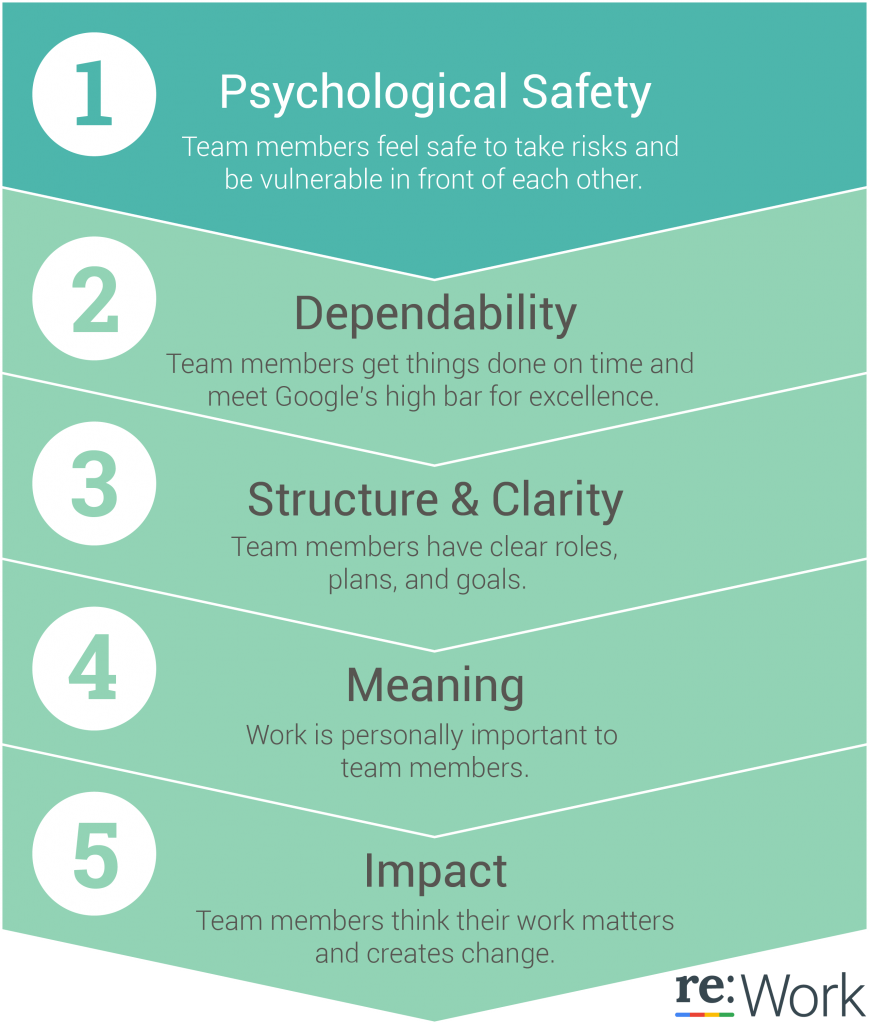
    They learned that there are five key dynamics that set successful teams apart from other teams at Google:

    1. Psychological safety: Can we take risks on this team without feeling insecure or embarrassed?
    2. Dependability: Can we count on each other to do high quality work on time?
    3. Structure & clarity: Are goals, roles, and execution plans on our team clear?
    4. Meaning of work: Are we working on something that is personally important for each of us?
    5. Impact of work: Do we fundamentally believe that the work we’re doing matters?

    If you answered “yes” to the five questions above, congrats! You’re probably on a high-performing team. And if not, not all hope is lost. This is a shortcut to help you figure out where to focus, how to get better, and a way to talk about this concept with your teammates in a structured way.

    Psychological safety was far and away the most important of the five dynamics they found — it’s the underpinning of the other four. How could that be? Taking a risk around your team members seems simple. But remember the last time you were working on a project. Did you feel like you could ask what the goal was without the risk of sounding like you’re the only one out of the loop? Or did you opt for continuing without clarifying anything, in order to avoid being perceived as someone who is unaware?

    Turns out, we’re all reluctant to engage in behaviors that could negatively influence how others perceive our competence, awareness, and positivity. Although this kind of self-protection is a natural strategy in the workplace, it is detrimental to effective teamwork. On the flip side, the safer team members feel with one another, the more likely they are to admit mistakes, to partner, and to take on new roles. And it affects pretty much every important dimension we look at for employees. Individuals on teams with higher psychological safety are less likely to leave Google, they’re more likely to harness the power of diverse ideas from their teammates, they bring in more revenue, and they’re rated as effective twice as often by executives.

  • Justice Index and LGBT Rights Worldwide

    During the Adobe Summit Amal Clooney, who was truly inspirational, talked about how they’re trying to use data to build a ‘justice index’ showing the quality of the justice system and laws in each country and how they change over time. The idea is that by being able to track this they would attempt to take action against countries where this measure was starting to decline.

    While not part of this project there’s a really interesting tool that’s been developed by the World Justice Project, not to be confused with DC Comics Justice Leauge! The tool shows the quality of the justice system in each county as a map visualisation here, they have far more detailed radar graphs by county here which you can click in to and see even more detail on.

    Something I find quite powerful when talking to people who aren’t aware is as of March 2019 it is still illegal to be gay in 70 countries! There are currently 6 UN Member States that impose the death penalty on consensual same-sex sexual acts, and a further five States where such a punishment is technically possible. In 26 other countries the maximum penalty can vary between 10 years to a life imprisonment.

    As a result there are many places I’m not willing to travel due the the risk I would face, places such as Dubai I could be sentenced to death and places like the Caribbean I could be sentenced to life in prison. I also wouldn’t risk travelling to places like Russia, Turkey or Egypt where I have no legal rights. The map below highlights as of March 2019 the legal status for LGBT rights around the world.

  • What’s the difference between a good rebel and a bad one?

    During the Adobe Summit a speaker referenced an article from “Rebels at Work” citing their definition of what makes up a ‘bad rebel’ and a ‘good rebel’ which I found a really interesting concept.

    How many people in your team, who are ‘rebels’ are rebels for the good or the bad reasons? Or how often have you been guilty of falling in to the bad rebel camp. Worth thinking about how you can be a better good rebel or bear it in mind when developing your team or hiring.

  • 24 cognitive biases that are warping your perception of reality

    We are each entitled to our own personal world view.

    Unfortunately, when it comes to interpreting information and making objective sense of reality, human brains are hard-wired to make all kinds of mental mistakes that can impact our ability to make rational judgments.

    In total, there are 180+ cognitive biases that mess with how we process data, think critically, and perceive reality.

    Flawed Human Reasoning

    There is no simple way to get around these basic human instincts, but one thing that we can do is understand the specific mistakes we make and why.

    Today’s infographic comes to us from School of Thought, a non-profit dedicated to spreading critical thinking. The graphic describes 24 of the key biases that warp our sense of reality, providing useful examples along the way.

  • The Four Laws of Combat

    Somebody in the team sent me this extract from a book they’re reading which I quite like the simplicity of, it’s a bit militant but I think the principle is quite valid.

    The first Law of Combat:

    Cover and Move. This is teamwork—every individual and team within the team, mutually supporting one another to accomplish the mission. Departments and groups within the team, and even those outside the immediate team that are nevertheless crucial to success, must break down silos and work together to win.

    It doesn’t matter if one element within the group does its job: if the team fails, everybody fails. But when the overall team wins, everybody wins. Everyone gets to share in that success.

    The second Law of Combat:

    Simple. Complexity breeds chaos and disaster, especially when things go wrong. And things always go wrong. When plans and orders get too complex, the people charged with executing those plans and orders do not understand them. When team members don’t understand, they can’t execute. Therefore, plans must be simplified so that everyone on the team recognizes the overall “commander’s intent”—the greater purpose behind the mission—and understands their role in achieving mission success.

    Orders must be communicated in a manner that is “simple, clear, and concise.” The true test for whether plans and orders have been communicated effectively is this: The team gets it. When the people on the team understand, then they can execute.

    The third Law of Combat:

    Prioritize and Execute. When multiple problems occur simultaneously (which happens often), taking on too many problems at once results in failure. It is imperative that leaders detach themselves—pull back from the details—and assess to determine the highest priority to the strategic mission. Then, once that highest-priority task has been determined, leaders must clearly communicate that priority to the team and ensure the team executes. Then the leaders and the team can move on to the next priority. Then the next.

    Training and proper contingency planning assist greatly to better prepare teams and leaders to most effectively Prioritize and Execute under pressure, in real time.

    The fourth Law of Combat:

    Decentralized Command. No one leader can manage it all or make every decision. Instead, leadership must be decentralized, with leaders at every level empowered to make decisions, right down to the frontline troopers in charge of no one but themselves and their small piece of the mission. With Decentralized Command, everyone leads. To empower everyone on the team to lead, team members must understand not just what to do but why they are doing it. This requires clear and frequent communication up and down the chain of command—and most importantly: trust.

    Junior leaders must have confidence that they clearly understand the strategic mission, the commander’s intent of their boss, and the parameters within which they can make decisions. Senior leaders must trust that their junior leaders will make the right decisions and encourage them to do so. This requires training and frequent communication to implement with maximum effectiveness.

  • The Beauty of Data Visualization

    Not just a talk about how ‘pretty’ data visualisation is but how it can help to tell a story and the importance of visualising stuff appropriately to avoid people taking the wrong message.