
Category: Development
-
An unexpected tool for understanding inequality: abstract math
How do we make sense of a world that doesn’t? By looking in unexpected places, says mathematician Eugenia Cheng. She explains how applying concepts from abstract mathematics to daily life can lead us to a deeper understanding of things like the root of anger and the function of privilege. Learn more about how this surprising tool can help us to empathize with each other.
-
Privilege/Class/Social Inequalities Explained in a $100 Race
This moving video about privilege demonstrates how inequality isn’t about something you’ve done or a choice you have made but the environment you are in. Many of us have experienced adversity and worked hard to get where we are, as a result we tend to believe we deserve what we have. It’s important to consider though if even through the adversity and hard work we would still be where we are without some of the invisible advantages we may have had in life.
-
The Feedback Fallacy
The debate about feedback at work isn’t new. Since at least the middle of the last century, the question of how to get employees to improve has generated a good deal of opinion and research. But recently the discussion has taken on new intensity. The ongoing experiment in “radical transparency” at Bridgewater Associates and the culture at Netflix, which the Wall Street Journal recently described as “encouraging harsh feedback” and subjecting workers to “intense and awkward” real-time 360s, are but two examples of the overriding belief that the way to increase performance in companies is through rigorous, frequent, candid, pervasive, and often critical feedback.
How should we give and receive feedback? we wonder. How much, and how often, and using which new app? And, given the hoopla over the approaches of Bridgewater and Netflix, how hard-edged and fearlessly candid should we be? Behind those questions, however, is another question that we’re missing, and it’s a crucial one. The search for ways to give and receive better feedback assumes that feedback is always useful. But the only reason we’re pursuing it is to help people do better. And when we examine that—asking, How can we help each person thrive and excel?—we find that the answers take us in a different direction.
To be clear, instruction—telling people what steps to follow or what factual knowledge they’re lacking—can be truly useful: That’s why we have checklists in airplane cockpits and, more recently, in operating rooms. There is indeed a right way for a nurse to give an injection safely, and if you as a novice nurse miss one of the steps, or if you’re unaware of critical facts about a patient’s condition, then someone should tell you. But the occasions when the actions or knowledge necessary to minimally perform a job can be objectively defined in advance are rare and becoming rarer. What we mean by “feedback” is very different. Feedback is about telling people what we think of their performance and how they should do it better—whether they’re giving an effective presentation, leading a team, or creating a strategy. And on that, the research is clear: Telling people what we think of their performance doesn’t help them thrive and excel, and telling people how we think they should improve actually hinders learning.
Underpinning the current conviction that feedback is an unalloyed good are three theories that we in the business world commonly accept as truths. The first is that other people are more aware than you are of your weaknesses, and that the best way to help you, therefore, is for them to show you what you cannot see for yourself. We can call this our theory of the source of truth. You do not realize that your suit is shabby, that your presentation is boring, or that your voice is grating, so it is up to your colleagues to tell you as plainly as possible “where you stand.” If they didn’t, you would never know, and this would be bad.
The second belief is that the process of learning is like filling up an empty vessel: You lack certain abilities you need to acquire, so your colleagues should teach them to you. We can call this our theory of learning. If you’re in sales, how can you possibly close deals if you don’t learn the competency of “mirroring and matching” the prospect? If you’re a teacher, how can you improve if you don’t learn and practice the steps in the latest team-teaching technique or “flipped classroom” format? The thought is that you can’t—and that you need feedback to develop the skills you’re missing.
And the third belief is that great performance is universal, analyzable, and describable, and that once defined, it can be transferred from one person to another, regardless of who each individual is. Hence you can, with feedback about what excellence looks like, understand where you fall short of this ideal and then strive to remedy your shortcomings. We can call this our theory of excellence. If you’re a manager, your boss might show you the company’s supervisor-behaviors model, hold you up against it, and tell you what you need to do to more closely hew to it. If you aspire to lead, your firm might use a 360-degree feedback tool to measure you against its predefined leadership competencies and then suggest various courses or experiences that will enable you to acquire the competencies that your results indicate you lack.
What these three theories have in common is self-centeredness: They take our own expertise and what we are sure is our colleagues’ inexpertise as givens; they assume that my way is necessarily your way. But as it turns out, in extrapolating from what creates our own performance to what might create performance in others, we overreach.
Research reveals that none of these theories is true. The more we depend on them, and the more technology we base on them, the less learning and productivity we will get from others. To understand why and to see the path to a more effective way of improving performance, let’s look more closely at each theory in turn.
The Source of Truth
The first problem with feedback is that humans are unreliable raters of other humans. Over the past 40 years psychometricians have shown in study after study that people don’t have the objectivity to hold in their heads a stable definition of an abstract quality, such as business acumen or assertiveness, and then accurately evaluate someone else on it. Our evaluations are deeply colored by our own understanding of what we’re rating others on, our own sense of what good looks like for a particular competency, our harshness or leniency as raters, and our own inherent and unconscious biases. This phenomenon is called the idiosyncratic rater effect, and it’s large (more than half of your rating of someone else reflects your characteristics, not hers) and resilient (no training can lessen it). In other words, the research shows that feedback is more distortion than truth.
This is why, despite all the training available on how to receive feedback, it’s such hard work: Recipients have to struggle through this forest of distortion in search of something that they recognize as themselves.
And because your feedback to others is always more you than them, it leads to systematic error, which is magnified when ratings are considered in aggregate. There are only two sorts of measurement error in the world: random error, which you can reduce by averaging many readings; and systematic error, which you can’t. Unfortunately, we all seem to have left math class remembering the former and not the latter. We’ve built all our performance and leadership feedback tools as though assessment errors are random, and they’re not. They’re systematic.
Consider color blindness. If we ask a color-blind person to rate the redness of a particular rose, we won’t trust his feedback—we know that he is incapable of seeing, let alone “rating,” red. His error isn’t random; it’s predictable and explainable, and it stems from a flaw in his measurement system; hence, it’s systematic. If we then decide to ask seven more color-blind people to rate the redness of our rose, their errors will be equally systematic, and averaging their ratings won’t get us any closer to determining the actual redness of the rose. In fact, it’s worse than this. Adding up all the inaccurate redness ratings—“gray,” “pretty gray,” “whitish gray,” “muddy brown,” and so on—and averaging them leads us further away both from learning anything reliable about the individuals’ personal experiences of the rose and from the actual truth of how red our rose really is.
What the research has revealed is that we’re all color-blind when it comes to abstract attributes, such as strategic thinking, potential, and political savvy. Our inability to rate others on them is predictable and explainable—it is systematic. We cannot remove the error by adding more data inputs and averaging them out, and doing that actually makes the error bigger.
Worse still, although science has long since proven that we are color-blind, in the business world we assume we’re clear-eyed. Deep down we don’t think we make very many errors at all. We think we’re reliable raters of others. We think we’re a source of truth. We aren’t. We’re a source of error.
When a feedback instrument surveys eight colleagues about your business acumen, your score of 3.79 is far greater a distortion than if it simply surveyed one person about you—the 3.79 number is all noise, no signal. Given that (a) we’re starting to see more of this sort of data-based feedback, (b) this data on you will likely be kept by your company for a very long time, and (c) it will be used to pay, promote, train, and deploy or fire you, you should be worried about just how fundamentally flawed it really is.
The only realm in which humans are an unimpeachable source of truth is that of their own feelings and experiences. Doctors have long known this. When they check up on you post-op, they’ll ask, “On a scale of one to 10, with 10 being high, how would you rate your pain?” And if you say, “Five,” the doctor may then prescribe all manner of treatments, but what she’s unlikely to do is challenge you on your “five.” It doesn’t make sense, no matter how many operations she has done, to tell you your “five” is wrong, and that, actually, this morning your pain is a “three.” It doesn’t make sense to try to parse what you mean by “five,” and whether any cultural differences might indicate that your “five” is not, in fact, a real “five.” It doesn’t make sense to hold calibration sessions with other doctors to ensure that your “five” is the same as the other “fives” in the rooms down the hall. Instead, she can be confident that you are the best judge of your pain and that all she can know for sure is that you will be feeling better when you rate your pain lower. Your rating is yours, not hers.
Just as your doctor doesn’t know the truth of your pain, we don’t know the truth about our colleagues, at least not in any objective way. You may read that workers today—especially Millennials—want to know where they stand. You may occasionally have team members ask you to tell them where they stand, objectively. You may feel that it’s your duty to try to answer these questions. But you can’t—none of us can. All we can do—and it’s not nothing—is share our own feelings and experiences, our own reactions. Thus we can tell someone whether his voice grates on us; whether he’s persuasive to us; whether his presentation is boring to us. We may not be able to tell him where he stands, but we can tell him where he stands with us. Those are our truths, not his. This is a humbler claim, but at least it’s accurate.
How We Learn
Another of our collective theories is that feedback contains useful information, and that this information is the magic ingredient that will accelerate someone’s learning. Again, the research points in the opposite direction. Learning is less a function of adding something that isn’t there than it is of recognizing, reinforcing, and refining what already is. There are two reasons for this.
The first is that, neurologically, we grow more in our areas of greater ability (our strengths are our development areas). The brain continues to develop throughout life, but each person’s does so differently. Because of your genetic inheritance and the oddities of your early childhood environment, your brain’s wiring is utterly unique. Some parts of it have tight thickets of synaptic connections, while others are far less dense, and these patterns are different from one person to the next. According to brain science, people grow far more neurons and synaptic connections where they already have the most neurons and synaptic connections. In other words, each brain grows most where it’s already strongest. As Joseph LeDoux, a professor of neuroscience at New York University, memorably described it, “Added connections are therefore more like new buds on a branch rather than new branches.” Through this lens, learning looks a lot like building, little by little, on the unique patterns already there within you. Which in turn means learning has to start by finding and understanding those patterns—your patterns, not someone else’s.
Second, getting attention to our strengths from others catalyzes learning, whereas attention to our weaknesses smothers it. Neurological science also shows what happens to us when other people focus on what’s working within us instead of remediating what isn’t. In one experiment scientists split students into two groups. To one group they gave positive coaching, asking the students about their dreams and how they’d go about achieving them. The scientists probed the other group about homework and what the students thought they were doing wrong and needed to fix. While those conversations were happening, the scientists hooked each student up to a functional magnetic resonance imaging machine to see which parts of the brain were most activated in response to these different sorts of attention.
In the brains of the students asked about what they needed to correct, the sympathetic nervous system lit up. This is the “fight or flight” system, which mutes the other parts of the brain and allows us to focus only on the information most necessary to survive. Your brain responds to critical feedback as a threat and narrows its activity. The strong negative emotion produced by criticism “inhibits access to existing neural circuits and invokes cognitive, emotional, and perceptual impairment,” psychology and business professor Richard Boyatzis said in summarizing the researchers’ findings.
Focusing people on their shortcomings or gaps doesn’t enable learning. It impairs it.
In the students who focused on their dreams and how they might achieve them, the sympathetic nervous system was not activated. What lit up instead was the parasympathetic nervous system, sometimes referred to as the “rest and digest” system. To quote Boyatzis again: “The parasympathetic nervous system…stimulates adult neurogenesis (i.e., growth of new neurons)…, a sense of well-being, better immune system functioning, and cognitive, emotional, and perceptual openness.”
What findings such as these show us is, first, that learning happens when we see how we might do something better by adding some new nuance or expansion to our own understanding. Learning rests on our grasp of what we’re doing well, not on what we’re doing poorly, and certainly not on someone else’s sense of what we’re doing poorly. And second, that we learn most when someone else pays attention to what’s working within us and asks us to cultivate it intelligently. We’re often told that the key to learning is to get out of our comfort zones, but these findings contradict that particular chestnut: Take us very far out of our comfort zones, and our brains stop paying attention to anything other than surviving the experience. It’s clear that we learn most in our comfort zones, because that’s where our neural pathways are most concentrated. It’s where we’re most open to possibility, most creative, insightful, and productive. That’s where feedback must meet us—in our moments of flow.
Excellence
We spend the bulk of our working lives pursuing excellence in the belief that while defining it is easy, the really hard part is codifying how we and everyone else on our team should get there. We’ve got it backward: Excellence in any endeavor is almost impossible to define, and yet getting there, for each of us, is relatively easy.
Excellence is idiosyncratic. Take funniness—the ability to make others laugh. If you watch early Steve Martin clips, you might land on the idea that excellence at it means strumming a banjo, waggling your knees, and wailing, “I’m a wild and crazy guy!” But watch Jerry Seinfeld, and you might conclude that it means talking about nothing in a slightly annoyed, exasperated tone. And if you watch Sarah Silverman, you might think to yourself, no, it’s being caustic, blunt, and rude in an incongruously affectless way. At this point you may begin to perceive the truth that “funny” is inherent to the person.
Watch an NBA game, and you may think to yourself, “Yes, most of them are tall and athletic, but boy, not only does each player have a different role on the team, but even the players in the same role on the same team seem to do it differently.” Examine something as specific and as limited as the free throws awarded after fouls, and you’ll learn that not only do the top two free-throw shooters in history have utterly different styles, but one of them, Rick Barry—the best ever on the day he retired (look him up)—didn’t even throw overhand.
Excellence seems to be inextricably and wonderfully intertwined with whoever demonstrates it. Each person’s version of it is uniquely shaped and is an expression of that person’s individuality. Which means that, for each of us, excellence is easy, in that it is a natural, fluid, and intelligent expression of our best extremes. It can be cultivated, but it’s unforced.
Excellence is also not the opposite of failure. But in virtually all aspects of human endeavor, people assume that it is and that if they study what leads to pathological functioning and do the reverse—or replace what they found missing—they can create optimal functioning. That assumption is flawed. Study disease and you will learn a lot about disease and precious little about health. Eradicating depression will get you no closer to joy. Divorce is mute on the topic of happy marriage. Exit interviews with employees who leave tell you nothing about why others stay. If you study failure, you’ll learn a lot about failure but nothing about how to achieve excellence. Excellence has its own pattern.
And it’s even more problematic than that. Excellence and failure often have a lot in common. So if you study ineffective leaders and observe that they have big egos, and then argue that good leaders should not have big egos, you will lead people astray. Why? Because when you do personality assessments with highly effective leaders, you discover that they have very strong egos as well. Telling someone that you must lose your ego to be a good leader is flawed advice. Likewise, if you study poor salespeople, discover that they take rejection personally, and then tell a budding salesperson to avoid doing the same, your advice will be misguided. Why? Because rigorous studies of the best salespeople reveal that they take rejection deeply personally, too.
As it happens, you find that effective leaders put their egos in the service of others, not themselves, and that effective salespeople take rejection personally because they are personally invested in the sale—but the point is that you will never find these things out by studying ineffective performance.
Since excellence is idiosyncratic and cannot be learned by studying failure, we can never help another person succeed by holding her performance up against a prefabricated model of excellence, giving her feedback on where she misses the model, and telling her to plug the gaps. That approach will only ever get her to adequate performance. Point out the grammatical flaws in an essay, ask the writer to fix the flaws, and while you may get an essay with good grammar, you won’t get a piece of writing that transports the reader. Show a new teacher when her students lost interest and tell her what to do to fix this, and while you may now have a teacher whose students don’t fall asleep in class, you won’t have one whose students necessarily learn any more.
How to Help People Excel
If we continue to spend our time identifying failure as we see it and giving people feedback about how to avoid it, we’ll languish in the business of adequacy. To get into the excellence business we need some new techniques:
Look for outcomes.
Excellence is an outcome, so take note of when a prospect leans into a sales pitch, a project runs smoothly, or an angry customer suddenly calms down. Then turn to the team member who created the outcome and say, “That! Yes, that!” By doing this, you’ll stop the flow of work for a moment and pull your colleague’s attention back toward something she just did that really worked.
There’s a story about how legendary Dallas Cowboys coach Tom Landry turned around his struggling team. While the other teams were reviewing missed tackles and dropped balls, Landry instead combed through footage of previous games and created for each player a highlight reel of when he had done something easily, naturally, and effectively. Landry reasoned that while the number of wrong ways to do something was infinite, the number of right ways, for any particular player, was not. It was knowable, and the best way to discover it was to look at plays where that person had done it excellently. From now on, he told each team member, “we only replay your winning plays.”
Now on one level he was doing this to make his team members feel better about themselves because he knew the power of praise. But according to the story, Landry wasn’t nearly as interested in praise as he was in learning. His instincts told him that each person would improve his performance most if he could see, in slow motion, what his own personal version of excellence looked like.
You can do the same. Whenever you see one of your people do something that worked for you, that rocked your world just a little, stop for a minute and highlight it. By helping your team member recognize what excellence looks like for her—by saying, “That! Yes, that!”—you’re offering her the chance to gain an insight; you’re highlighting a pattern that is already there within her so that she can recognize it, anchor it, re-create it, and refine it. That is learning.
Replay your instinctive reactions.
Unlike Landry, you’re not going to be able to videotape your people. Instead, learn how to replay to them your own personal reactions. The key is not to tell someone how well she’s performed or how good she is. While simple praise isn’t a bad thing, you are by no means the authority on what objectively good performance is, and instinctively she knows this. Instead, describe what you experienced when her moment of excellence caught your attention. There’s nothing more believable and more authoritative than sharing what you saw from her and how it made you feel. Use phrases such as “This is how that came across for me,” or “This is what that made me think,” or even just “Did you see what you did there?” Those are your reactions—they are your truth—and when you relay them in specific detail, you aren’t judging or rating or fixing her; you’re simply reflecting to her the unique “dent” she just made in the world, as seen through your eyes. And precisely because it isn’t a judgment or a rating it is at once more humble and more powerful.
The Right Way to Help Colleagues Excel
-
Mass Influence – the habits of the highly influential
Mass Influence is an innovative exploration into the key elements for influencing change by creating viral “wildfire word-of-mouth epidemics”. What is that “thing” that creates a leader so compelling and influential that the world turns when they speak? Mass Influence explores the identifiable habits and unspoken etiquette of the highly influential that are a mystery to most successful entrepreneurs and business leaders, yet that anyone can obtain.
Teresa de Grosbois is an International speaker and 4-time international best-selling author. Her latest bestseller Mass Influence – the habits of the highly influential, hit bestseller in pre-sales a month before it was scheduled to hit the bookstands. She has been featured on television, radio and print media across the globe. She is passionate about teaching others to play bigger and to generate wealth by creating more powerful relationships with others, both locally and internationally. Teresa is an expert on growing influence and generating positive word of mouth. Teresa teaches you how create positive change by building a relationship with and gain endorsement from influential people, and even become influential yourself. Discover Teresa’s energy and passion for teaching the principles of influence and success at the upcoming Canmore TedX.
-
The Real Cost of Burnout — And How to Avoid it
While it can be tempting to push through feeling run-down in the name of getting stuff done, that road can push us closer to burnout.
It’s 4:00 PM, and your project is due by the end of the day. But no matter how you try, you can’t seem to keep your mind focused for more than a few minutes at a time.
The stress of the workday presses down like a weight — one that keeps getting heavier. It feels like you have little left to give. In short, you’re burning out.
But while we’re all familiar with the term “burnout,” what does it actually mean? How do we know when we’re suffering from it? What measures can we take to recharge and avoid burnout before it’s too late, or deal with the consequences once we’re caught in the middle?
Interestingly, researchers haven’t yet agreed upon a clinical definition of burnout, but many characterize it as having three main types of symptomsthat we can look out for:
- Exhaustion — feeling depleted, having lowered concentration, being especially forgetful
- Alienation — wanting to avoid social situations, feeling pessimistic, feeling cynical
- Reduced performance — missing deadlines, feeling listless, being less engaged
We’ve all had moments when we’ve felt one or more of those things, and like our list of responsibilities might exceed our ability to handle them. Now, picture feeling that way for weeks on end, or even longer. That’s what feeling burned out can look like.
The real costs of burnout
Being burned out is far more serious than just “having a bad day” or “being stressed out.” It can cost us health, happiness, and achievement, with serious, long-term effects ranging from depression and insomnia to gastrointestinal issues, and even increased mortality.
And that’s to say nothing of the profound impact burnout has on those around us: our family, friends, and colleagues. When we burn out, it places deep stress on our personal relationships and businesses as well as damaging our own psyches and bodies.
Many of the symptoms of burnout overlap with feelings of depression, but the phenomena are different. More research is needed, but burnout is especially related to the pressures of work life, while with depression they can be related to several areas (for example romantic relationships, family dynamics, and socio-political issues). In both cases, we’re dealing with internal states that can be difficult to recognize and talk about, so developing self-awareness is key.
Worth heeding the signs
How do we know if we’re on the road to burnout?
Signals differ, but in general, we can watch for those three types of symptoms listed above: exhaustion, alienation, and reduced performance.
Exhaustion-wise, we might find ourselves “running out of gas” earlier in the day or week, eventually reaching the point where we can’t seem to focus no matter how hard we try. We might notice ourselves performing tasks out of logical order, becoming forgetful, or getting stuck on simple tasks.
If we’re feeling more alienated than usual, we may become irritable, cynical, or frustrated with people. Getting out of bed and going to work becomes a chore, then something worse — a stressful, anxiety-filled situation we can’t bring ourselves to face. We might find ourselves cancelling plans simply because we don’t have the energy and taking out our emotions on others.
Last, reduced performance might mean we are no longer fully engaged with our work. We approach our jobs with a lack of enthusiasm or apathy, miss deadlines, and perhaps fall into a cycle of guilt, where the stress of not doing our work well harms our performance even more.
Reclaiming control
When we take charge of a situation that may have seemed beyond our control, we’re giving ourselves an opportunity to pull back and rejuvenate.
While some factors that contribute to feeling burned out are out of our control, there are steps we can take to renew ourselves. Here are five self-care strategies for avoiding burnout:
1) Reach out to your community
There’s no need to go it alone. Sometimes, the symptoms of burnout can be hard to detect. And when life feels like it’s moving too fast, it can be easy to forget to ask for help, feedback, and support from friends, family, and trusted mentors. These people can help make us more self-aware, pointing out when we seem to be on the road to burnout.
Sometimes, simply sharing how we feel can be a reminder that we’re not alone, and be cathartic in itself. When in doubt, consider teaming up with a therapist to process these feelings.
2) Prioritize good quality sleep
Getting better sleep can help the exhaustion aspect of feeling burned out. While sleep disturbance can be a symptom of burnout, working towards having a consistent sleep schedule will be helpful. Most adults function best on 7.5 to 9 hours per night, with total darkness in the bedroom, and screen-free time before laying down. Developing a winding down ritual, when you might consider dimming the lights, lighting a candle, writing in a journal, or reading. These simple steps can help you relax and fall asleep faster.
3) Take care of your body
Like sleep, wholesome nutrition and regular exercise can help mitigate exhaustion symptoms. Having adequate protein, lots of veggies, and healthy fats promotes stable blood sugar, which is tied to heightened mood, better focus, and better awareness. Exercise promotes blood flow, releases endorphins, and increases focus — all factors that can help us feel more like ourselves.
Yoga may also help. In a two-year study of workers on sick leave from burnout, researchers found that participants who practiced yoga for seven hours per week for 20 weeks showed significant symptom improvements.
Interesting side note: regular exercise can also improve sleep quality, creating positive momentum in regards to the tip above.
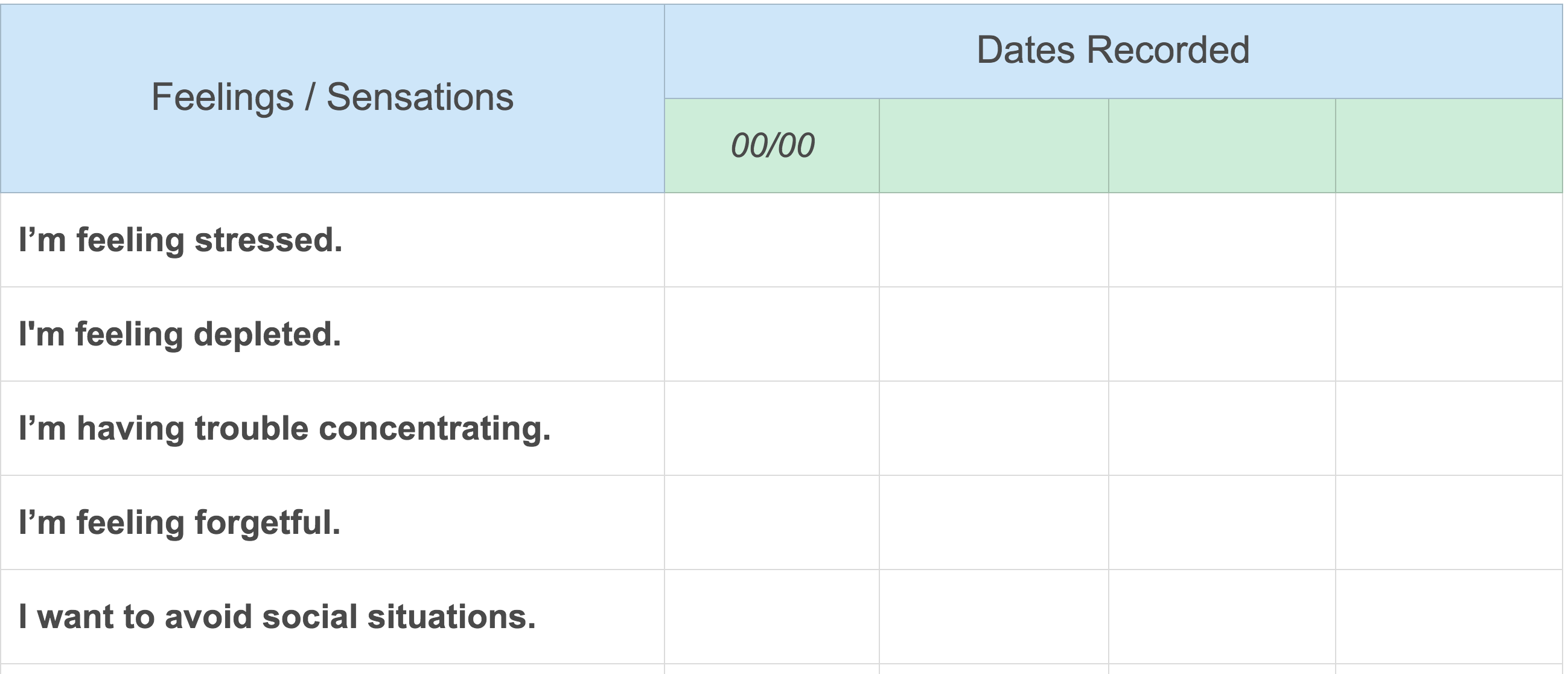
4) Keep a stress log
Because burnout symptoms are often challenging to recognize and heed, it can be helpful to evaluate your feelings by creating a stress log, using a journal or a digital tool such as Evernote.
A couple of times a week, and definitely whenever you’re stressed, consider ranking the following burnout symptoms on a 1–10 scale (1 = this feeling is hardly present; 10 = this feeling is all consuming):
Level of stress:
Level of feeling depleted:
Level of lowered concentration:
Level of forgetfulness:
Level of wanting to avoid social situations:
Level of pessimism:
Level of cynicism:
Level of apathy:
Level of lowered engagement:
You can also rank your overall amount of energy on a scale of 1–10, with 1 being totally depleted and 10 being the Energizer Bunny.
These are uncomfortable feelings, and being honest with ourselves about them can be difficult or feel slightly demoralizing. But we can also see it as empowering. When we notice those numbers creeping higher, we are taking charge of a situation that may have seemed beyond our control, giving ourselves an opportunity to pull back and rejuvenate.
If you want to keep your stress log in Evernote, we’ve created a simple template you can use.
5) Manage workplace stress
Since burnout is primarily associated with our work, that is one place we can definitely make an impact. We don’t have to accept the notion that jobs are inherently stressful and there’s nothing we can do about it. Find ways to structure your day to incorporate short breaks and maximize your peak energy times. Work with your employer and teammates to reduce meeting overload and focus your working hours on the things that matter.
In today’s “always on” world, stress can be overwhelming, and we often feel like it’s our fault if we can’t stay on top of everything. While it can be tempting to push through feeling run-down in the name of getting stuff done, that road can push us closer to burnout. Taking the time to assess, wind down, and rejuvenate instead can make us healthier, happier, and yes, more productive, in spades.
-
One invisible barrier holding back women at work: the conformity bind
Most of us enter the professional world believing that the focus and hard work which got us through our education will help us rise there, too. But we don’t yet realize that there are significant obstacles lying in our path. Author Michelle P. King explains how the need to conform can stand between women and success.
Between the ages of 24 and about 35 marks the beginning of the career track for many women. Women enter this first phase expecting that their road to success will be a meritocratic one. They work hard and try to advance, believing they alone are in control of their success. Like men, women want to do it all and have it all; the only difference is women experience invisible barriers early on that men do not. Women encounter these barriers before they set foot into an office, but without awareness, it is difficult for them to understand why they are struggling.
Even having access to that first career opportunity is more challenging for women because the standard of what “good” looks like in most recruitment processes is a male one. The challenges continue to unfold over the years, as women are held to higher performance standards and have less access to promotion opportunities or powerful individuals.
But once you are aware of the broken culture that exists in your organization, you will be prepared to see the invisible barriers for what they are: inequality. With that knowledge, you gain power over the barriers and will begin to see how exceptional you really are. This knowledge will help you preserve your mental and emotional energy and go from wondering how to fix yourself to recognizing that the problem is not you, it’s your workplace.
Here’s one of those invisible barriers: the conformity bind.
When we start a job, it takes a few months to learn the acceptable behaviors, team norms and routine practices that the organization values. This process is called socialization and it continues throughout a person’s career, but it is especially important for newcomers. Given that workplace cultures tend to be masculine, it’s a lot easier for men to assimilate. Women, on the other hand, must negotiate around masculine workplace norms, which often exclude them. As a part of my PhD research, I conducted 72 interviews at two large multinational organizations (one in the energy and resource sector, the other in the professional services industry). In every interview, I’d ask participants to describe the ideal employee. Men and women consistently said it was someone who works long hours, makes the organization a top priority, has no dependent-care responsibilities, asks for what they want, competes to get ahead, and is generally extroverted. Most descriptions were the same because employees learn what looks good from the social interactions they engage in at work and by observing leadership behaviors.
When new hires join an organization, they actively seek out clues for how to fit in. What does it take to succeed? Who gets rewarded and for what? Who gets promoted? How do leaders behave? What do employees need to do to fit in? Employees get a lot of the answers by watching leaders. Leaders don’t just manage the organization; in many respects, they are the organization. Leaders represent the behaviors, norms and standards that employees are expected to mirror if they want to be included. Behaviors that comply with these standards get promoted, developed, and rewarded. Individuals who fit the prototype are more likely to be accepted, included and advanced into leadership positions, which further reinforces the one-size-fits-all standard of success.
What does conformity ultimately get you? Social capital. In other words, that means being included and accepted at work. Social capital gives employees access to social groups, networks, mentors, sponsors and powerful people — all of which are important to career success. To thrive at work, men and women need to fit in to access social capital.
However, informal networks are a lot harder for women to break into. Telling women to do more networking ignores the exclusionary practices that men engage in. When Steven, a male colleague, went for a job interview, he was asked a handful of questions by the hiring manager about his experience for the leadership role. The rest of the conversation was a discussion about his years playing college soccer; the male interviewer let slip that once Steven joined his team, he could join the work soccer team. Steven got the job, and even he was amazed at the lack of rigor in the process. Steven joined the soccer team and quickly became one of the guys, getting invitations to Friday drinks, lunches and golf days. As men make up the dominant group at work, they determine the makeup and membership to most informal groups.
Even if women break into informal groups at work, it is unlikely they will be accepted in the same way men are. A great example of this is mentoring. Mentoring programs are a go-to solution for advancing women in the workplace, because they help socialize employees into an organization. While men and women do not differ in their reported levels of mentoring or networking, white men tend to benefit a lot more from this behavior.
The 2018 Harvard Business Review article “Research: Women Ask for Raises as Often as Men but Are Less Likely to Get Them” randomly examined 4,600 employees across 800 organizations. It found that women are mentored as much as men — and in some cases more — but the type of mentoring men and women received differed. Men were more likely to be sponsored by senior executives who would use their influence to help advance their mentees’ careers. Men are more likely to be accepted into the inner circle, which means they receive greater organizational awareness and understanding from mentoring relationships.
While accessing social support presents a significant barrier for white women, it’s even more difficult for women of color. They don’t share gender or racial similarities with white men. Both sexism and racism limit opportunities for women of color to access informal networks and mentors, which can become a significant source of stress. According to researchers Janis Sanchez-Hucles and Donald Davis, while white male leaders often exclude white women, they are still more likely to accept white women than women of color. What makes this particularly difficult to address is that it’s often hard to spot. Men who engage in these behaviors are often unaware of what they are doing or they deny the impact it creates. This is how male leaders can believe they support diversity and inclusion while continuing to hire, promote and reward employees who look like them.
Women have a very narrow range of behaviors they can engage in at work if they want to be accepted and succeed. It is not enough for women to be good at their job. Women need to display their competence and leadership capability in a way that conforms to gender stereotypes. This means doing your job well, while ensuring you are coming across as warm, friendly, kind, modest, sympathetic, and pleasant. If women don’t do this, they will be perceived as competent but not likable.
Women navigate a very narrow path at work by being assertive but pleasant, outspoken but warm, and successful but not self-promoting.While this Goldilocks standard is an impossible task for anyone to live up to, it becomes still harder when you layer on other areas of difference, like race or ethnicity. These identities carry with them additional stereotypes, expectations and constraints for how people are expected to behave at work. This process of getting women to conform to an impossible standard is how organizations slowly filter out difference, because employees need to work around, manage or hide their differences to fit in.
Hiding your womanhood to live up to the masculine ideal is how women start to lose themselves. Women are encouraged to power dress, speak louder and act more assertively — that is, they act like men to fit in. Women also face tremendous pressure to tolerate sexist jokes, inappropriate behavior, harassment, discriminatory comments and office banter for fear of being perceived as difficult or, worse, excluded altogether.
Women who succeed in workplaces often are required to deny their gender because of all the ways it makes them different. As psychologist Paula Nicolson has found in her research, which she shares in her book Gender, Power and Organizations, the ideal successful professional woman is single-minded, tough, autonomous and willing to distance herself from traditional femininity and domestic duties. But when women deny aspects of their identity, they also deny experiences of inequality, which makes it impossible to tackle them.
I know how powerful the need to fit in can be. My friend Emma Campbell worked in the energy and resource sector as an engineer. She was one of a handful of women working alongside hundreds of men on a mine site. This environment was so male dominated that there were no restrooms designated for women — only men had restrooms. Women had to share a portable toilet instead.
When Emma started out, she was desperate to fit in and be treated like an equal. So she began to act like one of the guys by laughing at sexist jokes, making derogatory comments, and even mocking herself for being a woman working in a man’s world. Within a year Emma had transformed. She talked, acted and even dressed like the men she worked with. But none of this worked. Emma would always be treated differently — because she was different. Only her work environment had made her believe that this difference was a bad thing. By trying to fit in to survive at work Emma had lost her identity.
Trying to pretend to be someone else is an exhausting and demoralizing process. So eventually Emma gave up and decided to be herself — regardless of the consequences. This made it easier for Emma to notice all the ways the mine site was unwelcoming to all women, a culture she had participated in creating. This made her want to change things. So, when male colleagues tried to engage her in sexist banter, she told them to stop, not caring if this isolated her even more. Emma was liberated. She could finally be herself. Some of the men she worked with saw her new behaviors as the permission they needed to speak up and push back on some of the sexist banter that made them uncomfortable. Soon Emma realized that she wasn’t alone. The negative comments and derogatory behavior toward women were something that only a small handful of men initiated and supported.
When Emma denied her differences, it didn’t make them disappear. Just by being one of a handful of women on a mine site, Emma stuck out. In fact, when any employee group makes up between 1 and 35 percent of the relevant employee population, they have a minority status at work. This can create added stress for women because their status makes them more visible and so they are scrutinized in a way that men are not. The term for this is hypervisibility. It feels a lot like working under a magnifying glass, where every move and mistake is examined. This added scrutiny places women under tremendous pressure to perform and prove their worth because they are trying to bridge their difference.
These challenges are significantly more pronounced for women of color,. who — because of race and gender differences — face a more extreme version of hypervisibility. They must also be on guard to deal with discrimination, insults or bias at work. A 2019 study undertaken by the nonprofit firm Catalyst examined the experiences of 649 black employees and included roughly even numbers of men and women. What they found was that hypervisibility is a major issue for black men and women, who felt they constantly needed to be “on guard” at work. This included constantly being prepared to manage negative comments, insults and exclusionary behavior as well as having to continually demonstrate their credibility. Over time, this negatively impacted participants’ emotional, mental and physical health, and well-being, as 45 percent of black employees reported sleep problems and 54 percent felt on edge.
The fix to this barrier: Solve the problems you create
If men present a barrier to women being accepted at work, men can also remove the barrier. At one company, male leaders had installed a PlayStation in the lunchroom for employees to use during their breaks. This was meant to be a way for all employees to relax and socialize. However, American football seemed to be the only video game that was ever played. Consequently, it was overrun with men who’d use it to bond with other senior men in the organization. They also excluded women from playing.
Frustrated, women raised the issue with the most senior male leader, arguing the PlayStation had become an informal network that excluded women from an opportunity to engage and build relationships with leaders. Instead of dismissing these complaints, the senior male leader decided to take it upon himself to solve the issue.
He took three specific actions, ones that all men can do to disrupt such practices at work. First, he spent time with the women in his office to analyze the issue. He wanted to educate himself and understand how this informal social practice excluded them. Second, he raised the issue with the men in the office, despite significant push back. The senior leader took time to share women’s accounts of how this social practice excluded them and the impact this was having and invited women to share their experiences and supported them when they did. This built men’s awareness and ownership of the problem. Men were then engaged to identify solutions to the inequality they had created, which was the final step.
The aim was never to remove the PlayStation or the game, but to provide women with an opportunity to play and give them access to the same informal social opportunities the men had. As such, male leaders committed to spending one-on-one time with each of the women in their teams. In addition, leaders identified an activity the whole team could undertake to ensure everyone interacted more. These leaders doubled down on their investment to level the playing field by spending time and effort to engage the women on their teams. This is something all men can do.
-
The #1 block to teamwork is defensiveness. Here’s how to defuse it
To be human is to get defensive. When we’ve been questioned or criticized at work, it’s fair to say that almost all of us — save for, perhaps, the Dalai Lama and other equanimous souls — have gotten irritated, retreated into silence, or said something cutting in response. And because it is so normal to get defensive, we tend to write it off as no big deal. Jim Tamm, however, begs to differ.
Former judge Tamm spent 25 years working through other interpersonal conflicts, including mediating more than 1,000 employment disputes, and he currently trains consultants to teach collaboration skills. So what does defensiveness have to do with collaboration? Tamm has come to believe that defensiveness is the major obstacle that prevents people from working well together. “There is nothing that will help you become more effective at building collaboration than better managing your own defensiveness,” he says in an interview.
While it’s close to impossible to completely eliminate getting defensive during stressful moments, you can become aware of your own reactions and have an action plan in place when you notice them. “Any time you’re getting defensive, you’re getting less effective. When you get defensive, your thinking becomes rigid and you simply become stupid,” says Tamm, also the author of the book Radical Collaboration.
Why is defensiveness such an obstacle to collaboration? When we get defensive, “we put way more into self-preservation than we do into problem-solving,” Tamm says. “We’re trying to prove that we’re right rather than search for creative solutions.” When this happens in a workplace, it can be a recipe for chaos and failure. Such impulses are especially harmful for bosses, managers and those in power. That behavior hurts more than just the defensive person. When we get defensive, adds Tamm, “we invite everyone else in the room to get defensive, too.”
Of course, it can be difficult to recognize defensiveness in ourselves, and that’s because there are underlying emotions at play. When a person becomes defensive, they might appear to be putting on protective armor and gearing up for battle, but they’re usually masking their fear. “Defensiveness does not protect us from other people,” says Tamm. “It defends us from fears we don’t want to feel.” Those fears can include thoughts about your own significance, your competence and your likeability. Your defenses might come up due to imposter syndrome — like when you’re scared not looking smart enough or that you’re a subpar employee or a bad boss.
For example, let’s say you’re worried about a performance review. When your manager gives you some constructive criticism, you may offer excuses or become angry or brusque. But Tamm says these behaviors are masking your real problem, which could be your fear of not getting the raise or promotion that you feel you deserve or even your fear of being fired. “Our defensiveness helps us hide our fears from ourselves,” he says, and it erroneously serves to convince you that the fears you have aren’t true.
OK, now that we understand the dangers of defensiveness, here’s what we can do about it. You can start by learning to spot the warning signs of defensiveness in yourself. When you feel yourself experiencing them, pay attention and take action. According to Tamm, here are the 10 most common warning signs that you may be getting defensive: A spurt of energy in your body; sudden confusion; flooding your audience with information to prove a point; withdrawing into silence; magnifying or minimizing everything; developing “all or nothing” thinking; feeling like you’re a victim or you’re misunderstood; blaming or shaming others; obsessive thinking; and wanting the last word.
Tamm recommends looking back on any charged conversations, disagreements or conflicts — minor and major — from your life, and finding the patterns of behavior you engage in when you get defensive. Perhaps a minor tiff at work made you default to “all or nothing” thinking, and suddenly you felt ready to quit. Or, a single question from your partner about where the soup pot is located gets magnified into “You never know where anything is because you never liked this apartment.” If you have difficulty determining your own signs of defensiveness, ask for feedback from your family, friends or trusted colleagues. “Usually, other people spot our defensiveness before we do,” says Tamm.
Why is internal observation so important? “Most of us are not sufficiently in tune with our fear to do anything about it until it’s too late,” says Tamm. “If we know what our signs of defensiveness are, they can become our own personalized early warning system. For example, I noticed that when I get defensive, my breathing becomes faster, I tend to talk much louder, and I usually feel very misunderstood.”
Creating your own warning system for defensiveness involves a few simple steps: Noticing, taking action, and letting go. Whenever you recognize one of your own warning signs — for example, obsessive thinking or confusion — acknowledge to yourself that you’re getting defensive by saying something like “It feels like I’m becoming defensive.” This is extremely important. Tamm points, “If you don’t notice that you’’re getting defensive, you’re not going to take any other action.”
Next, slow down your physiology in some way. That could mean taking a few deep breaths, being aware of your feet on the ground, or — if you can — going for a walk. Focusing your attention outward is like hitting a reset button on your defensiveness. At the same time, try to observe what you’re saying to yourself. If you find that you’re criticizing yourself for your defensiveness or for your lack of keeping cool, ask yourself something like “Is this helping me right now? What behavior would be more helpful?”
Then, create an action step to counteract any damage that your defensiveness may cause. If you typically go quiet and sulk, for instance, you may decide instead to ask a question or share what you’re feeling. One way to create a psychologically safe environment for yourself — and others — is when you demonstrate your vulnerability. This can be accomplished by sharing something like “I feel like I’m getting defensive here, so let me take a step back.” Or, if your defensiveness sign is bombarding your teammates with information to prove your point, you could consciously pause for 15 seconds and let others finish speaking first.
In his TEDx talk, Tamm shares a memorable example of an action step. He says, “One woman’s warning sign was always wanting the last word. So she got this image of herself standing in the conference room doorway, throwing in the last word, and slamming the door. [Picturing it] was a way of not only reminding her what she was doing but also lightening up her mood a little bit.”
Once you’ve taken your action step, you’ll find that you have an easier time letting go of your defensiveness and examining the situation — and your coworkers — with fresher, calmer eyes. Your physical and emotional selves will most likely be in a different place than when you first started getting defensive. Practice your action step until it becomes automatic, suggests Tamm.
Be patient: Noticing and managing your defensiveness takes practice. Find times — maybe with your family or friends — when you can rehearse your action steps so you’ll be ready when you most need them. Remember, says Tamm: “If you can stay non-defensive, you can always be more effective.”
-
How to be your best self in times of crisis
So given everything going on at the moment it seemed poignant to share this talk from Susan David about how to be your best self in times of crisis. About 28 minutes in there’s a bit around social distancing and working from home and something that stood out for me was the idea that we do not need to practice ‘social’ distancing but ‘physical’ distancing, the terminology can conjure ideas of being alone rather than just physically apart.
-
It’s okay to feel overwhelmed, here’s what to do next
Especially at the moment, an hour might feel like a heavy time commitment, it’s worth considering especially because of the current climate it might be even more important than normal to find that time. This profound talk from the author of “Eat, Prey, Love” about anxiety, fear and grief in the current climate offers some hope and reflects on how to stay present. Some of the highlights I took away were:
- “There is no more species more anxious than humans”, unlike most species we have such vast imaginations we can picture the future, and we often picture the worst.
- Humans are great at adapting, while we create a great amount of anxiety thinking about the future, often when it comes we just get on with it.
- The difference and importance of empathy vs. compassion.
The above resonate with a favourite quote of mine by Sceneca (sorry for the Greek philosophy), “We suffer more in imagination than in reality”, this is me all over, I spend a huge amount of time stressed and anxious because of what I ‘imagine’ and when it eventually comes, better or worse, it’s rarely that bad.