Category: Development

  • Analytics Maturity Model

    The below diagram illustrates a generally agreed maturity model for analytics. You may find you don’t exactly fit in any of the below boxes but the purpose is to highlight what basic and strong analytics are and unsurprisingly the most successful organisations are often at the higher end of this model.

    It’s often easier for smaller or newer businesses to get there as they have a greater degree of agility but it’s worth recognising the value of pushing the business forward on this curve. It’s especially challenging to get business buy in for analysts to focus on where they can add the most value rather than spending their time working on basic reporting which anybody could learn with a degree of training.

  • Eisenhower Matrix

    I suspect most of you will have seen this grid before but I wanted to write something you had to refer back to and some detail around the model for those of you who could do with a hand managing your workload, which we all need from time to time.

    The Eisenhower Matrix, which is also known as the Urgent-Important Matrix, helps you prioritize your tasks based upon their urgency and importance. It also allows you to identify tasks that you should either delegate or leave undone.

    You can even build this in to a Trello board to help you manage your workload. There’s some more detail at the bottom but you may also want to checkout http://www.eisenhower.me/ which has a web app, iPhone app, links to buyable notepads on Amazon with the matrix. I’ve also put a link here to a downloadable PDF template of the grid as a tick box sheet for those of you who love paper!

    How President Eisenhower Used This Matrix

    Prior to becoming the 34th President of the US, Dwight Eisenhower served as a general in the army, and as the Allied Forces Supreme Commander during World War II. During his time in the army, Eisenhower was faced with many tough decisions concerning the tasks he had to focus on every day. This led him to invent a principle that helps us prioritize our tasks by urgency and importance.

    Using the Eisenhower Matrix

    This Eisenhower matrix results in four quadrants with various strategies. Stephen Covey, author of The Seven Habits of Highly Effective People, further popularized Eisenhower’s concept of this time management matrix by supporting Eisenhower’s use of four quadrants to determine the urgency of one’s tasks.

    Here is how the four quadrants work:

    Quadrant 1: Do First

    Quadrant 1 contains tasks that are both urgent and important. These are “do first” tasks because they are critical for your life or career in some way and need to be finished right away. You want to get these tasks done as soon as possible.

    These are the tasks that need to be done in order to avoid negative consequences. It is important to be able to manage the tasks that are in quadrant 1.

    An example of a quadrant 1 task in your career may be answering a time-sensitive email from a client. This matrix can also be used in your personal life. An example of a quadrant 1 task in your personal life may be a crying baby, a medical emergency, or something burning in the oven.

    Quadrant 2: Decide When

    The tasks in quadrant 2 are important, but not urgent. This is where you want to invest the majority of your time. Quadrant 2 tasks are in line with your long-term goals.

    What are some examples of these tasks? Well, exercising is important to your health, but you can decide when that can be done. It is also important to spend time with your family, but again, that can be aligned with your schedule. When it comes to your career, it may benefit you to obtain another degree or get a certificate of some sort. These things are important to your career, but they do not need to be done immediately.

    It is important to remember here that everyone has different goals and objectives, so just because something falls into quadrant 2 for you, it may not for the next person. Also, just because these tasks are not urgent does not mean that they are not important. People often associate urgent matters with being important, which is not always true. Because your goals will stay constant, anything that will be beneficial to you in the long term will fall into the second quadrant.

    Quadrant 3: Delegate It

    Do you ever feel that you put too much importance on a task that in hindsight was not very important? Or think something has to be done right away, and it actually doesn’t?

    If so, you are in good company.

    This common mistake often occurs when someone asks you to do something that does not directly benefit you or get you closer to achieving your goals. For quadrant 3 tasks, it is important to learn and remember how to delegate certain things.

    When you think something is urgent but it actually is not, it is usually an outside source of distraction. This may include constantly checking your email or phone, or responding to people as soon as they try to contact you. You may think it is urgent at the moment, so you stop what you are doing to tend to the matter. But in reality, it could wait.

    If you are in the middle of working on a project and the phone rings, it is not important for you to answer it. So, you can delegate this task to someone else. It may seem urgent at the time while it is happening, but these little things can be handled by other people.

    Quadrant 4: Delete It

    Honestly, you want to avoid quadrant 4 tasks. These tasks are simply a waste of your time, and they should be eliminated. If you are able to identify and eliminate all of your quadrant 4 tasks, you will free up some much-needed time to invest in your quadrant 2 tasks.

    Some examples of quadrant 4 tasks are playing video games, watching television shows that you have already seen, or mindless web browsing.

    Does that mean nothing in quadrant 4 should be a part of your life? No. Having a balance between your professional and personal life is important, and downtime helps you regain your energy. The challenge here is to spend most of your time in quadrant 2, and just enough time in quadrant 4 to get by.

    Procrastination and the Eisenhower Matrix

    Sometimes it is easy to mistake the differences between your tasks. Maybe you have a list of things you have to do that seem equally urgent and important, but can’t seem to get them all done. Part of procrastination is figuring out why you are procrastinating. Without doing this and addressing the matter, you are likely to spend a lot of time on quadrant 3 and quadrant 4 tasks that don’t really matter.

    It is easy to procrastinate on quadrant 2 tasks because, while they are important, they do not need to be done right away. If something more urgent comes your way, like a phone call or even just a favor for a co-worker, these are likely to take precedence in your mind, but end up being just another form of procrastination.

    How to Use the Eisenhower Matrix to See If You Are Procrastinating

    To see if you are spending the bulk of your time in the first two quadrants, do a one-week assessment. To do this, make six copies of a blank grid, and use one grid per day, listing the tasks you accomplished or the activities you did, and the time spent on each thing. When all of the grids are full, combine the Monday-Friday data onto your sixth summary grid and calculate how much time you spent in each grid, then break those numbers down into percentages. Evaluate how effectively you spent your time and whether your process needs to be reorganized.

    Brain Dump

    Why is this important? We live in a time-pressured world where you are likely to have multiple overlapping commitments that feel like they need to be done right away. This means that true urgency is not reserved for special instances, because urgent matters seem to be an everyday occurrence.

    You will not succeed in your career if you are constantly missing deadlines or letting truly urgent matters just sit on your desk. Instead, you have to learn how to manage your constant reception of responsibilities while still doing excellent work. The Eisenhower Matrix is an effective method to use to organize your priorities.

    As previously mentioned, this spills over into your personal life as well. For example, you may get a personal phone call at work that seems urgent but in reality is really not very important. That needs to fall into the appropriate quadrant in order for this strategy to be effective.

    If you see something that is urgent and important, and that will have a large impact on your future, set aside an entire half day to focus on it. Get rid of any possible distractions, turn off your email and phone, close your door, or even take the project to a remote office area where no one can distract you. Complete the task so you can cross it off your list.

    It is easy to spend the bulk of your time in quadrants 1 and 3, and very little time in quadrant 2. Quadrant 3 is popular because it makes you look and feel busy. However, in order to be productive and effective in the long-term, quadrant 2 should be where you put your main focus.

    You can also look at the matrix like this: Live most of your life in the upper part of the matrix. Work on quadrant 1 to get by and use the rest of your time in quadrant 2. Use quadrants 3 and 4 only when necessary.

    Eisenhower.me

    So this all sounds like a great idea in theory, but where do you get started? Eisenhower.me is a website that is created with simplicity in mind to make the process easy for you. They are able to let you know where your tasks fall in the quadrant grid through apps and strategies. This will then help you focus and work on the most important tasks. Eisenhower.me helps you prioritize and plan your schedule easily, while minimizing any stress and increasing your productivity.

    You may be thinking that this tool sounds old-fashioned, since it is associated with Dwight Eisenhower. It is an old idea, but it is widely accepted, and has been used successfully for decades.

    Following the guidelines presented on Eisenhower.me will benefit you by saving you time. Time cannot be purchased, and is often mismanaged by people. This tool gives you the opportunity to think about the time that you unconsciously waste every day.

    When you apply these practices to your professional and personal life, you are able to plan ahead, increase your effectiveness, and boost your efficiency. You want to be able to manage your work with your available time to avoid procrastinating, which will then help decrease stress. Improper time management can easily lead to stress and job burnout.

    Learning the principles of planning, prioritizing, delegating, and scheduling will help you see the right things to do in order to be successful. This is a simple matrix to help you achieve your goals and be successful in life.

  • What is NLP?

    NLP or Neuro Linguistic Programming in summary is the process of recognising a behaviour and creating a pre-programmed action. I’ve found it incredibly helpful in learning where I don’t react to a situation in the best way how to react in the ideal way. I’ve also coached people on it and they’ve found it effective too so worth giving it a go if you’d like to change the way you react to certain situations. It’s also a technique that can be effective for people who struggle with mental health or anger management. Please come and talk to me if you’d like anymore information.

    NLP is the practice of understanding how people organise their thinking, feeling, language and behaviour to produce the results they do. NLP provides people with a methodology to model outstanding performances achieved by geniuses and leaders in their field. NLP is also used for personal development and for success in business. A key element of NLP is that we form our unique internal mental maps of the world as a product of the way we filter and perceive information absorbed through our five senses from the world around us.

    Neuro

    Each individual has established their own unique mental filtering system for processing the millions of bits of data being absorbed through the senses. Our first mental map of the world is constituted of internal images, sounds, tactile awareness, internal sensations, tastes and smells that form as result of the neurological filtering process. The first mental map is called ‘First Access’ in NLP.

    Linguistic

    We then assign personal meaning to the information being received from the world outside. We form our second mental map by assigning language to the internal images, sounds and feelings, tastes and smells, thus forming everyday conscious awareness. The second mental map is called the Linguistic Map (sometimes known as Linguistic Representation)

    Programming

    The behavioural response that occurs as a result of neurological filtering processes and the subsequent linguistic map.

  • Number of years it took each product to gain 50 million users

    This is something I saw on the Digital Engineering teams Slack channel which gave me a laugh!

  • The Dirty History of Doctors’ Hands

    In 1846, Ignaz Philipp Semmelweis, a sad-eyed, mustachioed young medical graduate, became chief resident of obstetrics at the Vienna General Hospital. Over the next two decades of his brief career, he became the “savior of mothers” and an enemy of the medical establishment, driven mad by his quest for the truth about hospital-acquired infections.

    In the 1840s, teaching hospitals operated by trading free medical care in exchange for the opportunity to practice on poor people. At Semmelweis’s hospital, two clinics ran side-by-side. One clinic trained midwives, and operated with a maternal mortality rate of about one in 25. But in the other clinic, which taught medical students, one in ten women admitted would die before she left the hospital. In some months, nearly a third of the women at this clinic died. The leading cause of death was childbed (or puerperal) fever, and both clinics were referred to in official papers as “houses of death.” But, Semmelweis noted, mortality rates were perplexingly lower among women who insisted on giving birth in the streets and fields of Vienna rather than risk setting foot in the maternity clinics:

    To me, it appeared logical that patients who experienced street births would become ill at least as frequently as those who delivered in the clinic. What protected those who delivered outside the clinic from these destructive unknown endemic influences?

    Despondent, Semmelweis left for Venice:

    I hoped the Venetian art treasures would revive my mind and spirit, which had been so seriously affected by my experiences in the maternity hospital.

    But while the art treasures of Venice may have temporarily soothed his spirit, upon his return Semmelweis learned that his close friend, another doctor, had been pricked with a clumsy students’ scalpel in the middle of an autopsy. The doctor quickly became ill and died. Semmelweis wrote:

    Day and night I was haunted by the image of [his] disease and was forced to recognize, ever more decisively, that the disease from which [he] died was identical to that from which so many maternity patients died.

    In these pre-Louis Pasteur days, the medical establishment didn’t yet know about bacteria. The main preoccupation of the time was with humours and miasmas, and ‘treatment’ for childbed fever involved inducing vomiting, bloodletting, blistering agents applied to the women’s inner thighs, enemas, and liberal use of leeches with the aim of purging the fever heat from the body.

    His friend’s death—so similar to the deaths in the medical student clinic—led Semmelweis to hypothesize that the trainee doctors were exposed to ‘cadaverous particles’ in the course of the autopsies they conducted, which they then transferred to the new mothers. The midwives in the neighboring clinic, who concerned themselves only with births, weren’t exposed to these cadaverous vapors. Semmelweis proposed, for the first time in medical history, a connection between touching cadavers and a risk of infection.

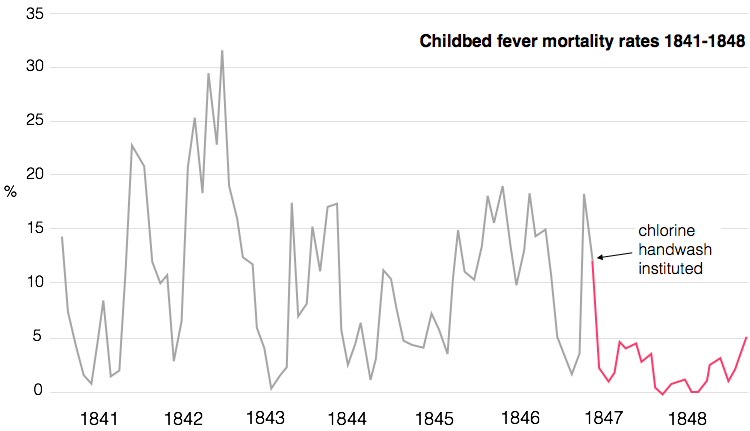
    Semmelweis decided to act on his hunch. He instituted a clinic-wide policy of mandatory hand washing between cutting up a body and assisting in a birth. “[Hospital staff] had frequent opportunity to contact cadavers. Ordinary washing with soap is not sufficient to remove all adhering cadaverous particles. This is proven by the cadaverous smell the hands retain,” Semmelweis wrote, introducing a chlorinated lime solution to the hospital. It removed the smell of death and would, hopefully, remove the particles too.

    In the first three months, death rates plummeted from one in ten to one in a hundred. Semmelweis had shown that he could conquer childbed fever with handwashing.

    Or so you’d think. In fact, Semmelweis’ arguments were completely rejected by the medical establishment at the time. Coming decades before Pasteur’s germ theory of disease, and without a strong theoretical explanation, his actions seemed to be a reversion to the “speculative theories of earlier decades that were so repugnant to his positivist contemporaries.”

    Danish physician Carl Edvard Marius Levy wrote a vitriolic attack of Semmelweis’s findings. First, he deferred to the statistics, blaming the success of Semmelweis’s hypothesis on normal fluctuations of mortality rates in maternity clinics. Next, he argued against the assertion that anything so small as to be invisible could cause death, saying that, “With due respect for the cleanliness of the Viennese students, it seems improbable that enough infective matter or vapor could be secluded around the fingernails to kill a patient.” Lastly, he questioned Semmelweis’s methods altogether: why didn’t he run a simpler experiment, by fully separating those working with cadavers from those aiding in births?

    To be fair, Semmelweis did have major faults in his reasoning—he thought that only cadaverous particles caused the fever, and couldn’t explain why some women still contracted fever in the midwife clinic. But, perhaps most importantly, his theories presented a behavioral conundrum for his fellow physicians: testing his hypothesis further could implicate them as dealers of death. Accusing doctors of haplessly causing disease was a slur on the gentlemanly art of medical practice.

    Such resistance within the medical community was short-lived. In the later part of the 19th century, a rising tide of empiricism—in particular the work of Joseph Lister and Louis Pasteur—lifted the lonely little ship of hygiene, and the benefits of hand washing would become universally accepted.

    But while medical knowledge has radically shifted in the last 170 years, the reluctance to wash hands has persisted. The figures are striking. One large study found that hand washing rates were at just 26% in intensive care units, and 36% in the other wards (after monitoring systems were put in place, they jumped to about 50%). Another found doctors self-reported hand washing 73% o the time, but actually only did it 10% of the times they should have. The results are clear: doctors in hospitals not washing their hands kills roughly 100,000 Americans every year and sickens 1.7 million more.

    So after 150 years, why is this still a problem? Excuses from doctors range from being too busy, to the washing solution and alcohol rubs drying out their hands, to constantly having to carry equipment which makes it difficult to wash, to hand washing facilities being inconveniently located. Others simply say they forget.

    Today, a whole industry of high-tech ways to remind doctors to wash their hands has sprung up, selling hospitals vibrating sensors to remind doctors to lather up, intensive video-monitoring, and incentive schemes for good hygienic practices. One hospital introduced waist-high monitoring that buzzed when doctors walked past without washing their hands. But doctors got down on their knees and crawled under the sensors, just to avoid washing their hands. While busy doctors may occasionally be absent-minded, such reports seem to indicate that sometimes they knowingly avoid it.

    Several studies have shown that nurses wash their hands more than doctors. Ironically, part of this may go back to the resistance among Semmelweis’s 19th century peers: It’s speculated that doctors develop a complex of invulnerability—that, as medical professionals, they can’t be harmed or harm others. “The ego can kick in after you have been in practice a while,” one emergency department physician told the New York Times. “You say: ‘Hey, I couldn’t be carrying the bad bugs. It’s the other hospital personnel.’”

    Doctors are pretty much universally regarded as empirically-minded. But knowledge doesn’t always translate to universal shifts in behavior—regardless of how easy, necessary, or cheap the solution. The clean, elegant answers produced by biomedical science can’t be found in equal measure in the dirty world of human actions and motivation.

    And what about our hero, Dr. Semmelweis? Increasingly obsessive over the years, Semmelweis took his colleagues’ reluctance to accept his theories as a personal affront. Rather than launch a charm offensive to win his fellow obstetricians over, he wrote them abusive public letters: “I declare before God that you are a murderer and [history] would not be too unfair if it remembers you as a medical Nero,” he told one. Increasingly driven mad by the world’s failure to appreciate the importance of hand washing, likely exacerbated by a a touch of syphilis or Alzheimer’s, his colleagues eventually had enough: three obstetricians signed referrals committing him to a mental asylum. One day, while on vacation with his wife and child, he was met at a train station by an old friend who wanted to show him his sanitarium.

    Under this pretext, the 47-year old Semmelweis was driven straight to a large, public asylum. He was severely beaten by the guards and died—of an infection—two weeks later.

    In honor of Semmelweis’s legacy to medicine, several medical schools, hospitals, womens’ clinics, and museums now stand proudly bearing his name. But, perhaps most appropriately, his name graces the so-called “Semmelweis reflex”: the kneejerk reflex to reject new evidence contradicting established norms.

  • Retail 2018 – Exclusive insights about the year ahead from retail’s top leaders

    The uncertainty expressed at the beginning of 2017 has continued throughout the trading period with some retailers unable to whether the storm. Those that adapted to the new trading climate have seen growth. Despite the turbulent market Craig Summers, UK Managing Director at Manhattan Associates says that “customers still need to buy things” and the focus should be “on the basic premise – connecting the customer to the product they desire, when, where and how they want it – then they will come back for more”.

    Looking forward to 2018 the big question seems to be what will Britain’s decision to the leave the EU mean for retail. This has the potential despite retailers’ best efforts to negatively affect consumer sentiment and the UK economy.

    Retail Week have compiled a report with exclusive insights about the year ahead from retail’s top leaders. I’ve pulled together some of the juicier figures from the survey.

    Shifting Business Models for the Future

    • Average hourly pay in retail was up 4.6% in 2017, compared with 2.9% growth for the UK economy. This has been argued by the BRC as a result of the new digital landscape and the rising cost to serve.
    • 44% of retail chiefs surveyed predict a sales increase whilst 28% expect a decline in 2018.
    • The fallout from Brexit is expected to have the greatest impact on consume behaviour in 2018, with 59% of the retail leaders citing this, quickly followed by inflation and the cost of living at 45%.

    Investing in the Right Areas

    • 47% of retailers say they are now omnichannel (though 33% are yet to achieve this visibility in real time), compared with just 18% last year and 19% in 2015. However, 33% do not have a single view of their customer or stock.
    • A rather depressing 27% are using data insight to forecast the future.
    • While gaining a single view of customers is clearly an ambition, Retail Week’s research provoked interesting opinions from at least three chief executives who believe that customer resistance to ‘being known’ will mean it is impossible for businesses to ever have access to full comprehensive customer history and data.

     Winning the Customer Experience Battle

    • 59% of consumers find they know more than the store assistant “some of the time” with a further 10% saying they know more “all of the time”.
    • The majority, 51% of consumers, say product knowledge, followed by checking stock availability, is the most important service provided by a store associate, highlighting the point further.
    • 57% of consumers go in to store to get their product there and then. 52% because they can touch and feel the product.

    Drilling Down into Data

    • 17% say big data, database organisation or developing central systems that hold comprehensive customer information are high up the to-do list in the 12 months ahead.
    • 52% of the leaders list “investment in customer experience” as a priority.
    • 28% of respondents use the terms “personalisation” or “personalised service” when explaining their key goals.

    Delivering a Profitable Supply Chain

    • Although supply chain and infrastructure are not top of the investment priority list among the retail chief executives surveyed, with 28% citing it as a key focus area in the year ahead.
    • 27% of the surveyed retailers expect to see more demand for same-day delivery in 2018, nearly on a par with the currently more common next-day option, at 33%. Both, however, are dwarfed by the named-day or slot delivery option, which 47% of retailers expect to see more demand for next year.
    • Try-before-you-buy will become more prevalent. Amazon and Asos already offer the service to a degree in certain parts of the world, but there are technology companies now supplying what is essentially the option to ‘buy now, pay later’ online to support impulse purchases.

    Brexit: Operating in the Shadow of Uncertainty

    • Of the 25 business leaders we spoke to, 48% say they feel Brexit will have a negative impact, while 28% say it is too early to tell its effect on future performance because it is so difficult to understand what the process will do to consumer confidence.

    If you’re looking for a more in depth read, then the whole report is attached below.

  • Creating Secure Excel SQL Queries

    Sometimes it’s easier (lazier?) to use an Excel query for simple reports.  One problem with this is that the query authentication properties are viewable to anyone who has access to the report.  While this is like teaching a dog algebra for the average user, an advanced user could, conceivably, use this connection data to create their own, unauthorized queries.

    While there is no way that I know of to hide the query information, you can create a set of protected procedures that:

    1. adds the authentication (connection string)
    2. runs the query
    3. then removes it again.

    This is a simple example of what it could look like:

    1. First you’ll want to create a new VBA module in your Excel worksheet with procedures that look something like this:

    Sub AddConnect()
    'this will add the connection string to
    'all connections in the active workbook
        For Each CN In ActiveWorkbook.Connections
            CN.ODBCConnection.BackgroundQuery = False 'this line is optional
            CN.ODBCConnection.Connection = _
            "ODBC;DRIVER={Progress OpenEdge 10.1C Driver};" & _
            "UID=YOURUSERNAME;PWD=YOURPASSWORD;" & _
            "HOST=YOURHOST;PORT=YOURPORT;DB=YOURDATABASE;" & _
            "DefaultIsolationLevel=READUNCOMMITTED"
        Next
    End Sub

    Sub RemoveConnect()
    'this will remove the connection string from
    'all connections in the active workbook
        For Each CN In ActiveWorkbook.Connections
            CN.ODBCConnection.Connection = "ODBC;"
        Next
    End Sub

    Sub ListConnections()
    'this will list all query connection strings
    'in the active workbook
        For Each CN In ActiveWorkbook.Connections
            MsgBox (CN.ODBCConnection.Connection)
        Next
    End Sub

    Sub RefreshAll()
        'this will refresh all the data connections in the active workbook
        AddConnect 'add the connection strings
        ActiveWorkbook.RefreshAll 'refresh all connections
        RemoveConnect 'remove the connection strings
    End Sub

    1.  You can then password protect the module by right-clicking it and selecting properties.

    1. Then check “Lock project for viewing” and enter your password.  Finally, click OK.

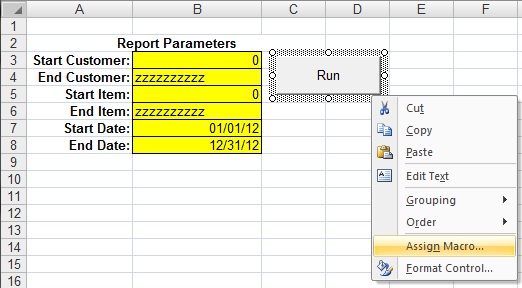
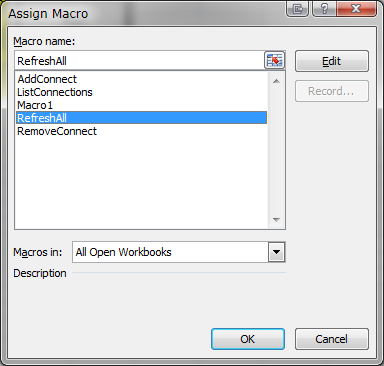
    1. You can then add a command button to your worksheet with the macro assigned to RefreshAll().

  • Black Swan – The Impact of the Highly Improbable

    I have recently finished listening to Black Swan by Nassim Nicholas Taleb (a former derivatives trader, is Dean’s Professor in the Sciences Courant Institute of Mathematical Sciences).

    The book is written about the extreme impact of certain kinds of rare and unpredictable events and our tendency to try and find simplistic explanations. I have pulled together a few extracts I found valuable.

    The Black Swan 

    Before 1697, teachers confidently taught European schoolchildren that all swans were white. They had little reason to think otherwise. But then Dutch explorer Willem de Vlamingh landed in Australia and found dark feathered birds that looked remarkably like swans. Black swans? Indeed. Once observed, they were as unmistakable as they had been unimaginable, and they forced Europeans to revise forever their concept of “swan.” In time, black swans came to seem ordinary. This pattern is common. Just because you haven’t seen a black swan, doesn’t mean that there are no black swans. Unlikely events seem impossible when they lie in the unknown or in the future. But after they happen, people assimilate them into their conception of the world. Think of the advent of World Wars I and II, the popping of the 1990s Internet stock bubble, or world-changing inventions like the internal combustion engine, the personal computer and the Internet, yet in hindsight they seem almost inevitable. Why?


    The human mind is wonderful at simplifying the onslaught of today’s “booming, buzzing confusion” of data. Mental schema, heuristics, biases, self-deception – these are not “bugs” in the cognitive system, but useful features that allow the human mind to concentrate on the task at hand and not get overwhelmed by a literally infinite amount of data. But human simplifying mechanisms are not without their costs. Take stories, for example.

    The Narrative Fallacy

    Stories help people remember and make sense of the past. Think of a typical business magazine profile of a successful businessman. The story begins in the present, after he has become rich beyond his wildest dreams. The story then cuts back to his humble beginnings. He started with nothing and wanted to get rich (in terms of story structure, his “dramatic need”). He faced obstacle after obstacle (perhaps he had a rival – the “antagonist”). But he made shrewd decisions and flouted the wisdom of the Cassandras who counselled caution (“Idiots!”). As success built on success, he amassed a fortune. He retired early, married a model and now has brilliant children who play Chopin blindfolded and will all attend Ivy League colleges. His virtues will be extolled in a B-School case study. Wide-eyed business students will sit rapt at his feet when he visits their schools on a lecture tour promoting his latest book. He is a superman, an inspiration. Now consider an alternative hypothesis: He got lucky. His putative “virtues” had nothing to do with his success. He is, essentially, a lottery winner. The public looks at his life and concocts a story about how brilliant he was, when, in fact, he was merely at the right place at the right time. This is the “ludic fallacy” (ludus means game in Latin): People underestimate luck in life – though they ironically overestimate it in certain games of “chance.” Even the businessman himself falls victim to flawed thinking through the self-sampling bias. He looks at himself, a sample of one, and draws a sweeping conclusion, such as, “If I can do it, anyone can!” Notice that the same reasoning would apply had he merely bought a winning lottery ticket. “I’m a genius for picking 3293927! Those long odds didn’t mean a darn thing. I mean, after all, I won didn’t I!” In the case of the inspiring businessman, consider his population cohort. Where are all the similarly situated people, who started out like him and have the same attributes? Are they also rich? Or homeless? Usually you can’t find this sort of “silent” disconfirming evidence. The mind uses many more simplifying schema that can lead to error. Once people have theories, they seek confirming evidence; this is called “confirmation bias.” They fall victim to “epistemic arrogance,” becoming overconfident about their ideas and failing to account for randomness.

    “Mediocristan” or “Extremistan?”

    So, the human mind tends to smooth away the rough features of reality. Does this matter? It can matter, and a lot, depending on whether you’re in “Mediocristan” or “Extremistan.” Mediocristan refers to phenomena you could describe with standard statistical concepts. Extremistan refers to phenomena where a single, event or person can radically skew the distribution. For instance, if you and Bill Gates share a cab, the average wealth in the cab can be north of $25 billion dollars. But the distribution is not certainly not even. When this happens, odds are you’re no longer in Kansas. You’re in Extremistan.

    Phony Forecasting (or Nerds and Herds)

    Extremistan might not be so bad if you could predict when outliers would occur and what their magnitude might be. But no one can do this precisely. Consider Harry Potter. Nobody could predict whether a book by a mother on welfare about a boy magician with an odd birthmark would flop or make the author a billionaire. Stock prices are the same way. Anyone who claims to be able to predict the price of a stock or commodity years in the future is a charlatan. Yet the magazines are filled with the latest “insider” advice about what the market will do. Ditto for technology. Do you know what the “next big thing” will be? No. No one does. Prognosticators generally miss the big important events – the black swans that impel history. Chalk these errors up to “nerds and herds.” Nerds are people who can only think in terms of the tools they have been taught to use. When all you have is a hammer, everything becomes a nail. If all you have is standard deviation, and mild, ordinary randomness, you’ll see bell curves everywhere and will explain away disconfirming data as “outliers,” “noise” or “exogenous shocks.” (The proliferation of Excel spreadsheets allowing every user to fit a regression line to any messy series of data doesn’t help.)

    Further, humans follow the herd and look to “experts” for guidance. Yet, some domains can’t have experts because the phenomena the expert is supposed to know are inherently and wildly random. Of course, this discomforting thought requires a palliative, which is to think that the world is much more orderly and uniform than it often is. This soothing belief usually serves people well. Then comes a stock market drop or a meteor strike (on the downside), or Star Wars and the Internet (on the upside), and the curve is shot.

    Befriending Black Swans

    Even given these grim facts, you can tame, if not befriend, the black swan by cultivating some “epistemic virtues:”

    • Keep your eyes open for black swans – Look around and realize when you are in Extremistan rather than Mediocristan. Social contagion and rich-get-richer phenomena are clues that you’ve just gotten off the bus in Extremistan.
    • Beliefs are “sticky,” but don’t get glued to them – Revise your beliefs when confronted with contrary evidence. Dare to say, “I don’t know,” “I was wrong” or “It didn’t work.”
    • Know where you can be a fool and where you can’t – Are you trying to predict what sort of birthday cake your daughter wants? Or the price of oil in 17 years after investing your life’s savings in oil futures? You can’t help being foolish – no one can. But sometimes foolishness is dangerous, and sometimes it is benign.
    • As a forecasting period lengthens, prediction errors grow exponentially – Suspend judgment where evidence is lacking and be wary of overly precise predictions. “Fuzzy” thinking can be more useful. Often you should focus only on consequences, not overly precise probabilities.
    • Look for the non obvious – Seek out disconfirming evidence for pet theories. Think, “What event would refute this theory?” rather than just stacking up confirming evidence for the sake of consistency, and turning out any evidence that contradicts your notion. In other words: Amassing confirming evidence doesn’t prove a theory or a mental model.
    • Know that in many cases, you cannot know – Think outside your usual, customary conceptual categories. Eliminate alternatives that you know are wrong rather than always trying to find out what is right.
    • Avoid dogmatism – “De-narrate” the past and remember that stories mislead. That’s the whole point: They are psychological armour against the “slings and arrows of outrageous fortune.” Think for yourself. Avoid nerds and herds. This universe, this planet and your life were highly unlikely. But they happened. Enjoy your good fortune and remember that you are a black swan.
  • Does Page Load Speed Really Matter?

    If your website takes longer than three seconds to load, you could be losing nearly half of your visitors, according to data from Akamai.

    It’s pretty simple: the faster the speed of your website, the happier your visitors will be. Optimizing page load time leads to noticable improvements in customer experience, conversion rates, and ultimately, your sales revenue.

    In fact, reducing your website’s page load time can have a surprisingly positive impact on your entire marketing and sales pipelines. Up to 79% of customers who are dissatisfied with a website’s performance say they’re less likely to buy from the same site again. But can big business issues actually be solved simply by shaving off a few milliseconds on your website’s page load time?

    To see the real power of page load time,  a company called Skilled compiled 12 case studies from real companies in the infographic below. These examples illustrate the impact reducing page load time.

  • 5 Common Productivity Myths You Need To Stop Believing

    “If you keep making that face, it’ll get stuck that way.”
    “Don’t sit too close to the television or you’ll fall in.”
    “Eat your carrots and you’ll always have great eyesight.”

    Sound familiar? When you were just a kid, you were on the receiving end of plenty of fibs and tall tales just like those.

    Now that you’re older and (hopefully) wiser, it seems odd to think that you could be falling for the same types of dirty tricks and widely-accepted fabrications. But, believe it or not, you still do—particularly when it involves your personal productivity levels.

    When it comes to cranking through your to-do list, there are tons of warnings for you to heed. How can you tell which ones are fact and which are mere fantasy? Here are five productivity myths you should kick to the curb once and for all.

    Myth #1: Multitasking is inherently bad

    Yes, the concept of task switching—constantly jumping from one to-do to another—does have some pretty dire effects on your productivity. It’s important to note, however, that task switching isn’t the same as multitasking.

    Instead, multitasking is the concept of doing more than one thing at one time. That’s tough for most of us (unless you’re a champion of patting your head and rubbing your stomach). But, there are some positive manifestations of multitasking:

    • Rehearsing your elevator pitch while you’re washing dishes.
    • Listening to that informative podcast while you torture yourself on the stairmaster.
    • Riding your bike while conjuring up dinner ideas for the week.

    In these instances, multitasking actually serves to maximize your time and, in many cases, improve your performance. The key is that the tasks are complementary rather than competitive, requiring the same cognitive effort or type of focus.

    So, the next time someone tries to tell you that your affinity for multitasking is sending your productivity levels into a nosedive, you have our permission to brush that off as nothing more than yet another incorrect piece of advice.

    Myth #2: The early bird gets the worm

    If you’re someone who has your finger permanently glued to the snooze button, you’ve probably been bombarded with your fair share of tips on how to magically transform yourself into a morning person.

    This means that you’ve heard advice like this echoed time and time again: In order to have a productive day, it needs to start early.

    Nothing against the early birds out there, but that’s not necessarily true.

    Just take this study conducted by scientists at the University of Liege in Belgium. The research included 31 participants—15 of which prided themselves on being major night owls, while the other 16 classified themselves as early risers.

    Spending two nights in a sleep lab, the two groups had differences of about four hours in their sleep patterns. For example, if the early birds were cartwheeling out of bed at 7AM, the night owls didn’t crawl out from under the covers until 11AM.

    An hour and a half and 10 and a half hours after their wakeup times, participants took a reaction-time test of their ability to maintain focused attention while an MRI measured their brain activity.

    In the morning test that occurred shortly after the wakeup call, there was no real difference between the early birds and the night owls. But, during the test in the evening? Night owls were far less groggy and had much faster reaction times than early birds. So, put simply, late risers can stay mentally alert for longer before feeling drained.

    As for the MRIs of the brain function, they also confirmed those findings. Ten and a half hours after waking up, the early birds had much lower brain activity in regions linked to things like attention.

    Oh, and while we don’t want to pour salt in an open wound, some research says that night owls are also (possibly) smarter. A different study of 420 participants found that night owls outperformed early birds on intelligence tests—particularly in working memory and processing speed. And, the real kicker? That finding held water even when the tests were given in the morning hours.

    Myth #3: The best way to beat a slump is to take a break

    There’s nothing worse than laying your head on your desk or staring at that menacing blinking text cursor while feeling completely stuck.

    You’re facing a creative block of mythical proportions, and—if you take note of a lot of the popular advice—you’ll take a walk, work on something else, or really do anything that gets you a break from the thing that has you feeling stumped.

    While that might make you feel better, it’s not actually the best way to cope. Science says that the most effective way to get to the other side of a creative block is to do the very thing that feels impossible: keep pushing through it.

    According to research from The Kellogg School at Northwestern University, persistence is all it takes to land on your greatest ideas.

    During the study, participants brainstormed creative ideas (in the form of original dishes to serve at Thanksgiving dinner) during two short time periods. When the first chunk of time ran out, they were asked to estimate how many more ideas they could generate during the second period.

    On average, participants underestimated themselves. They predicted that they could generate another 10 ideas during that second time interval. However, they actually came up with closer to 15.

    Perhaps the most interesting finding? The ideas were also far more creative during that second time block. While the first interval involved standards like turkey and mashed potatoes, the second round had suggestions as innovative as turkey-shaped waffles.

    Myth #4: Get the busy work out of the way

    If you’re like most people, you cram the start of your workday with all sorts of menial tasks—answering emails, catching up with colleagues, and filling out your expense report, for example.

    You figure it’s smart to get all of those little things out of the way in order to focus on the larger work that’s on your plate that day. It’s sort of like mental housekeeping.

    There’s merit to that idea, but plenty of psychologists and experts assert that it’s typically far better to kick your day off with something larger and more meaningful—or even a task that you’re dreading.

    You’ve probably heard it referred to as “eating the frog,” which references an old Mark Twain quote. If you begin your day with something groan-worthy, you can power through the rest knowing the worst is behind you.

    But, your brain chemistry has something to contribute to this conversation as well. Psychologist Ron Friedman explains that the first three hours of our workdays are actually when we’re at our most focused.

    “If we end up squandering those first three hours reacting to other people’s priorities for us, which is ultimately what voicemail or email is—a list of other people’s requests for our time, that ends up using up our best hours and we’re not quite as effective as we could be,” Friedman explains in a Harvard Business Review Ideacast.

    Even further, as we move into the afternoon, we experience a decrease in cognitive functioning (we’re all familiar with that foggy 3PM feeling). So, tackling your more important work first thing might just be the ticket for a more productive workday.

    Myth #5: Being productive means getting everything done

    When you picture a productive day, what does that look like? Unfortunately for most people, it’s far too easy to confuse the terms “busy” and “productive.”

    We want an empty inbox and a to-do list that looks like it’s been through a paper shredder as a badge of honor at the end of a jam-packed work session. But, be forewarned, those aren’t true indicators of your productivity levels.

    Sure, you may feel like you got a lot done if you managed to whittle your inbox down from 582 to 200, but ask yourself this: Was that really the most efficient use of your time? Or, would you have been better off dedicating those hours to making meaningful progress on that major presentation you have coming up?

    When it comes to true productivity, it’s important to remember the golden rule of quality over quantity. If you can take steps forward on that big, juicy project that’s hanging over your head, that’s just as productive (arguably, even more so) as scratching 15 different things off your to-do list.

    Productivity Is Personal

    If you’re eager to be more productive, you’ve been met with your fair share of conflicting advice or hacks that are touted as the one key secret you need to dominate your workday.

    With regards to your own productivity, however, it’s important to remember that the smartest thing you can do for yourself is to land on what works best for you.

    If your unique method is supported by science, experts, and endless advice articles, then that’s great. But if it’s not, don’t assume you need to immediately switch gears and change your approach. In the end, if it helps you to get things done, that’s really all that matters.