Blog

  • Mass Influence – the habits of the highly influential

    Mass Influence is an innovative exploration into the key elements for influencing change by creating viral “wildfire word-of-mouth epidemics”. What is that “thing” that creates a leader so compelling and influential that the world turns when they speak? Mass Influence explores the identifiable habits and unspoken etiquette of the highly influential that are a mystery to most successful entrepreneurs and business leaders, yet that anyone can obtain.

    Teresa de Grosbois is an International speaker and 4-time international best-selling author. Her latest bestseller Mass Influence – the habits of the highly influential, hit bestseller in pre-sales a month before it was scheduled to hit the bookstands. She has been featured on television, radio and print media across the globe. She is passionate about teaching others to play bigger and to generate wealth by creating more powerful relationships with others, both locally and internationally. Teresa is an expert on growing influence and generating positive word of mouth. Teresa teaches you how create positive change by building a relationship with and gain endorsement from influential people, and even become influential yourself. Discover Teresa’s energy and passion for teaching the principles of influence and success at the upcoming Canmore TedX.

  • The Real Cost of Burnout — And How to Avoid it

    While it can be tempting to push through feeling run-down in the name of getting stuff done, that road can push us closer to burnout.

    It’s 4:00 PM, and your project is due by the end of the day. But no matter how you try, you can’t seem to keep your mind focused for more than a few minutes at a time.

    The stress of the workday presses down like a weight — one that keeps getting heavier. It feels like you have little left to give. In short, you’re burning out.

    But while we’re all familiar with the term “burnout,” what does it actually mean? How do we know when we’re suffering from it? What measures can we take to recharge and avoid burnout before it’s too late, or deal with the consequences once we’re caught in the middle?

    Interestingly, researchers haven’t yet agreed upon a clinical definition of burnout, but many characterize it as having three main types of symptomsthat we can look out for:

    • Exhaustion — feeling depleted, having lowered concentration, being especially forgetful
    • Alienation — wanting to avoid social situations, feeling pessimistic, feeling cynical

    We’ve all had moments when we’ve felt one or more of those things, and like our list of responsibilities might exceed our ability to handle them. Now, picture feeling that way for weeks on end, or even longer. That’s what feeling burned out can look like.

    The real costs of burnout

    Being burned out is far more serious than just “having a bad day” or “being stressed out.” It can cost us health, happiness, and achievement, with serious, long-term effects ranging from depression and insomnia to gastrointestinal issues, and even increased mortality.

    And that’s to say nothing of the profound impact burnout has on those around us: our family, friends, and colleagues. When we burn out, it places deep stress on our personal relationships and businesses as well as damaging our own psyches and bodies.

    Many of the symptoms of burnout overlap with feelings of depression, but the phenomena are different. More research is needed, but burnout is especially related to the pressures of work life, while with depression they can be related to several areas (for example romantic relationships, family dynamics, and socio-political issues). In both cases, we’re dealing with internal states that can be difficult to recognize and talk about, so developing self-awareness is key.

    Worth heeding the signs

    How do we know if we’re on the road to burnout?

    Signals differ, but in general, we can watch for those three types of symptoms listed above: exhaustion, alienation, and reduced performance.

    Exhaustion-wise, we might find ourselves “running out of gas” earlier in the day or week, eventually reaching the point where we can’t seem to focus no matter how hard we try. We might notice ourselves performing tasks out of logical order, becoming forgetful, or getting stuck on simple tasks.

    If we’re feeling more alienated than usual, we may become irritable, cynical, or frustrated with people. Getting out of bed and going to work becomes a chore, then something worse — a stressful, anxiety-filled situation we can’t bring ourselves to face. We might find ourselves cancelling plans simply because we don’t have the energy and taking out our emotions on others.

    Last, reduced performance might mean we are no longer fully engaged with our work. We approach our jobs with a lack of enthusiasm or apathy, miss deadlines, and perhaps fall into a cycle of guilt, where the stress of not doing our work well harms our performance even more.

    Reclaiming control

    When we take charge of a situation that may have seemed beyond our control, we’re giving ourselves an opportunity to pull back and rejuvenate.

    While some factors that contribute to feeling burned out are out of our control, there are steps we can take to renew ourselves. Here are five self-care strategies for avoiding burnout:

    1) Reach out to your community

    There’s no need to go it alone. Sometimes, the symptoms of burnout can be hard to detect. And when life feels like it’s moving too fast, it can be easy to forget to ask for help, feedback, and support from friends, family, and trusted mentors. These people can help make us more self-aware, pointing out when we seem to be on the road to burnout.

    Sometimes, simply sharing how we feel can be a reminder that we’re not alone, and be cathartic in itself. When in doubt, consider teaming up with a therapist to process these feelings.

    2) Prioritize good quality sleep

    Getting better sleep can help the exhaustion aspect of feeling burned out. While sleep disturbance can be a symptom of burnout, working towards having a consistent sleep schedule will be helpful. Most adults function best on 7.5 to 9 hours per night, with total darkness in the bedroom, and screen-free time before laying down. Developing a winding down ritual, when you might consider dimming the lights, lighting a candle, writing in a journal, or reading. These simple steps can help you relax and fall asleep faster.

    3) Take care of your body

    Like sleep, wholesome nutrition and regular exercise can help mitigate exhaustion symptoms. Having adequate protein, lots of veggies, and healthy fats promotes stable blood sugar, which is tied to heightened mood, better focus, and better awareness. Exercise promotes blood flow, releases endorphins, and increases focus — all factors that can help us feel more like ourselves.

    Yoga may also help. In a two-year study of workers on sick leave from burnout, researchers found that participants who practiced yoga for seven hours per week for 20 weeks showed significant symptom improvements.

    Interesting side note: regular exercise can also improve sleep quality, creating positive momentum in regards to the tip above.

    4) Keep a stress log

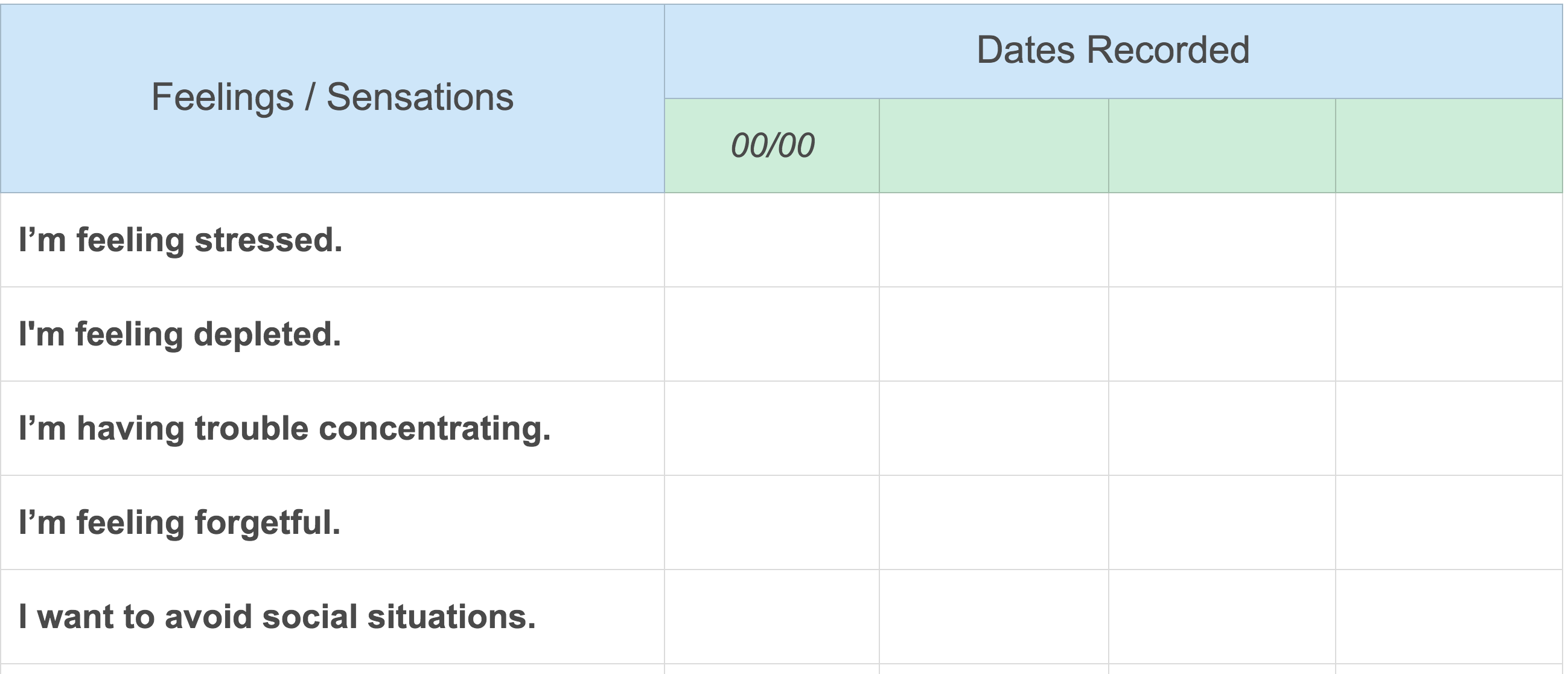
    Because burnout symptoms are often challenging to recognize and heed, it can be helpful to evaluate your feelings by creating a stress log, using a journal or a digital tool such as Evernote.

    A couple of times a week, and definitely whenever you’re stressed, consider ranking the following burnout symptoms on a 1–10 scale (1 = this feeling is hardly present; 10 = this feeling is all consuming):

    Level of stress:

    Level of feeling depleted:

    Level of lowered concentration:

    Level of forgetfulness:

    Level of wanting to avoid social situations:

    Level of pessimism:

    Level of cynicism:

    Level of apathy:

    Level of lowered engagement:

    You can also rank your overall amount of energy on a scale of 1–10, with 1 being totally depleted and 10 being the Energizer Bunny.

    These are uncomfortable feelings, and being honest with ourselves about them can be difficult or feel slightly demoralizing. But we can also see it as empowering. When we notice those numbers creeping higher, we are taking charge of a situation that may have seemed beyond our control, giving ourselves an opportunity to pull back and rejuvenate.

    If you want to keep your stress log in Evernote, we’ve created a simple template you can use.

    5) Manage workplace stress

    Since burnout is primarily associated with our work, that is one place we can definitely make an impact. We don’t have to accept the notion that jobs are inherently stressful and there’s nothing we can do about it. Find ways to structure your day to incorporate short breaks and maximize your peak energy times. Work with your employer and teammates to reduce meeting overload and focus your working hours on the things that matter.

    In today’s “always on” world, stress can be overwhelming, and we often feel like it’s our fault if we can’t stay on top of everything. While it can be tempting to push through feeling run-down in the name of getting stuff done, that road can push us closer to burnout. Taking the time to assess, wind down, and rejuvenate instead can make us healthier, happier, and yes, more productive, in spades.

  • One invisible barrier holding back women at work: the conformity bind

    Most of us enter the professional world believing that the focus and hard work which got us through our education will help us rise there, too. But we don’t yet realize that there are significant obstacles lying in our path. Author Michelle P. King explains how the need to conform can stand between women and success.

    Between the ages of 24 and about 35 marks the beginning of the career track for many women. Women enter this first phase expecting that their road to success will be a meritocratic one. They work hard and try to advance, believing they alone are in control of their success. Like men, women want to do it all and have it all; the only difference is women experience invisible barriers early on that men do not. Women encounter these barriers before they set foot into an office, but without awareness, it is difficult for them to understand why they are struggling.

    Even having access to that first career opportunity is more challenging for women because the standard of what “good” looks like in most recruitment processes is a male one. The challenges continue to unfold over the years, as women are held to higher performance standards and have less access to promotion opportunities or powerful individuals.

    But once you are aware of the broken culture that exists in your organization, you will be prepared to see the invisible barriers for what they are: inequality. With that knowledge, you gain power over the barriers and will begin to see how exceptional you really are. This knowledge will help you preserve your mental and emotional energy and go from wondering how to fix yourself to recognizing that the problem is not you, it’s your workplace.

    Here’s one of those invisible barriers: the conformity bind.

    When we start a job, it takes a few months to learn the acceptable behaviors, team norms and routine practices that the organization values. This process is called socialization and it continues throughout a person’s career, but it is especially important for newcomers. Given that workplace cultures tend to be masculine, it’s a lot easier for men to assimilate. Women, on the other hand, must negotiate around masculine workplace norms, which often exclude them. As a part of my PhD research, I conducted 72 interviews at two large multinational organizations (one in the energy and resource sector, the other in the professional services industry). In every interview, I’d ask participants to describe the ideal employee. Men and women consistently said it was someone who works long hours, makes the organization a top priority, has no dependent-care responsibilities, asks for what they want, competes to get ahead, and is generally extroverted. Most descriptions were the same because employees learn what looks good from the social interactions they engage in at work and by observing leadership behaviors.

    When new hires join an organization, they actively seek out clues for how to fit in. What does it take to succeed? Who gets rewarded and for what? Who gets promoted? How do leaders behave? What do employees need to do to fit in? Employees get a lot of the answers by watching leaders. Leaders don’t just manage the organization; in many respects, they are the organization. Leaders represent the behaviors, norms and standards that employees are expected to mirror if they want to be included. Behaviors that comply with these standards get promoted, developed, and rewarded. Individuals who fit the prototype are more likely to be accepted, included and advanced into leadership positions, which further reinforces the one-size-fits-all standard of success.

    What does conformity ultimately get you? Social capital. In other words, that means being included and accepted at work. Social capital gives employees access to social groups, networks, mentors, sponsors and powerful people — all of which are important to career success. To thrive at work, men and women need to fit in to access social capital.

    However, informal networks are a lot harder for women to break into. Telling women to do more networking ignores the exclusionary practices that men engage in. When Steven, a male colleague, went for a job interview, he was asked a handful of questions by the hiring manager about his experience for the leadership role. The rest of the conversation was a discussion about his years playing college soccer; the male interviewer let slip that once Steven joined his team, he could join the work soccer team. Steven got the job, and even he was amazed at the lack of rigor in the process. Steven joined the soccer team and quickly became one of the guys, getting invitations to Friday drinks, lunches and golf days. As men make up the dominant group at work, they determine the makeup and membership to most informal groups.

    Even if women break into informal groups at work, it is unlikely they will be accepted in the same way men are. A great example of this is mentoring. Mentoring programs are a go-to solution for advancing women in the workplace, because they help socialize employees into an organization. While men and women do not differ in their reported levels of mentoring or networking, white men tend to benefit a lot more from this behavior.

    The 2018 Harvard Business Review article “Research: Women Ask for Raises as Often as Men but Are Less Likely to Get Them” randomly examined 4,600 employees across 800 organizations. It found that women are mentored as much as men — and in some cases more — but the type of mentoring men and women received differed. Men were more likely to be sponsored by senior executives who would use their influence to help advance their mentees’ careers. Men are more likely to be accepted into the inner circle, which means they receive greater organizational awareness and understanding from mentoring relationships.

    While accessing social support presents a significant barrier for white women, it’s even more difficult for women of color. They don’t share gender or racial similarities with white men. Both sexism and racism limit opportunities for women of color to access informal networks and mentors, which can become a significant source of stress. According to researchers Janis Sanchez-Hucles and Donald Davis, while white male leaders often exclude white women, they are still more likely to accept white women than women of color. What makes this particularly difficult to address is that it’s often hard to spot. Men who engage in these behaviors are often unaware of what they are doing or they deny the impact it creates. This is how male leaders can believe they support diversity and inclusion while continuing to hire, promote and reward employees who look like them.

    Women have a very narrow range of behaviors they can engage in at work if they want to be accepted and succeed. It is not enough for women to be good at their job. Women need to display their competence and leadership capability in a way that conforms to gender stereotypes. This means doing your job well, while ensuring you are coming across as warm, friendly, kind, modest, sympathetic, and pleasant. If women don’t do this, they will be perceived as competent but not likable.

    Women navigate a very narrow path at work by being assertive but pleasant, outspoken but warm, and successful but not self-promoting.While this Goldilocks standard is an impossible task for anyone to live up to, it becomes still harder when you layer on other areas of difference, like race or ethnicity. These identities carry with them additional stereotypes, expectations and constraints for how people are expected to behave at work. This process of getting women to conform to an impossible standard is how organizations slowly filter out difference, because employees need to work around, manage or hide their differences to fit in.

    Hiding your womanhood to live up to the masculine ideal is how women start to lose themselves. Women are encouraged to power dress, speak louder and act more assertively — that is, they act like men to fit in. Women also face tremendous pressure to tolerate sexist jokes, inappropriate behavior, harassment, discriminatory comments and office banter for fear of being perceived as difficult or, worse, excluded altogether.

    Women who succeed in workplaces often are required to deny their gender because of all the ways it makes them different. As psychologist Paula Nicolson has found in her research, which she shares in her book Gender, Power and Organizations, the ideal successful professional woman is single-minded, tough, autonomous and willing to distance herself from traditional femininity and domestic duties. But when women deny aspects of their identity, they also deny experiences of inequality, which makes it impossible to tackle them.

    I know how powerful the need to fit in can be. My friend Emma Campbell worked in the energy and resource sector as an engineer. She was one of a handful of women working alongside hundreds of men on a mine site. This environment was so male dominated that there were no restrooms designated for women — only men had restrooms. Women had to share a portable toilet instead.

    When Emma started out, she was desperate to fit in and be treated like an equal. So she began to act like one of the guys by laughing at sexist jokes, making derogatory comments, and even mocking herself for being a woman working in a man’s world. Within a year Emma had transformed. She talked, acted and even dressed like the men she worked with. But none of this worked. Emma would always be treated differently — because she was different. Only her work environment had made her believe that this difference was a bad thing. By trying to fit in to survive at work Emma had lost her identity.

    Trying to pretend to be someone else is an exhausting and demoralizing process. So eventually Emma gave up and decided to be herself — regardless of the consequences. This made it easier for Emma to notice all the ways the mine site was unwelcoming to all women, a culture she had participated in creating. This made her want to change things. So, when male colleagues tried to engage her in sexist banter, she told them to stop, not caring if this isolated her even more. Emma was liberated. She could finally be herself. Some of the men she worked with saw her new behaviors as the permission they needed to speak up and push back on some of the sexist banter that made them uncomfortable. Soon Emma realized that she wasn’t alone. The negative comments and derogatory behavior toward women were something that only a small handful of men initiated and supported.

    When Emma denied her differences, it didn’t make them disappear. Just by being one of a handful of women on a mine site, Emma stuck out. In fact, when any employee group makes up between 1 and 35 percent of the relevant employee population, they have a minority status at work. This can create added stress for women because their status makes them more visible and so they are scrutinized in a way that men are not. The term for this is hypervisibility. It feels a lot like working under a magnifying glass, where every move and mistake is examined. This added scrutiny places women under tremendous pressure to perform and prove their worth because they are trying to bridge their difference.

    These challenges are significantly more pronounced for women of color,. who — because of race and gender differences — face a more extreme version of hypervisibility. They must also be on guard to deal with discrimination, insults or bias at work. A 2019 study undertaken by the nonprofit firm Catalyst examined the experiences of 649 black employees and included roughly even numbers of men and women. What they found was that hypervisibility is a major issue for black men and women, who felt they constantly needed to be “on guard” at work. This included constantly being prepared to manage negative comments, insults and exclusionary behavior as well as having to continually demonstrate their credibility. Over time, this negatively impacted participants’ emotional, mental and physical health, and well-being, as 45 percent of black employees reported sleep problems and 54 percent felt on edge.

    The fix to this barrier: Solve the problems you create

    If men present a barrier to women being accepted at work, men can also remove the barrier. At one company, male leaders had installed a PlayStation in the lunchroom for employees to use during their breaks. This was meant to be a way for all employees to relax and socialize. However, American football seemed to be the only video game that was ever played. Consequently, it was overrun with men who’d use it to bond with other senior men in the organization. They also excluded women from playing.

    Frustrated, women raised the issue with the most senior male leader, arguing the PlayStation had become an informal network that excluded women from an opportunity to engage and build relationships with leaders. Instead of dismissing these complaints, the senior male leader decided to take it upon himself to solve the issue.

    He took three specific actions, ones that all men can do to disrupt such practices at work. First, he spent time with the women in his office to analyze the issue. He wanted to educate himself and understand how this informal social practice excluded them. Second, he raised the issue with the men in the office, despite significant push back. The senior leader took time to share women’s accounts of how this social practice excluded them and the impact this was having and invited women to share their experiences and supported them when they did. This built men’s awareness and ownership of the problem. Men were then engaged to identify solutions to the inequality they had created, which was the final step.

    The aim was never to remove the PlayStation or the game, but to provide women with an opportunity to play and give them access to the same informal social opportunities the men had. As such, male leaders committed to spending one-on-one time with each of the women in their teams. In addition, leaders identified an activity the whole team could undertake to ensure everyone interacted more. These leaders doubled down on their investment to level the playing field by spending time and effort to engage the women on their teams. This is something all men can do.
  • The #1 block to teamwork is defensiveness. Here’s how to defuse it

    To be human is to get defensive. When we’ve been questioned or criticized at work, it’s fair to say that almost all of us — save for, perhaps, the Dalai Lama and other equanimous souls — have gotten irritated, retreated into silence, or said something cutting in response. And because it is so normal to get defensive, we tend to write it off as no big deal. Jim Tamm, however, begs to differ.

    Former judge Tamm spent 25 years working through other interpersonal conflicts, including mediating more than 1,000 employment disputes, and he currently trains consultants to teach collaboration skills. So what does defensiveness have to do with collaboration? Tamm has come to believe that defensiveness is the major obstacle that prevents people from working well together. “There is nothing that will help you become more effective at building collaboration than better managing your own defensiveness,” he says in an interview.

    While it’s close to impossible to completely eliminate getting defensive during stressful moments, you can become aware of your own reactions and have an action plan in place when you notice them. “Any time you’re getting defensive, you’re getting less effective. When you get defensive, your thinking becomes rigid and you simply become stupid,” says Tamm, also the author of the book Radical Collaboration.

    Why is defensiveness such an obstacle to collaboration? When we get defensive, “we put way more into self-preservation than we do into problem-solving,” Tamm says. “We’re trying to prove that we’re right rather than search for creative solutions.” When this happens in a workplace, it can be a recipe for chaos and failure. Such impulses are especially harmful for bosses, managers and those in power. That behavior hurts more than just the defensive person. When we get defensive, adds Tamm, “we invite everyone else in the room to get defensive, too.”

    Of course, it can be difficult to recognize defensiveness in ourselves, and that’s because there are underlying emotions at play. When a person becomes defensive, they might appear to be putting on protective armor and gearing up for battle, but they’re usually masking their fear. “Defensiveness does not protect us from other people,” says Tamm. “It defends us from fears we don’t want to feel.” Those fears can include thoughts about your own significance, your competence and your likeability. Your defenses might come up due to imposter syndrome — like when you’re scared not looking smart enough or that you’re a subpar employee or a bad boss.

    For example, let’s say you’re worried about a performance review. When your manager gives you some constructive criticism, you may offer excuses or become angry or brusque. But Tamm says these behaviors are masking your real problem, which could be your fear of not getting the raise or promotion that you feel you deserve or even your fear of being fired. “Our defensiveness helps us hide our fears from ourselves,” he says, and it erroneously serves to convince you that the fears you have aren’t true.

    OK, now that we understand the dangers of defensiveness, here’s what we can do about it. You can start by learning to spot the warning signs of defensiveness in yourself. When you feel yourself experiencing them, pay attention and take action. According to Tamm, here are the 10 most common warning signs that you may be getting defensive: A spurt of energy in your body; sudden confusion; flooding your audience with information to prove a point; withdrawing into silence; magnifying or minimizing everything; developing “all or nothing” thinking; feeling like you’re a victim or you’re misunderstood; blaming or shaming others; obsessive thinking; and wanting the last word.

    Tamm recommends looking back on any charged conversations, disagreements or conflicts — minor and major — from your life, and finding the patterns of behavior you engage in when you get defensive. Perhaps a minor tiff at work made you default to “all or nothing” thinking, and suddenly you felt ready to quit. Or, a single question from your partner about where the soup pot is located gets magnified into “You never know where anything is because you never liked this apartment.” If you have difficulty determining your own signs of defensiveness, ask for feedback from your family, friends or trusted colleagues. “Usually, other people spot our defensiveness before we do,” says Tamm.

    Why is internal observation so important? “Most of us are not sufficiently in tune with our fear to do anything about it until it’s too late,” says Tamm. “If we know what our signs of defensiveness are, they can become our own personalized early warning system. For example, I noticed that when I get defensive, my breathing becomes faster, I tend to talk much louder, and I usually feel very misunderstood.”

    Creating your own warning system for defensiveness involves a few simple steps: Noticing, taking action, and letting go. Whenever you recognize one of your own warning signs — for example, obsessive thinking or confusion — acknowledge to yourself that you’re getting defensive by saying something like “It feels like I’m becoming defensive.” This is extremely important. Tamm points, “If you don’t notice that you’’re getting defensive, you’re not going to take any other action.”

    Next, slow down your physiology in some way. That could mean taking a few deep breaths, being aware of your feet on the ground, or — if you can — going for a walk. Focusing your attention outward is like hitting a reset button on your defensiveness. At the same time, try to observe what you’re saying to yourself. If you find that you’re criticizing yourself for your defensiveness or for your lack of keeping cool, ask yourself something like “Is this helping me right now? What behavior would be more helpful?”

    Then, create an action step to counteract any damage that your defensiveness may cause. If you typically go quiet and sulk, for instance, you may decide instead to ask a question or share what you’re feeling. One way to create a psychologically safe environment for yourself — and others — is when you demonstrate your vulnerability. This can be accomplished by sharing something like “I feel like I’m getting defensive here, so let me take a step back.” Or, if your defensiveness sign is bombarding your teammates with information to prove your point, you could consciously pause for 15 seconds and let others finish speaking first.

    In his TEDx talk, Tamm shares a memorable example of an action step. He says, “One woman’s warning sign was always wanting the last word. So she got this image of herself standing in the conference room doorway, throwing in the last word, and slamming the door. [Picturing it] was a way of not only reminding her what she was doing but also lightening up her mood a little bit.”

    Once you’ve taken your action step, you’ll find that you have an easier time letting go of your defensiveness and examining the situation — and your coworkers — with fresher, calmer eyes. Your physical and emotional selves will most likely be in a different place than when you first started getting defensive. Practice your action step until it becomes automatic, suggests Tamm.

    Be patient: Noticing and managing your defensiveness takes practice. Find times — maybe with your family or friends — when you can rehearse your action steps so you’ll be ready when you most need them. Remember, says Tamm: “If you can stay non-defensive, you can always be more effective.”

  • How to be your best self in times of crisis

    So given everything going on at the moment it seemed poignant to share this talk from Susan David about how to be your best self in times of crisis. About 28 minutes in there’s a bit around social distancing and working from home and something that stood out for me was the idea that we do not need to practice ‘social’ distancing but ‘physical’ distancing, the terminology can conjure ideas of being alone rather than just physically apart.

  • It’s okay to feel overwhelmed, here’s what to do next

    Especially at the moment, an hour might feel like a heavy time commitment, it’s worth considering especially because of the current climate it might be even more important than normal to find that time. This profound talk from the author of “Eat, Prey, Love” about anxiety, fear and grief in the current climate offers some hope and reflects on how to stay present. Some of the highlights I took away were:

    • “There is no more species more anxious than humans”, unlike most species we have such vast imaginations we can picture the future, and we often picture the worst.
    • Humans are great at adapting, while we create a great amount of anxiety thinking about the future, often when it comes we just get on with it.
    • The difference and importance of empathy vs. compassion.

    The above resonate with a favourite quote of mine by Sceneca (sorry for the Greek philosophy), “We suffer more in imagination than in reality”, this is me all over, I spend a huge amount of time stressed and anxious because of what I ‘imagine’ and when it eventually comes, better or worse, it’s rarely that bad.

  • Under stress at work? Just remember: Don’t believe what you think.

    Here’s how you can take control of your brain’s knee-jerk reactions to distressing situations, says psychology researcher Lisa Penney.

    This post is part of TED’s “How to Be a Better Human” series, each of which contains a piece of helpful advice from people in the TED community; browse through all the posts here.

    Question: When you’re under stress at work, are you able to do your best thinking?

    For almost all of us, the answer is No.

    In fact, for many, we might go one step further and say we end up doing some of our worst thinking when we’re under pressure.

    But there’s a big problem: When you’re under stress, that’s often the time when you need to be at your best — to think clearly and critically.

    Lisa Penney, a business-school professor at the University of South Florida, Sarasota-Manatee, has been looking into this phenomenon. She specializes in studying stress, a key element of the business world. When she began, she focused on trying to identify the causes of stress because she wanted to figure out how to dispel them. “What I learned is, that’s not realistic,” she says in her TEDxUFSM Talk. “We can’t make it all go away and even if we could, that’s not a good thing — we need challenges to learn and grow.”

    In the course of her research, she has realized that when we’re distracted or distressed, our thoughts can get distorted. “Some of the more fundamental assumptions you make on a daily basis about the world you experience and the people in it, including yourself, can’t always be trusted,” Penney says. In numerous lab experiments, it’s been shown, as she puts it, “sometimes we see things that aren’t there, and sometimes we fail to see things that are in plain sight … This happens because we are hardwired to make fast decisions not accurate ones.”

    As Nobel Prize-winning economist (and TED speaker) Daniel Kahnemanrevealed, our brains process information in two ways: fast and slow. ”Our fast brain is highly efficient, and it makes decisions automatically by focusing on a few details that it thinks are important, based on past experience,” explains Penney. “Our slow brain, on the other hand, uses control processing in order to make decisions, and it takes into account far more information and it thinks critically.”

    Our brains spend almost all of their time in fast mode — more than 95 percent of our thoughts are believed to be unconscious and automatic. “The fact that our thoughts and decisions become automatic is really helpful and it works great in situations that closely match our past experiences,” says Penney. “But it gets us in trouble when we have new experiences and when we’re under stress.” (Our fast brains are also the ones responsible when we fall for phishing emails and other scams.)

    The next time you’re in a tense situation at work, here are a few things you can do to counteract your fast brain.

    Pay attention

    “Be aware that your brain will default to making fast decisions, not accurate ones, “ says Penney. “Pay attention the next time you find yourself telling a familiar story about what’s happening at work.”

    For example, let’s say you just sent your boss a detailed proposal that you’ve spent a considerable amount of time on. She replies to your lengthy email with this word: “OK.” You start to worry that she didn’t like it. Worse, maybe she dislikes you. But before you begin to fall into a spiral of rumination and worry, check yourself. Tell yourself something like: “I know I’m under stress right now, and it’s affecting my thinking.”

    Take some deep breaths

    “Once you notice that story, breathe,” suggests Penney. “Remember, when we’re stressed, part of our brain goes offline as our bodies go into fight or flight, and we can’t see clearly. Taking a deep breath tells your body you’re safe.”

    You can try what’s called “coherent breathing,” which has been shown to help calm the nervous system. Here’s how to do it: breathe in, letting your inbreath last five to six seconds. Pause for a moment. Breathe out, letting your outbreath last five to six seconds. Repeat. To feel its full effects, some experts recommend practicing coherent breathing for 10 minutes (or more) every day.

    Be curious

    “Ask yourself: ‘What’s the story I’m telling myself? Is it true?’” says Penney. She cautions, “Remember, thoughts that are familiar will feel true, so don’t stop there. Ask yourself: ‘What evidence do I have? Do I have other stories that might also make sense?’”

    With the “OK” email from your boss, consider the many other possibilities: she’s really busy, she’s going to look at it later, she just wanted to reply and acknowledge she received it, she’s walking into another meeting, she’s really busy, etc.

    With practice, according to Penney, you can learn to disrupt your fast thinking before it runs away from you. But there’s one important thing you should keep in mind — having those automatic thoughts in the first place doesn’t make us bad or gullible or weak. “It makes us human,” says Penney. “We just have to be willing to be aware of and question those thoughts so we can decide which thoughts we want to drive [us].”

    The more that we can take the time to question our thoughts, the wiser decisions we’ll be able to make for ourselves and our organizations. As Penney puts it, ““We live in overwhelming and stressful times and face very real and serious challenges in our personal lives, at work, and in our communities. In order to effectively meet these challenges, we need to be able to see clearly.”

  • Women in marketing: 5 Google leaders share their career stories and advice

    On March 8, the world celebrates International Women’s Day. It’s an appropriate time for a societal gut check: Just how well are we doing at achieving gender equality?

    When it comes to career growth, women in the workplace still face a greater uphill battle than their male colleagues. Studies show that less than 1/3 of senior roles globally are held by women. And, according to the World Economic Forum, women are paid just 63% of what men earn. Then there’s the matter of self-promotion. On average, men apply for a job or promotion when they meet just 60% of the qualifications, but women only apply if they meet 100% of them. On the other hand, more recent research shows that if a woman exhibits too much confidence, she’ll face a backlash effect.

    Below Google Marketing leaders from around the world share their views about this topic, their career stories, challenges, and advice for women — or anyone — developing their careers.

    Keep learning at every point in your life

    Sapna Chadha always knew she wanted to work globally. She credits her move from the U.S. to Asia as one of the most pivotal moments in her career. However, she says, “That wasn’t something I strategized. It was because my husband needed to move to Asia for work.” In retrospect, Chadha wonders, “As women, are we as vocal around some of our desires as we could be?”

    Chadha advises others to actively “influence how your journey is, and not just wait to be asked for the next thing. If you’re not clear on what opportunities you want, you’ll just spend your time looking at everything.” She adds, “I’ve now realized that I should have a shortlist of jobs that I am most keen to pursue in the next few years. And, most importantly, I should go for jobs that I don’t meet all the requirements for.”

    Chadha also posits that “to succeed in marketing in the next 10 years, you have to understand everything is becoming more technical.” While brand marketing is important, performance, growth, and digital marketing are vital. But, she says, “I think women believe somehow that they’re not good at technical components, so they don’t jump in. Well, you can learn anything at any point in your life. If women hold themselves back from the science of marketing, it’s not going to get them to their full potential.”

    Choose the right people to work with and the right environment to work in

    Kristell Rivaille credits a toilet with helping her choose her first marketing job. More specifically, a sign above a toilet. While interviewing at a company, she noticed the usual request in the restroom telling people not to throw paper towels in the toilet. But this particular sign explained why: Unlike toilet paper, hand towels don’t dissolve when wet. “I don’t like when people just tell me what to do,” Rivaille says. “I like when people explain to me why we need to do it and get my buy in.” The job hadn’t been her first choice originally, but that restroom sign made her feel the company would respect their employees’ intelligence and encourage open communication.

    “The rational approach to choosing a career move is important,” Rivaille says, “But paying attention to the emotional aspect is when you get the best results. You’ll be doing what you love and bringing passion, energy, and creativity to your job.” She recommends looking beyond what brand or product excites you and “choosing the right people to work with and the right environment to work in.”

    Rivaille also stresses the importance of self-awareness and emotional intelligence. By understanding who you are and how you come across to others, you can “learn how to flex yourself depending on the situation and the people you’re working with. Being assertive can be much-needed in a situation, but in other moments I might need to just shut up and listen.”

    Find opportunities to learn and move out of your comfort zone

    Susana Ayarza believes women should be vocal about what they deserve at work. However, she also wonders if people focus too much on titles and levels rather than on personal growth. “Obviously promotions are important because they’re part of being recognized in your career, but just as important is finding opportunities to learn and move out of your comfort zone.”

    Ayarza mentions a time when she agreed to lead a global team while still working in Brazil. It wasn’t technically a promotion, but she considered it to be one. “It was a totally new experience and I had the chance to learn from different cultures. That’s real growth. I’m a different executive now because I had that opportunity.”

    Part of Ayarza’s growth includes reevaluating her career goals. A few years ago, she wanted to become a top executive in marketing. Now her focus has shifted to leaving a lasting legacy and fulfilling a higher purpose. She tells others, “When you’re older, you’re not going to remember the numbers, the projects, the initiatives you did that were good for business. You’re going to remember the impact you made on society and the people around you.”

    Do your best imperfectly

    Michelle Bryan-Low once stepped away from her career for seven years, moved to France, and ran a wild boar hunting lodge. “It gave me this massively different life experience than if I had just stayed in corporate businesses through my entire career.” As valuable as these years were, however, Bryan-Low was nervous when she decided to leave rural France and return to the workforce. “I lost a lot of confidence in my own abilities and my own potential.”

    While Bryan-Low feels fortunate that a former company rehired her in a familiar role and that she could spend time rebuilding her confidence, she understands how hard it is for women to come back from maternity leave or a sabbatical and juggle career and home life. “You always feel like you’re compromising somewhere. You feel guilty about being away from your children, and you feel guilty about loving your work.”

    Bryan-Low believes it’s important to realize that “there is no superwoman. We set such unrealistic bars for ourselves.” She advises women on her team to “be kind to yourself. It’s fine that things aren’t perfect. Don’t try and have it all. Just do your best imperfectly.”

    Be responsible for your own decisions and choices

    Earlier in her career, Kazuha Okuda had a job that she felt diminished her. “I was always assigned to a supporting role, never as the main lead even though I was capable of it.” The longer she stayed in the situation, Okuda says, the easier it became to internalize it. “Once you get used to it, you don’t really see the problem. You default to the box they put you in.”

    Finally, she spoke with male colleagues and discovered they were being given much more substantial projects. “I was shocked. What had I been doing? So I made a plan to get out of that team, start over in a leading role, and set expectations differently. Proactively changing my environment and the dynamic is what it took to change my career.”

    Now Okuda stays on track with a personal mission statement: Make the world a better place. “Having an ambitious goal in the back of my head helps me steer my career. I’m selective in what projects I take on and who I work with.” She advises others, “It’s OK to be picky because you have to navigate yourself through your career and be responsible for your own decisions and choices.”

    Get practical steps for developing your career in the free Primer app.

  • Did you know there are scientifically proven benefits of being kind?

    There are scientifically proven benefits to being kind! It is contagious, teachable, and makes you feel all fuzzy inside.

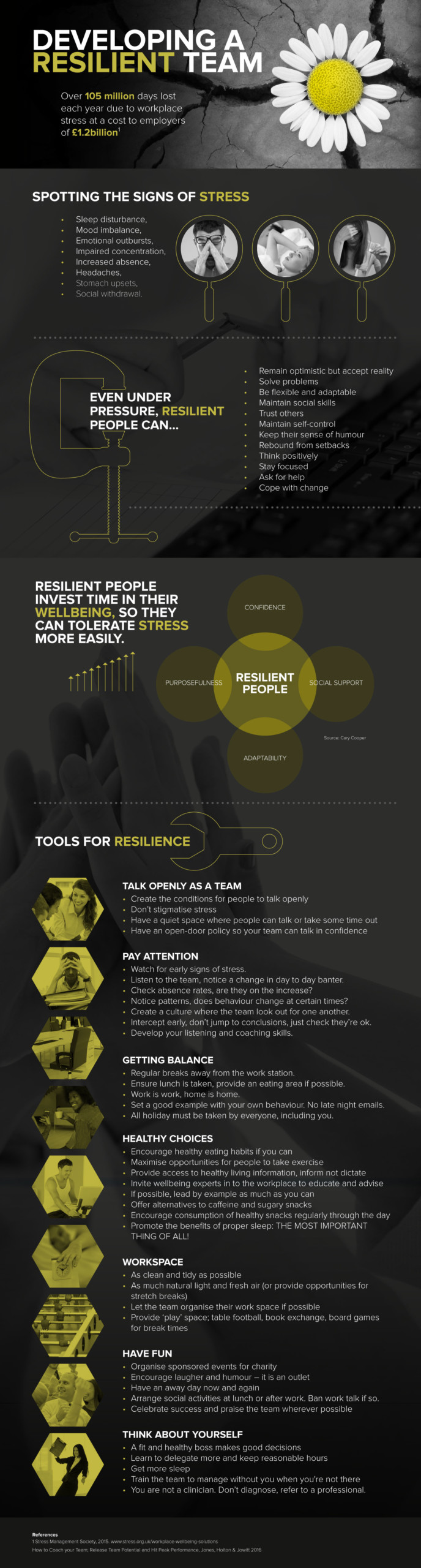
  • Developing a resilient team

    A great infographic highlighting the signs of stress, what resilience means and some tools to improve it.