Category: Development

  • Time Parting in Analysis Workspace

    So some of you might have found it annoying that you can’t look at say Monday for the last four weeks rolled up, or hour of the day. Instead you have to run every weekday or every hour and then sum them after. Well now you don’t have to, analysis workspace has now introduced time parting which means you have dimensions like “Day of Week” or “Hour of Day” that you can drop in to a report.

    This means you can do things like drop last four weeks across the top, day of week down the side and instantly have a table of trended data by weekday.

  • Excel Formulas & Data Presentation

    Excel Data Presentation Guide [Download]

    Copy & Paste Values Copying the the contents of a cell and pasting just the value and not the underlying formula that is displayed in the formula bar.
    Remove Duplicates Delete duplicate rows from a sheet.
    Number Formats Changes the appearance of numbers, including dates and times, without changing the actual number.
    Data Validation Pick from a list of rules to limit the type of data that can be entered in a cell.
    Sort Values in a list with their corresponding values in adjacent columns are ordered by criteria to make them more legible.
    Filter Create a subset of data that meet certain criteria from the current dataset.
    Freeze Panes Freeze a portion of the sheet to keep it visible while you scroll through the rest of the sheet.
    Conditional Formatting Easily spot trends and patterns in your data using bars, colours, and icons to visually highlight important values.
    Graphs Easily spot trends and patterns in your data using bars, colours, and icons to visually highlight important values.

    Excel Formula Reference Guide [Download]

    Some of you might have seen this already but before Lee left us he gave us a great reference document of the top Excel formulas you might find helpful, it includes:

    Anchoring Cells – Defines whether the cell or range of cells referenced changes relative to the position of the copied cell or range of cells or remains constant regardless.
    SUM – Adds all the numbers in a range of cells.
    SUMIF and SUMIFS – Adds the cells specified by a given condition or criteria.
    – Adds the cells specified by a given set of conditions or criteria.
    ROUND, ROUNDUP and ROUNDDOWN – Rounds a number to a specified number of digits.
    – Rounds a number up, away from zero.
    – Rounds a number down, towards zero.
    Wildcards – Used when the full text reference is unknown or if it needs to be non-specific.
    COUNT and COUNTA – Counts the number of cells in a range that contain numbers.
    – Counts the number of cells in a range that are not empty.
    COUNTIF and COUNTIFS – Counts the number of cells within a range that meet the given condition.
    – Counts the number of cells specified by a given set of conditions or criteria.
    VLOOKUP and HLOOKUP – Looks for a value in the leftmost column of a table, and then returns a value in the same row from a column you specify. By default the table must be sorted in an ascending order.
    – Looks for a value in the top row of a table or array of values and returns the value in the same column from a row you specify.
    MATCH – Returns the relative position of an item in an array that matches a specified value in a specified order.
    INDEX and INDEX with MATCH – Returns a value or reference of the cell at the intersection of a particular row and column, in a given range.
    – Returns a value or reference of the cell at the intersection of a particular row, based on the relative position of an item in an array that matches a specified value in a specified order, and column, based on the relative position of an item in an array that matches a specified value in a specified order, in a given range.
    OFFSET and OFFSET with MATCH – Returns a reference to a range that is a given number of rows and columns from a given reference.
    – Returns a reference to a range that is a given number of rows, based on the relative position of an item in an array that matches a specified value in a specified order, and columns, based on the relative position of an item in an array that matches a specified value in a specified order, from a given reference.
    RANK – Returns the rank of a number in a list of numbers: its size relative to other values in the list.
    LARGE and SMALL – Returns the k-th largest value in a data set. For example, the first largest number.
    – Returns the k-th smallest value in a data set. For example, the first smallest number.
    AND, OR and NOT – Checks whether all arguments are TRUE, and returns TRUE if all arguments are TRUE.
    – Checks whether any of the arguments are TRUE, and returns TRUE or FALSE. Returns FALSE only if all arguments are FALSE.
    – Changes FALSE to TRUE, or TRUE to FALSE.
    IF and IS Functions – Checks whether a condition is met, and returns one value if TRUE, and another value if FALSE.
    – Checks the specified value in relation to the function and returns TRUE or FALSE depending upon the outcome.
    Errors and IFERROR – Errors are returned when Excel cannot properly evaluate a worksheet formula or function.
    – Returns value_if_error if expression is an error and the value of the expression itself otherwise.
  • Data Viz Study

    So if the words data visualisation don’t make your eyes roll back in your head Tableau have written an article based on tracking eye movements when looking at dashboards to give some ideas on how to improve your visuals here. My favourite take-aways though are:

    • Big numbers draw attention, rather than just putting all of your numbers in a table with a total row why not put them up the top and change the font size.
    • It might look tidy to use the same graph types but people get repetition fatigue and you’re better off mixing up your visuals.
    • Use contrast, having a colour pallet that’s easy on the eye might be important but if all of your colours are similar it can be easy to glaze over and you’re better off using contrasting or bright colours to draw attention.
  • Error Reporting in SessionCam

    SessionCam ran a seminar recently on how to use their new Error Reporting feature, which you can now watch above. I’ve had a play around with it but it’s definitely in its early stages and could do with some refining. If anyone has a go and has any questions/feedback I’d love to hear it and would be happy to pass it on to SessionCam for future developments.


  • How to live longer!

    I read a really interesting article in Scientific American here around how time appears to pass faster as you get older. It seems rather depressing the older you get the faster your perception of time seems to get, there are some things you can do to change this however and so from your perception you’ll feel like you’ve lived longer!

    1. Make more memorable events, go on more holidays, have more firsts.
    2. Get more excited about things, remember all that excitement counting down the days until Christmas that excitement and time watching makes time appear to pass more slowly.
    3. Stress! If you haven’t already consider some of the Academy e-learning on “Improving my Resilience” here or “Managing stress in the workplace” here. Stress is a leading factor in how we perceive time so less stress means more time.
  • Workspace Visualisations

    If you’re looking to improve your knowledge of analysis workspace take a look at this video which will give you an overview of the visualisation capabilities of Workspace. The password is “arg0s”. If you want to see some more Adobe Workspace videos take a look at their at their playlist on their YouTube channel here.

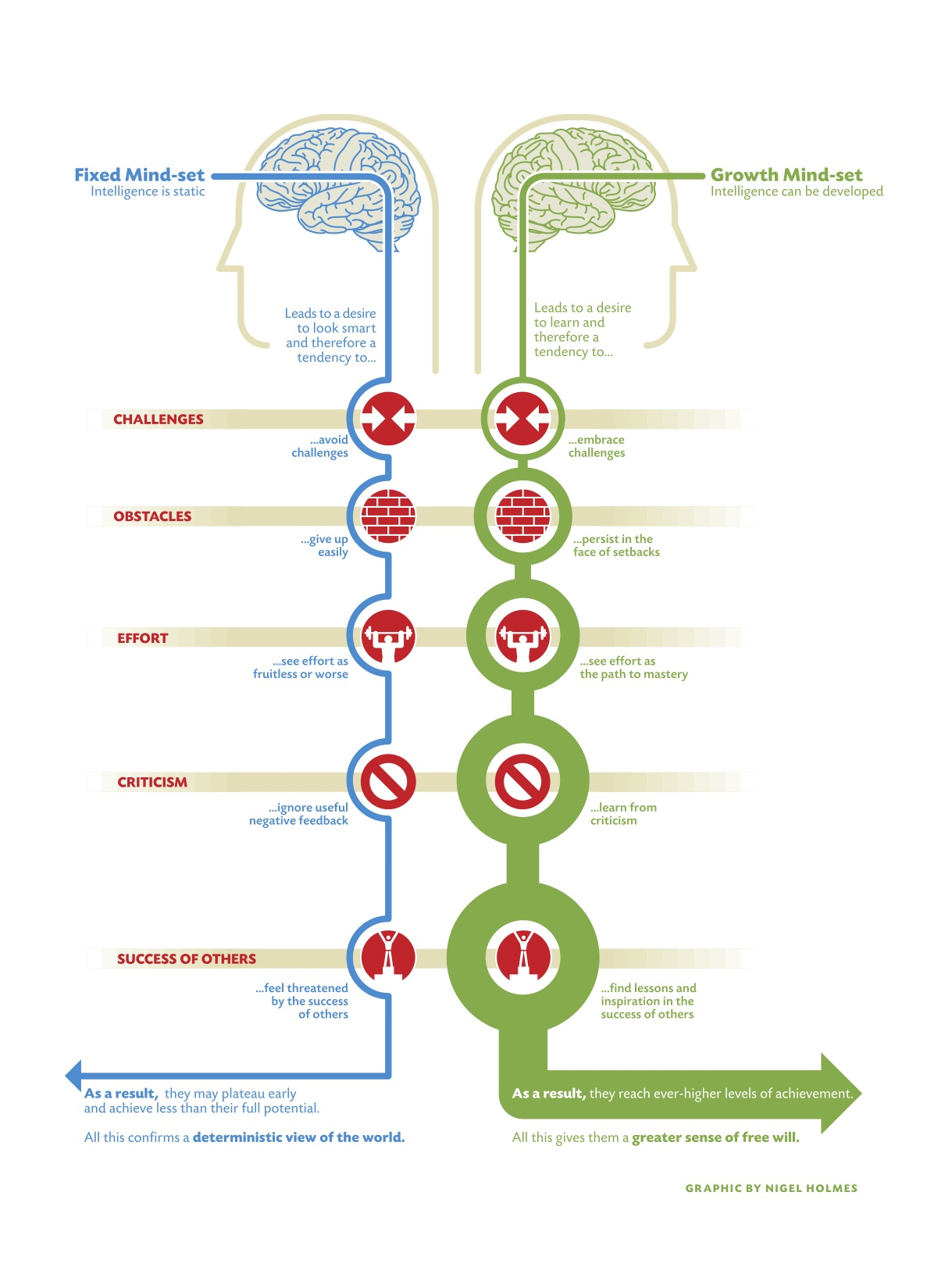
  • Fixed & Growth Mindset

    So there’s a load of support available on The Academy around this but I just wanted to share this infographic which I think highlights the key differences between a “fixed” and “growth” mindset.

  • 8 Teamwork Myths To Tackle At Your Office

    teamwork tips

    When was the last time you stopped to think about one of the most important relationships in your life? One that consumes a huge portion of your time, energy, and has a huge impact on your future? That’s right, we’re talking about the one you have with your team at work.

    With long to-do lists and non-stop meetings, you might not have enough time in any given day to stop and really think about your co-workers. In fact, the whole point is to get the job done.

    But what if we told you that thinking about how your team members relate to each other would make all the difference to your bottom line?

    As we’ve discovered in a recent survey, professionalism isn’t a patch to cover up a team’s underlying emotional connections. In fact, there are a number of assumptions about teamwork out there that might be getting in the way of better performing teams.

    The Survey Says…

    We set out to explore what teamwork in modern offices is all about, in partnership with join.me and HipChat.

    After surveying over 1,000 knowledge workers across the United States, we discovered team truths we weren’t expecting.

    For example, people feel twice the emotional reward when given recognition as an individual rather than as a team. Additionally, Millennials love working in teams, but they’re not so keen on texting with colleagues. Furthermore, it’s still the case that (gasp) phone calls are used more between colleagues than video meetings or chat apps.

    Here are some more notable truths we uncovered:

    • Teamwork may or may not inspire co-workers: One-third of surveyed professionals prefer to work on a team, one-third prefer to go solo, one-third are fine either way!
    • Remote work doesn’t hinder teamwork: 32% of professionals we surveyed work remotely at least once a week, and the vast majority (83%) said it had little-to-no negative impact on their teamwork.
    • But communication is the biggest team improvement wish: Over 20% of respondents would like to communicate with their team members more often, and an additional 20% would like to communicate more efficiently in meetings.

    Are any of these insights making you look differently at how your team works?

    Perspective starts with knowledge, so we’ve collected the most valuable data and key lessons from the survey in one office-friendly presentation.

    Take a look, share with your team, and discuss what you think about these eight biggest teamwork myths of the modern office:

    Collaborate For Extra Credit

    We partnered with two other collaborative companies on this initiative to help teams explore better ways to work together. The tool tips in the above presentation outline ways you can use project collaboration (Trello), chat communication (HipChat), and video connections (join.me) to create a teamwork structure that works regardless of time, location, or device.

    Check out these additional ideas on how to build a collaborative toolset for your team:

    If we’ve learned anything, it’s this oh-so-golden rule: Keep your team connected in a positive, well-balanced way in order to keep your work, and work relationships, at their best.

  • The Secret To Limitless Motivation Lies In Self-Validation

    self-validation techniques

    Completing a task is as simple as powering through it. Except that this kind of advice is much easier said than done. It’s not that you can’t handle the task at hand; in fact, you know you have all the resources and necessary information at your disposal.

    So why, then, can’t you seem to push forward and finish?

    Unlocking productive self-motivation has a lot to do with where and how you seek validation. (Validation, in this case, being the recognition and affirmation that what you’re doing is worthwhile and important.)

    Turns out there are a few crafty psychological tactics ingrained in your thinking since childhood that can affect your ability to validate yourself—and ultimately the strength of your self-motivation. These tactics exist to stall, stupefy, and sabotage your momentum and confidence.

    Let’s dig into what they are and, more importantly, how to stop them.

    Do You Have A Fixed Or A Growth Mindset?

    fixed mindset vs. growth mindset

    One of the most revolutionary theories of modern psychology revolves around the concept of fixed versus growth mindset. Essentially all motivation (or lack thereof) can be traced back to whether a person is operating in fixed or growth thinking.

    This distinction dictates whether you constantly need to seek external validation of your own ability, or whether you recognize your own worth.

    Fixed

    People operating in a fixed mindset believe that their intelligence is finite, so it is only prudent to pursue endeavors that align with their perceived areas of expertise. On the flipside, they can become anxious about (or avoid entirely) situations where they feel like they will come off as unprepared or ineffective.

    Common traits of people in a fixed mindset include:

    • Aversion to trying something new
    • Being dismissive of useful feedback
    • Feeling threatened by the success of others

    One of the most significant side effects of operating in a fixed mindset is that such thinkers are constantly seeking external validation as a means to “prove” their worth not just to others, but also to themselves.

    Growth

    People with a growth mindset tend to think of their intelligence as flexible and able to be expanded with knowledge, effort, and practice. While people with a fixed mindset see intelligence within boundaries, those with a growth mindset view their potential as boundless.

    Common traits of people with a growth mindset include:

    • Believing that mastery is a result of their effort
    • Learning from criticism
    • Becoming inspired by the success of others

    One of the most striking qualities of a growth mindset is the ability to self-validate, thus avoiding the constant need for approval from others.

    Learning To Self-Validate

    learning to self-validate

    Learning to self-validate is not easy, or common. According to the Objective Leader Assessment survey, 55% of people credit their self-worth to what others think.

    It’s normal to move through life performing for others, especially in a professional sense. Seeking approval for a job well done in the form of monetary compensation is good survival sense. Issues arise when you displace your motivation for your own happiness in favor of performing for others. You can still be successful, but you will likely be limiting yourself in one way or another.

    According to professional speaker and entrepreneur Geoffrey James, “Your success will depend almost entirely on how well you can motivate yourself. Consider: a self-motivated but otherwise average person always outperforms a genius who can’t get going.”

    So how do you tune out the noise of judgement and approval from others and motivate yourself to keep going?

    Rely On Mindfulness And… Guesswork

    self-validation practices

    Author, speaker, and psychologist specializing in validation, Karyn Hall, PhD, notes that validation is all about accepting your own experience—the good and the bad. In order to progress, you cannot discount your past or look for justifications in hindsight.

    Instead of looking in your internal rearview mirror, you must be present. Understanding your mood and motivations in any current situation helps in creating a plan of action while working. Presence and awareness are both cornerstones of mindfulness practices that have been proven to help with intrinsic satisfaction.

    Hall references six levels of self-validation that can be tapped into while being mindful. They range from being present to your emotions when you’re feeling unmotivated or discouraged, to being genuine to who you are in the face of external pressure.

    However, what if you’re not sure what the heck you’re feeling? Sometimes that to-do list is just long, and hard, and tiring.

    Understanding your own experience can prove to be challenging, which is why it’s okay to effectively guess why you’re experiencing certain emotions. Following a hunch does not mean lying to yourself about your emotional state; rather, it’s an educated hypothesis.

    Making a guess in order to learn and improve is an extension of the growth mindset, which uses exploration as inspiration to succeed in the face of adversity.

    Taking a few minutes to be mindful in the face of slowing progress or lack of motivation might just be what you need to recenter and move forward.

    Find Motivation Outside Of Work

    motivation and self-validation

    Focusing on life beyond the daily grind is crucial to finding the motivation that will, in turn, validate your professional life. When the only light at the end of a tunnel is more of the same, you may find yourself struggling to continue. After all, being averse to new trying new things is a fixed mindset pitfall.

    Geoffrey James writes that he “must simultaneously be doing multiple projects that have nothing to do with work.” For him, this means spending less time on his 9-to-5 and bringing back activities he normally pushed to the side for the sake of work. Doubling down on side projects as a mental health exercise isn’t a new idea. The concept that working less means working better is an increasingly popular idea that is ultimately leaving people more fulfilled both in their work and personal lives.

    During your mindful self-reflection, hone in on what brings you joy outside of work. Perhaps it’s travel instead of your morning commute, reading novels instead of research papers, or simply eating your lunch away from your desk.

    Having something to look forward to outside of work will motivate you to meet deadlines and perform tasks successfully inside of work. You will bring that positive energy and inspiration back to your work, moving you naturally into a growth-oriented frame of mind.

    Be (A Little) Selfish

    Brains are powerful organs; they can shift their mode of operation if you will them to. Although you’ve been socialized to think that being selfish is a bad quality, in the case of self-validating, it’s imperative.

    Laura Mola, writing on self-esteem, poses the question, “Are you a player in someone else’s movie? Then star in your own.” In order to validate how your feel and your accomplishments, you cannot be a supporting character.

    At the heart of self-validation is the self-respect and understanding associated with a growth mindset. The pursuit of self-validation cannot include pushing so hard that you burn out. It is the opposite: Slow down and listen to your emotions, understand why something motivates or discourages you, make an educated guess when you’re at a loss for understanding, and look in the mirror rather than at your peers when you’re in need of a boost. When it comes to how you think, your potential is boundless.
  • Freakonomics

    If you like to read and want to understand economics a bit better but the idea of reading about “elastic demand” makes you feel like sticking pins in your eyes give this ago which talks about the hidden side of economics. The author poses some compelling evidence that the rapid decline in crime in the 1990’s was driven by the legalisation of abortion in the 1970’s and children who would have received a poor upbringing due to not being wanted and statistically more likely to commit crime weren’t around at the time they would have been the right age to commit those crimes.

    http://freakonomics.com/books/