We often find ourselves stuck in narrow social circles with similar people. What habits confine us, and how can we break them? Organizational psychologist Tanya Menon considers how we can be more intentional about expanding our social universes — and how it can lead to new ideas and opportunities.
Blog
-
How to Push Your Team to Take Risks and Experiment
Article from HBR here.
Most managers I know want their employees to be curious and experimental, to take the initiative and develop new products and solutions. But, as it turns out, managers also like to micromanage and control outcomes through safe, predictable processes. As a result, managers end up stifling the very experimentation they want to foster.
When Upworthy launched, we were berated for not using industry-standard practices. But two years and 50 million monthly readers later, Upworthy was barraged with requests for lectures and workshops on our “best practices” — and some of those requests came from past detractors. Ironically, we didn’t have a list of “best” practices; we simply had a practice of fostering experimentation by testing every piece of content. In fact, as our site grew I came to be suspicious of the very idea of best practices and got in the habit of saying: “Best practices are for amateurs.”
In my experience, the only way to encourage a team to be more innovative is to shift from a static, “best practices” mentality to a dynamic, “laboratory” mentality and to make each team member, not the manager, responsible for the results.
To accomplish this, managers can do four things:
Foster divergent thinking. Most people have an ingrained assumption that all problems have a single right answer, a mentality that most schools and workplaces reinforce. Don’t expect your staff to change that mental model overnight, or on their own. You’ve got to retrain them in how to think. I do this by employing a divergent thinking program.
Divergent thinking is different from creative thinking. It’s not the ability to come up with an original idea, but the ability to come up with lots of different answers to the same question. Divergent thinking looks more like insatiable curiosity than like original ideas. It is an essential skill for innovation because it provides team members with the foundation to create great tests. The goal is to gradually change a company’s culture from one of finding the right answer to one of exploring and testing many possible answers.
Every new writer on Upworthy’s staff went through a three-month boot camp, using a custom-designed curriculum that heavily reinforced skills in divergent thinking. The main component of the boot camp was drafting 25 headlines and generating eight to 15 images for every single story.
You can teach divergent thinking in a number of ways:
- Ask your team members to come up with 15 solutions to a problem the company is currently facing.
- Examine your company’s blueprints and ask your staff, from execs to interns, “How many ways could we rearrange our space to make our work more efficient?”
- Make 20 mockups for every design change.
- My personal favorite: If you are a manager, stop answering questions. Instead, respond with, “What do you think?” And then wait. After an answer is given ask, “What else?” And then wait. Repeat five to seven more times.
But the key to making divergence stick is to keep reintroducing it into the daily culture of your team. After completed the boot camp at Upworthy, our staff had free rein to publish on our site without approval. However, we encouraged them to continue drafting 25 headlines for each piece.
Make everyone responsible for their own tests. The most important lesson I’ve learned about implementing a testing culture in various corporate environments, media organizations, and startups is that the test results live inside the tester.
Segregating the person who generates ideas from the person who tests those ideas negates the ability of the ideator to learn how to craft solutions that resonate with the consumer. All team members must be able to test their own cockamamie ideas and see the results. This is experiential learning. And it’s how humans are hardwired to learn, iterate, and innovate.
Managers must set up a great testing culture and technical framework, but refrain from taking responsibility for their team’s outcomes, the good or the bad. Every single writer at Upworthy tested their own work. That meant they got to be the mad scientists in the lab, absorbing the lessons and accepting responsibility for the outcomes. If a writer had a big hit, that person got all the rewards and accolades. Not the team. Not the manager. The writer. If the writer bombed, it provided all the more motivation to try to “win” the next time.
Team members can’t take responsibility for what they can’t understand. Too many analytics dashboards are hard to navigate and display data in hard-to-use ways. At Upworthy, we made our dashboard more user-friendly by using visual cues like emojis, colors, and funny photos.
Team members can’t be responsible for what they don’t have time to do. Realistically, managers need to reduce their production expectations to free up the time needed to develop thoughtful tests. Depending on the complexity of your products, team members might be producing 25–75% less than others in the industry, but testing 100% of what they produce with the extra time. This is what I would expect to see in a company that is taking innovation seriously.
Empower your whole team with the support, structure, and time to do thoughtful, careful, creative testing, and you will see a culture of innovation flourish.
Normalize failure. No really, normalize it. How do you know whether your team is really embracing this new culture of testing? Set a baseline failure rate and success rate, and measure your team’s work by that baseline.
For example, at Upworthy, only about 1% of our content received massive engagement (relative to the level of engagement our content received on an average basis). The next 4% received very high engagement. The other 95% received average or low engagement.
However, the big, hairy, audacious goal at Upworthy was to make everything go viral. Many editorial staffers would mope in disappointment when 95% of their work fell below our aspirations. With that disappointment would come fear of failing. And fear inhibits creativity. The team started playing it safe. They relied on headline structures that performed well in the past and leaned into creating best practices to safeguard them from failure.
In order to break the “playing it safe” habit, the first thing the team needed to hear me say was, “A 95% fail rate means you are doing a great job! No, not just a great job — a fantastic job!”
For the whole company to succeed, smaller teams must have varying rates of success and failure. That’s how a company cycles through enough innovative ideas to arrive at a few successful ones. But often that looks like failure to insulated team members who may not be looking at the big picture every day. They become convinced they must be doing something wrong, which drives them to seek and implement best practices, as all the other “successful” companies must be doing.
The more that managers can normalize failure rates to align the team’s perspective with the reality of actual achievement and to eliminate fear, the easier it will be to innovate.
Testing and data should not be used to create best practices. The more tests your team runs, the more ideas they should get for new tests. Data should be generative, not conclusive.
At Upworthy, our goal with every piece of content was to discover the very best headline and image for that specific piece of content — not to discover rules to apply to all content. It is very hard to hold all this data lightly, to continually throw spaghetti at the wall, and to fight against the mind’s desire for simplicity and familiarity, especially when best practices may produce great results for a while. But if managers don’t establish a culture of continual optimization, the effectiveness of best practices will soon fade, often without anyone noticing.
Static best practices are problematic in two ways. First, they will put your staff on autopilot, which dulls creativity. Second, they aren’t optimized for maximum success today. They continue to rely on what worked last week, last month, last year.
Don’t use what you learn to create rules; use what you learn to push your team into even more exciting experiments. When you adopt a practice of continuous experimentation and curiosity, innovation will follow.
-
Comparing yourself to others is a sure route to misery — 5 ways to turn it into action instead
Adapted from the new book Big Feelings: How to Be Okay When Things Are Not Okay by Liz Fosslien and Mollie West Duffy, in agreement with Portfolio, an imprint of Penguin Publishing Group, a division of Penguin Random House LLC. Copyright © Liz Fosslien and Mollie West Duffy, 2022.
We all experience feelings that are difficult to handle. But between our emotion-phobic society and the debilitating uncertainty of modern times, we usually don’t know how to talk about them, much less handle them.
Well, that’s where the online community of Liz Fosslien and Mollie West Duffy — the duo behind the @lizandmollie Instagram account — comes in. They, like so many creators, have built a place where people can gather to laugh and cry about things like productivity guilt, anxiety and Zoom fatigue. Below, Fosslien and Duffy offer tools to help you understand the feelings that arise when you compare yourself to other people and start to move forward from them.
Left unchecked, comparison can make you miserable. Seeing people be better at something than you are can feel like a vicious uprooting. But with the right tools, you can use your envy to uncover what you value.
Here’s how to take your envy, decode it and turn it into positive action:
1. Listen to your strongest triggers
Twenty years ago, while waiting for coffee to brew, a young lawyer flipped through her law school’s alumni magazine. When she read about an alum who was a full-time writer, her stomach dropped like an elevator – but that’s what led Gretchen Rubin, now a New York Times bestselling author, to pursue a new career as an author.
That’s right – her career change didn’t happen because of a conversation with her boss or visits with a life coach. It happened because she felt desperately envious of someone else’s life. Comparison can teach you what you value when you see yourself envying someone doing something you want, even if you haven’t consciously allowed yourself to want it.
Self-awareness can help you turn your feelings into something useful, so the next time envy rears its head, ask yourself:
• What do they have that makes me feel less than?
• What void do I believe having it would fill?
• Do I really want what they have?
• If yes, how much, and is it worth taking action to try to get it for myself?
The more specific your answers, the better you’ll be able to redirect your emotion into actions and strategies.
2. Make sure your envy doesn’t become malicious
Comparison-induced envy can be a great motivator and guide. It can also make us bitter.
Psychologists distinguish between benign envy, when we admire someone and try to emulate them, and malicious envy, when we dislike the other person for having what we want. It’s the difference between “They have a penthouse apartment, and it’s cool how they got it” and “I hate that their home has panoramic views, and I want them to suffer.”
To be clear: Both are painful. Benign envy motivates us to work harder to improve, while malicious envy makes us nasty.
We often feel malicious envy when we perceive scarcity. But in many cases, another person’s ability to achieve something is evidence that it’s possible for us, too.
To shift your thinking from malicious to benign envy, try these phrases that we heard from reader Aya:
• “I’m inspired by _____. Maybe I can learn from them, or ask them to be my mentor.”
• “I haven’t done what they’ve done . . . yet.”
• “Every person is on their own journey. I’m grateful for mine.”
• “If my favorite role models stopped what they were doing, I wouldn’t be able to enjoy their incredible work.”
3. Pick a broader baseline
If you see a friend hitting a personal milestone, it’s easy to feel you’re far behind in life. But if you think of 10 or 20 of your acquaintances, chances are a bunch will be in the same boat as you – and might even be happily sailing along.
In an experiment, researchers asked people to assess their running abilities. They found that participants spontaneously compared themselves with the best runner they could think of and deemed themselves not so great. The researchers then prompted the participants to list the top 10 runners they knew personally. By reflecting on the seventh- or ninth-best runner they had rubbed shoulders with, people suddenly felt a lot better. Comparing themselves with a broader group diminished the enormous gulf between themselves and what they thought of as “good.”
Psychologists also find that broadening your perspective can be helpful when you experience what they call deprivation intolerance: when you don’t get what you want and that causes you to plunge into a pit of despair.
The next time you desperately covet what someone else has, swap out the question “Why don’t I have that?” with “Do I have enough?”
Chances are, you can survive without whatever it is you pine for, and not having it has no impact on your worth as a person.
4. Compare the nitty-gritty
A few years ago, Liz learned that a friend-of-a-friend had been promoted and would soon be leading a team of 200 people. Liz was overcome with envy. “Does my jealousy mean I should shift all my plans?” she wondered. “Have I been wrong about who I am and what I want?”
But the next morning, Liz awoke with the certainty that she didn’t want to trade places with her acquaintance. She wasn’t actually longing for the day-to-day that came with being a manager of managers; she just wanted the prestige and social validation of announcing a big, exciting accomplishment.
Thinking through a day-in-the-life helped Liz realize that she didn’t need to shift her entire career but instead should keep going in her current path and look for more opportunities to become more visible.
Here’s a list of questions that can help you make better comparisons:
• What would a day-in-the-life look like?
• What specific pieces of that life do I want?
• What specific pieces of that life do I not want?
• What experience does this person have?
• Is this comparison based on some imagined/ better version of myself or other people’s/ society’s expectation of me?
• Am I willing to give up the good things in my current life to have that?
5. Compare present you against past you
You may not always be exactly where you want to be, but chances are you’re not where you used to be, either. Pausing to take stock of your accomplishments – and the skills you’ve developed as a result – can help you feel proud of your progress and untangle yourself from malicious envy.
Though reader Eliza has always loved mountains, she avoided running or hiking because her asthma left her at a disadvantage compared with her peers. In her late twenties, she finally decided to go for it, even if that meant going for it at a slower pace.
“I will never be able to hike as fast as others,” she told us. “I’ll always be slower because of my low lung capacity. The only person I can and should compare myself to is me.” Eliza’s persistence and new attitude paid off: Just before her 30th birthday, she completed a five-day hike.
A simple way to make this type of self-comparison a habit is to take a few minutes at the end of each month to reflect on these prompts:
• What have I learned over the past few weeks?
• What was difficult, and how would I approach it differently given what I know now?
• What progress did I make?
Yes, comparing yourself with others is unavoidable, but by applying some of this advice, you can learn to use it to your advantage. Remember that you only see the tip of the iceberg, especially on social media – someone whose life seems perfect on Instagram may be dealing with struggles that you’re completely unaware of. One last good rule of thumb is to balance comparing up (looking at people who have more than you) with comparing down (looking at those who are worse off than you).
-
Ever say “I’ll be happy when …?” Here’s why you need to stop doing that — now
This post was first published on Ingrid Fetell Lee’s site, The Aesthetics of Joy. Go there, and learn about how you can build more joy into your life.
It was the summer of 2002, and I was sitting around a campfire with my college boyfriend and some of his friends.
He was a year younger than me and headed back to school in the fall; I was moving to Washington DC, for my first job. Even though we were spinning off in different directions, we weren’t quite ready for it to end. On a whim I said, “Let’s go to Iceland!”
“Iceland?” he said, looking at me strangely.
“Yeah! It’s beautiful there, and I want to see the Northern Lights.”
I can’t remember his exact reply, but it was not enthusiastic. We broke up two months later.
Iceland was a symbol of a lot of things for me. It was an indicator of compatibility, but it was also a thing I believed I needed to do with a partner. And finding a partner was the one thing that I truly felt I needed in order to be happy in life.
This habit of saying “I’ll be happy when …” is far more insidious than it seems on the surface.
In fact, whenever anything good happened to me, I thought, “Sure, this is nice, but I’ll be happy when I find a partner.”
When I found a beautiful new apartment, I envisioned all the dinner parties that I could host if I just had the right person to host them with. “I’ll be happy when I can find someone to share this place with,” I thought.
When I got a promotion, I went out for drinks with my friends and thought, “I’ll be happy when I’m not the only one sitting here single.”
And as I saw my coupled friends share their vacations on social media while I went home to visit my family yet again, I thought, “I’ll be happy when I finally find someone who will go to Iceland with me.”
And there they are, those four joy-killing little words: “I’ll be happy when …”
You might have said them yourself, or you might be better acquainted with their cousins “When I get through ____________, I’ll feel better” or “If I just had ______________, life would be great.”
We say these words all the time casually, carelessly. They seem innocuous enough, just an expression of a desire or dream. But in fact, this habit of saying “I’ll be happy when …” is far more insidious than it seems on the surface.
That’s because “I’ll be happy when …” isn’t just a phrase. It’s a mindset — and that mindset keeps us waiting for happiness instead of cultivating joy in our lives right now.
Reaching a milestone can feel good, but eventually we start to look for the next milestone, and then we’re back to thinking “I’ll be happy when …” all over again.
Happiness and joy are not the same thing
We often use the words “happiness” and “joy” interchangeably, but in fact they’re different things — and I find it really helps to pull them apart.
Happiness is a broad evaluation of how we feel about our lives over time. It’s synonymous with what psychologists call “subjective well-being” and encompasses a range of different factors, including how we feel about our health and our work, whether we feel we have meaning and purpose in life and how connected we feel to other people.
If happiness is how we feel about our lives over time, joy is how we feel in the moment. Joy is an intense, momentary burst of positive emotion. We can tell we’re experiencing joy because we feel it in our bodies as well as our minds. We smile and laugh, our posture opens, and we may feel warm or light. Joy makes us feel like the best version of ourselves — energized, invigorated, and alive.
Because happiness is somewhat big and complex, it’s not always easy to know what will make us happy. Many of us have been conditioned to see happiness as tied to certain big milestones in life, such as finding a partner, getting a promotion, buying a house, having a child. We tell ourselves that securing these things will complete the puzzle and give us our “happily ever after.” But the reality is, we’re not always especially good at predicting what will make us happy.
Research has shown that while happiness tends to spike in the wake of this kind of big life event, it tends to return to its natural set point not long after. Reaching a milestone can feel good, but eventually we start to look for the next milestone, and then we’re back to thinking “I’ll be happy when …” all over again.
It’s also important to note that we don’t actually have a lot of control about how or when these big things happen to us. And the problem is when we fixate on these milestones, it can sabotage the joy we find in our lives right now.
In other words: In our pursuit of happiness, we end up postponing joy.
Every time we say to ourselves “I’ll be happy when …” what we’re really saying is “I can’t be happy now.”
How?
We put off spending time with the people we love to put in overtime at work so we can get that raise.
We don’t have time for hobbies because we have to take on side hustle to get ahead in our career.
We don’t decorate our rental apartment because we want to save every single penny for a down payment, but in the meantime we live in a boring blank box.
We put off the trip to Iceland until we have the right partner to go with. But then as we scroll through our Instagram feed, it feels like everyone else is living life while we’re just sitting on the sidelines.
Focusing on uncertain life events takes away our power to create joy in the present. Every time you say to yourself “I’ll be happy when …” what you’re really saying is “I can’t be happy now.” And if you can’t be happy now, because you’re missing some essential ingredient for the perfect life, then why bother trying?
The habit of saying “I’ll be happy when …” keeps us waiting for life to happen to us instead of creating a life we want right now. It makes us passive and stuck, like we’re watching a TV show about our life and looking to see what the writers have come up with for the next episode instead of being active and realizing that we are the creators of our own life. It keeps us wishing and searching instead of enjoying and living.
The habit of saying “I’ll be happy when …” keeps us wishing and searching instead of enjoying and living.
Here’s how I stopped waiting for happiness
In 2011, I’d been dating someone for most of a year and it wasn’t going very well. I took him to Bermuda for my childhood best friend’s wedding, and while I was doing bridesmaid things, he downed a bunch of dark-n-stormys in town with strangers and showed up to the ceremony drunk. Things went downhill from there. As I was trying to figure out if the relationship could be salvaged, one day I suggested, “Let’s go to Iceland!” The lack of enthusiasm I was met with felt familiar.
Two days later, I booked a New Year’s trip to Iceland — by myself. “You can come if you want,” I said to the boyfriend. “You just need to book a ticket.”
We broke up a few weeks later, and come New Year’s, I was traversing lava fields and soaking in geothermal pools by my lonesome.
What do you think happened when I finally took that trip to Iceland after nearly 10 years of thinking about it? I found joy!
I reached out to an artist I had profiled, and we met at an art museum. She ended up inviting me to her family’s New Year’s celebration, and I watched the fireworks explode over Reykjavik with three generations of Icelanders. I ate fish and chips and scribbled in my journal. I booked a trip to Snæfellsnes, which ended with spiked hot chocolate and singing carols with a crowd of farmers in an inn. I made new friends on my Iceland trip, and I visited two of them just a few years ago in Copenhagen. And I finally got to see the Northern Lights, which were more magical than I had imagined.
Even though moments of joy are small, they do something significant: They expand our world.
So often we dismiss joy because it seems like a distraction from the big happiness we’re hoping for. But even though moments of joy are small, they do something significant: They expand our world.
I think sometimes when we’re waiting for happiness, we freeze in place. It’s as if we’re stranded on a deserted island and we don’t want to move because we’re worried that the thing we’re hoping for (the rescue plane) might not be able to find us.
But what I’ve learned about leaning into the present rather than waiting for the future is that something unexpected always happens. Sometimes it’s adventure, and then you’re left with memories you never would’ve had if you’d just waited for happiness to find you. Other times, we find new friends, new opportunities, new inspiration — things that may actually help you get to the happiness you’re seeking faster or help you uncover a new definition of happiness.
And whether that happiness comes sooner or later, in the meantime you’re living a full life, one that is rich in joy.
Now, when I catch myself saying some version of “I’ll be happy when …” I try to imagine myself in the future, looking back on right now.
So what are you waiting for?
All that said, I can’t pretend I never say “I’ll be happy when …” Certainly, during these pandemic years, I found myself fantasizing about what it would be like to take my baby to a cafe or a music class without ever having to think about COVID.
But I’ve realized that waiting for happiness is a habit, and like any other habit, we can break it. Now, when I catch myself saying some version of “I’ll be happy when …” I try to imagine myself in the future, looking back on right now.
Then I ask myself: “How will I wish I’d used this time?” Asking this question always brings me back to joy, because the answer is never “Waiting for things to change.” Usually, it’s more like “Living the best version of my life as it is right now.”
See, waiting for happiness is often rooted in a kind of perfectionism, which works backwards from an imagined perfect life and measures everything else against it. Anything that falls short of that so-called perfect life is a disappointment. And since perfection is unattainable, even when you do get the thing you were hoping for, you’re constantly operating at a deficit.
Joy, on the other hand, starts where you are. Joy begins with a beautifully imperfect life and asks: How can we can make this life more vibrant, more fun, more full of the things that make us excited to wake up in the morning? It’s a creative mindset, not a comparing one.
I went to Iceland again in 2016, five years after that solo trip — this time with my husband Albert. We saw puffins nesting in the side of a cliff, foraged for wild bilberries, and went to Elf School. And you know what? That trip was better simply because I’d been there before. New memories mingled with old, and I had the joy of getting to introduce the person I loved to a place that was special to me. I was so glad I hadn’t waited.
Is there something that you’re waiting for before you can be happy? What would happen if you stopped waiting and started creating joy right now?
-
OKRs: goal setting that focuses on outcomes
When you want to achieve something, anything, your desires are based on a preferred outcome. It’s a very simple, basic human concept developed at an early age. One way of putting it into a sentence is:
I will ________ as measured by ____________.
This is how John Doerr explained objectives and key results (OKR) in his book Measure what Matters. While it’s a simple concept, the business world is a complex place with many moving parts. Still, by adhering to simple principles, big results can manifest.

What is an OKR?
An OKR is a popular management strategy that defines objectives and tracks results. It helps create alignment and engagement around measurable goals. Introduced and popularized in the 1970s at Intel, it has since spread throughout technology companies as a way to help employees understand and be engaged in an enterprise’s charter. Studies show that team members are more engaged in their work and more productive when they have a clear idea of what the team is trying to achieve and, more importantly, the significance of the task.
“When employees perceive their jobs as high in task significance, they display higher job performance.”
“The Significance of Task Significance: Job Performance Effects, Relational Mechanisms, and Boundary Conditions,” in the Journal of Applied Psychology.OKRs are a refinement of a widely used practice of management by objectives (MBO). The difference is that OKRs are a more collaborative process as opposed to a top-down bureaucratic process. Peter Drucker – who first popularized MBO – suggested that a manager should review the organization’s goals and then set the worker’s objectives. In contrast, OKRs rely on the teams within the organization to take high-level objectives and refine them for each specific area. And if teams have to work with other partners in the organization to reach high-level objectives, those teams might collaborate and write OKRs together to ensure proper alignment. It’s a shift in mindset where the question changes from “were we busy doing the tasks?” to “did we move the needle for our organization to thrive?”
It’s more useful to think about the “OKR process” than it is to just consider the “objective” and the “key result” bits. Static goals that aren’t regularly reviewed and revised as the operating environment changes quickly become stale and meaningless. Combining clear objectives with a small set of specific, measurable results and a regular process of reviewing progress toward those measures is what makes OKRs truly useful.
Defining OKRs
OKRs have two important parts: The objective you want to achieve and the key results, which are the way you measure achieving the objective.
Felipe Castro, an OKR coach, author, speaker, and evangelist, summarizes the two components of an OKR:
Objectives: are memorable, qualitative descriptions of what you want to achieve. Objectives should be short, inspirational, and engaging. An objective should motivate and challenge the team.
Key results: are a set of metrics that measure your progress towards the objective. For each objective, you should have a set of two to five key results. More than that and no one will remember them.There are a couple of key points in this definition. First, the objective should be concise and engaging, so a team can easily remember it. Next, there should be a small number of metrics to track the key results. These metrics should be something you can measure on a timely basis. If you can only see the results after two years, it’s not possible to review your progress on a quarterly basis.
Examples of objectives
As Steven Covey wrote in The Seven Habits of Highly Successful People, “begin with the end in mind.” That fits perfectly with identifying the objectives you want to reach.
Some high-level objectives are:
- Improve customer satisfaction
- Increase recurring revenue
- Scale system performance
- Increase the number of customers served
- Reduce the number of data errors in the system
The important thing for each enterprise is to identify the objectives that are relevant to a specific context (market forces, customer requirements, competitive landscape, regulatory environment, etc.) And the objectives should help guide the activities of each of the teams within the organization. Having an objective of “be profitable” is fine for most companies, but that objective is so high-level it doesn’t help teams determine how they’re going to “be profitable.” Framing objectives in terms of “what can we achieve in the next quarter to help us reach our long-term goals” helps teams focus their efforts into smaller steps that allow for regular reflection and realignment of activities.
Examples of key results
“Key results” are the desired outcome after taking a set of actions. A common mistake with OKRs is confusing desired outcomes with actions used to reach objectives. For example, in the case below, the objective is to reduce the number of data errors in the system. But the specified key result is the installation of a new vendor package release. However, there’s no mention of tracked data errors or the future goal. There’s no way of knowing if installing the latest release made things better, worse, or had no effect.
What NOT to do: Mistake the actions taken to achieve an objective as the key result. For example:
Objectives: Reduce the number of data errors in the system
Key results: Installation of release 10.0 of the vendor package
In the example below, we show how to keep the same objective and specify key results that tracks if improvements are achieved. There may be many different activities done in concert to achieve the desired objective.
What to do: Identify measurable results:
Objectives: Reduce the number of data errors in the system
Key results:
- as measured by the number of data quality errors reported to the support desk
- as measured by the number of orders that can’t be filled automatically
- as measured by the order errors reported by customers
Matching objectives and key results
It’s important to find key results that are leading indicators of your objective, as opposed to lagging indicators. You want results that can be measured regularly and frequently, and lead to the overall objective.
Objective Metric Customer satisfaction Net promoter scores
Survey results
Customer churn
Adoption rate
Engagement
Market share (vs competition)
Conversion ratesRecurring revenue Quarterly revenue
SubscriptionsSystem performance Simultaneous users
Number of customers
Number of performance complaints
Number of monitoring system triggered critical eventsTracking success with OKRs
Scores – A sliding scale between 0 and 1 that indicates whether you missed, came close to, or hit your stated target for the KR. For example:
- .3 = you missed the mark by quite a lot
- .7 = you didn’t hit your target but made great progress
- 1 = you hit your stretch target (awwwww yeah…)
That’s right: scoring .7 on a key result is considered a success! You should set ambitious stretch goals and not feel like a failure if you end the quarter without a perfect score.
If you are regularly scoring 1.0 on your results, you might want to make sure your key result targets are a little more ambitious.
At Atlassian, we use a simple confluence template to score our OKRs and communicate our progress to the broader org.
OKRs and agile development
Agile development and OKRs go together perfectly. It’s been said that agile development decreases the costs of changing your mind. That’s because agile planning calls for a regular, planned cadence of checking the progress of development, evaluating the context of the enterprise (the competition, customer requirements, regulatory requirements, market conditions), and making adjustments based on this information. Having clearly communicated objectives and key results provides transparency.
A quarterly review can shift from “did we deliver the things we said we’d deliver?” to “did we achieve the objectives we wanted?” Combining those two questions helps an organization decide whether to continue on its path or modify it.
Aligning OKRs to business strategy
When establishing OKRs, it is important not to lose sight of what’s guiding your organization. Therefore, you should align top-line OKRs with your organization’s mission, vision, and “north star” values. Where OKRs help define the “what” and the “how,” your vision should enforce the “why.” This cascading diagram helps illustrate how a company’s vision should be linked to both your annual and quarterly OKRs. It also shows where OKRs fit within the overall strategic planning exercise.
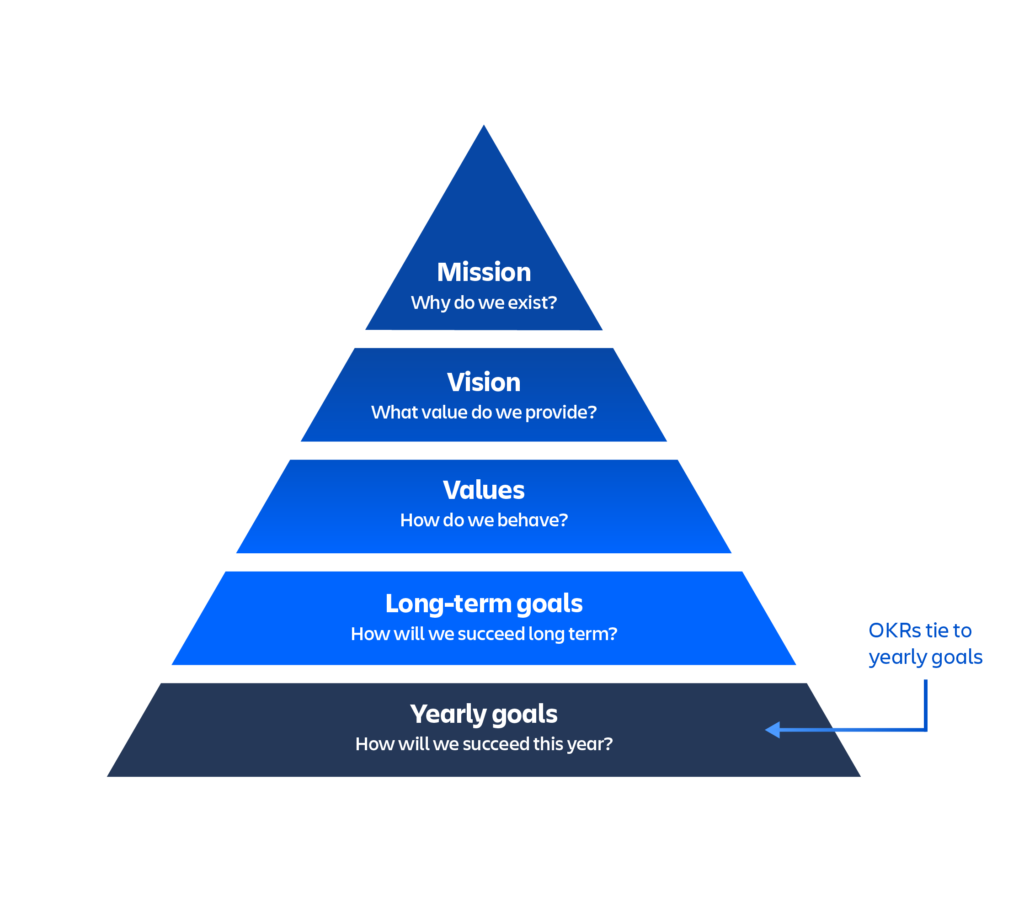
Your objectives should support your mission and your company’s values, but they should be tightly aligned to your long-term and short-term (or 1 year) goals.
Getting started with OKRs
One way to introduce OKRs is to have an organization identify three or four objectives it wants to achieve for the entire year. This is usually done at the CEO level. Then have each part of the organization identify related objectives they can achieve in each of the four quarters in the year. This mix of a big yearly target with the smaller quarters can help the organization learn how objectives in one particular area contribute to the entire organization.
It’s important to identify measurable key results so you can check progress toward your objective. If you set a key result that can only be measured once a year, you’ll only have one chance per year to know if your work helps you reach your objectives. As organizations deal with the increasing pace of change, checking progress once per year isn’t enough.
If you would like more guidance on the process of establishing and scoring OKRs, check out this OKRs play.
How Jira Align can help
Atlassian’s Jira Align solution helps connect your business strategy to technical execution. Where OKRs track the results of execution, Jira Align provides a clear insight into objectives, key results you track, and the work toward delivering objectives. The OKR features natively included in Jira Align help your team get aligned, stay aligned, and instantly connect work with value delivery.
Curious to learn more about how OKRs can help focus your organizational strategy and drive alignment on an ongoing basis? Watch our on-demand webinar.
Special thanks to Caz Gottlieb, Associate Product Manager, Jira Align for her contributions to this article.
-
Product requirements documents, downsized
Summary: A product requirements document (PRD) defines the requirements of a particular product, including the product’s purpose, features, functionality, and behavior. It serves as a guide for business and technical teams to help build, launch, or market the product.
Building a great product requires tons of research and comprehensive planning. But where do you start? Product managers often start with a product requirements document (PRD).
A product requirements document defines the product you are about to build: It outlines the product’s purpose, its features, functionalities, and behaviour.
Next, you share the PRD with (and seek input from) stakeholders – business and technical teams who will help build, launch or market your product.
Once all stakeholders are aligned, the PRD serves as a compass, providing clear direction toward a product’s purpose while creating a shared understanding among business and technical teams.
Gathering requirements in an agile world
What does the requirements gathering process look like in an agile world? It sounds tricky – and it is. But don’t worry. At Atlassian, we know all about creating PRDs in an agile environment. Here are a few things to keep in mind:
Agile requirements are a product owner’s best friend. Product owners who don’t use agile requirements get caught up with spec’ing out every detail to deliver the right software (then cross their fingers hoping they’ve spec’ed out the right things). Agile requirements, on the other hand, depend on a shared understanding of the customer that is shared between the product owner, designer, and the development team. That shared understanding and empathy for the target customer unlocks hidden bandwidth for product owners. They can focus on higher-level requirements and leave implementation details to the development team, who is fully equipped to do so – again, because of that shared understanding. (Boom.)
Creating a shared understanding among teams
If you’re excited by the idea of a shared understanding, but haven’t a clue how to create it, try some of these tips:
- When conducting customer interviews, include a member of the design and development teams so they can hear from a customer directly instead of relying on the product owner’s notes. It will also give them the chance to probe deeper while the topic is fresh in the customer’s mind.
- Make developing and using customer personas a team effort. Each team member has unique perspectives and insights, and needs to understand how the personas influences product development.
- Make issue triage and backlog grooming a team sport as well. These are great opportunities to make sure everyone is on the same page, and understand why the product owner has prioritized work the way they have.
Want to give it a try? Sign up or log into Confluence >>
Create a customer interview template to document your customer insights. Follow our tutorial to get started on conducting valuable customer interviews:
- Create insighful customer interview pages
- Turn info into insights with the Customer Interview Pyramid
When the team and product owner share the same mindset, you don’t need ultra-detailed requirements.
ANTI-PATTERNS TO WATCH FOR:
- The entire project is already spec’d out in great detail before any engineering work begins
- Thorough review and iron-clad sign-off from all teams are required before work even starts
- Designers and developers don’t know when requirements have been updated
- Requirements are never updated in the first place (because everyone signed off on them, remember?)
- The product owner writes requirements without the participation of the team
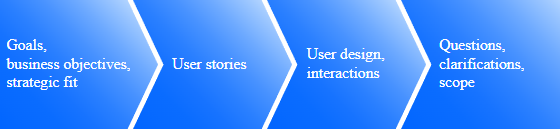
Ok: you’ve discussed a set of user stories with your engineer and designer. Gone back and forth, had a few whiteboard sessions, and concluded there are a few more dimensions you need to consider for this feature that you are working on. You need to flesh out some assumptions you’re making, think deeper about how this fits in the overall scheme of things and keep track of all the open questions you need to answer. What next?
Keeping requirements lean with a one-page dashboard
When writing a requirements document, it’s helpful to use a consistent template across the team so everyone can follow along and give feedback. At Atlassian, we use Confluence to create product requirements with the product requirements document template. We’ve found that the section below provides “just enough” context to understand a project’s requirements and its impact on users:
1. Define project specifics
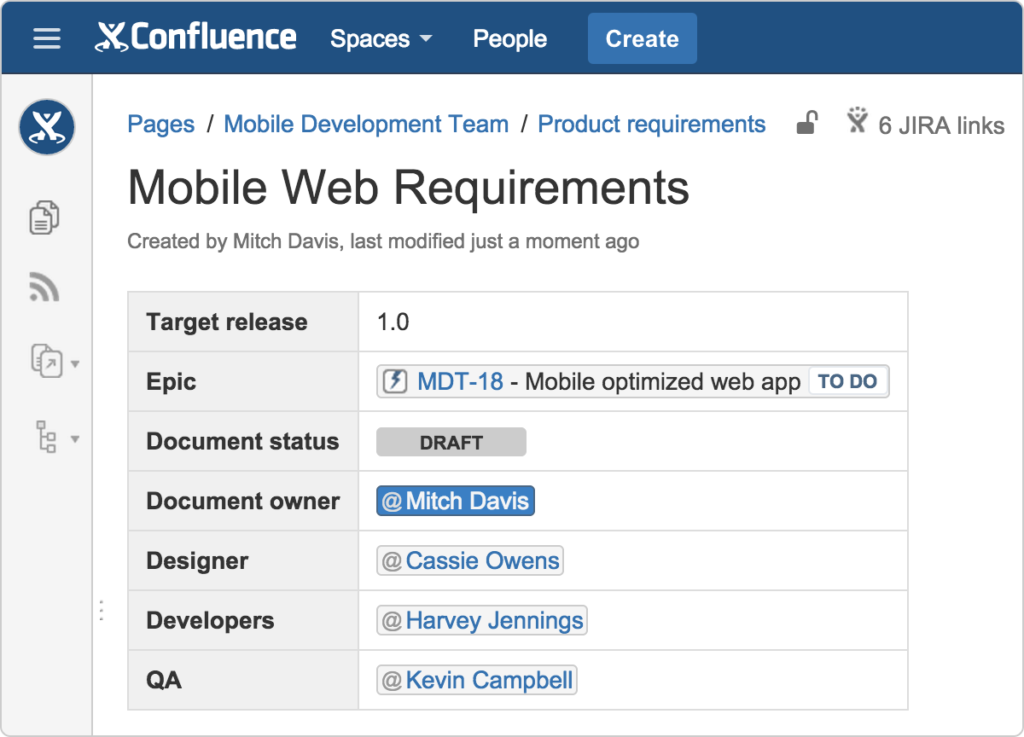
We recommend including high-level direction at the top of the page as follows:- Participants: Who is involved? Include the product owner, team, stakeholders
- Status: What’s the current state of the program? On target, at risk, delayed, deferred, etc.
- Target release: When is it projected to ship?
2. Team goals and business objectives
Get straight to the point. Inform, but don’t bore.
3. Background and strategic fit
Why are we doing this? How does this fit into the overall company objectives?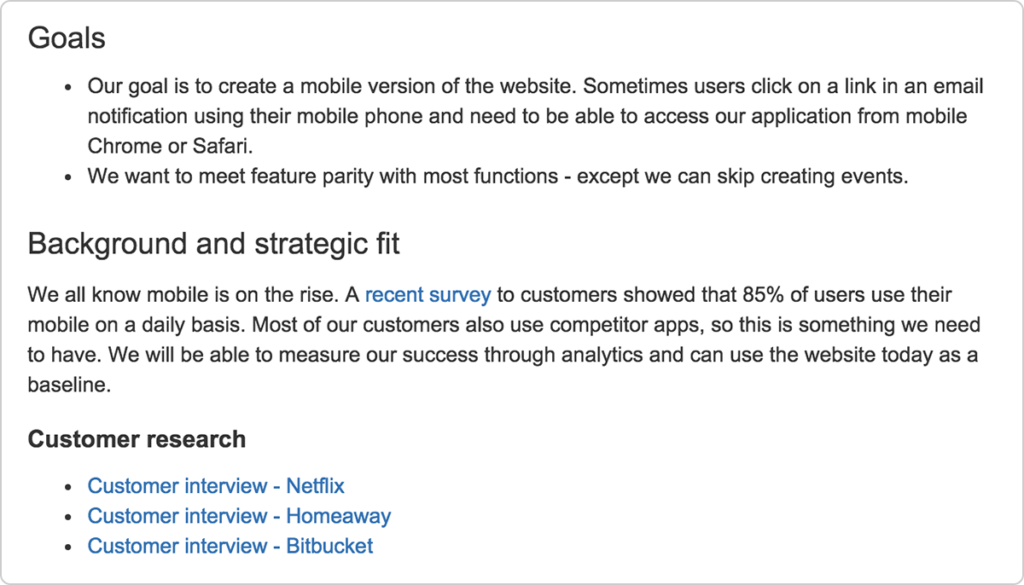
4. Assumptions
List the technical, business, or user assumptions you might be making.
5. User Stories
List or link to the user stories involved. Also link to customer interviews, and inclused screenshots of what you’ve seen. Provide enough detail to make a complete story, and include success metrics.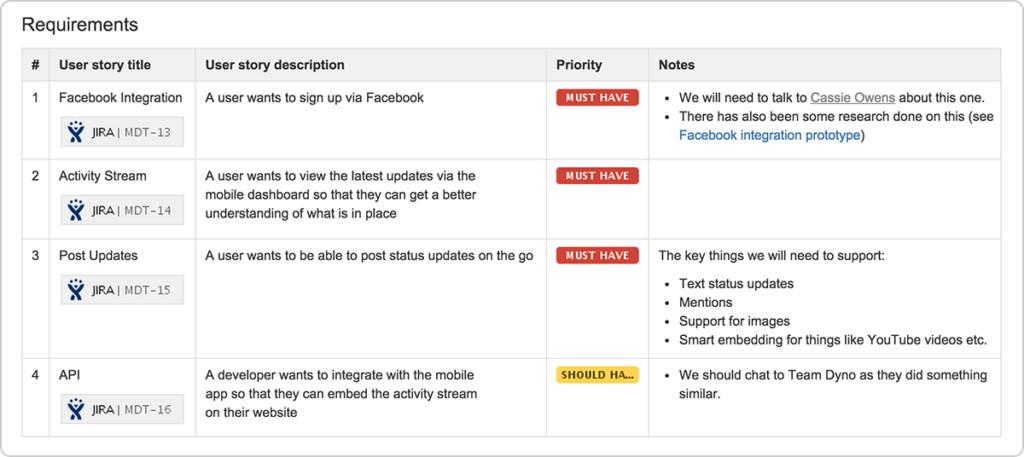
6. User interaction and design
After the team fleshes out the solution for each user story, link design explorations and wireframes to the page.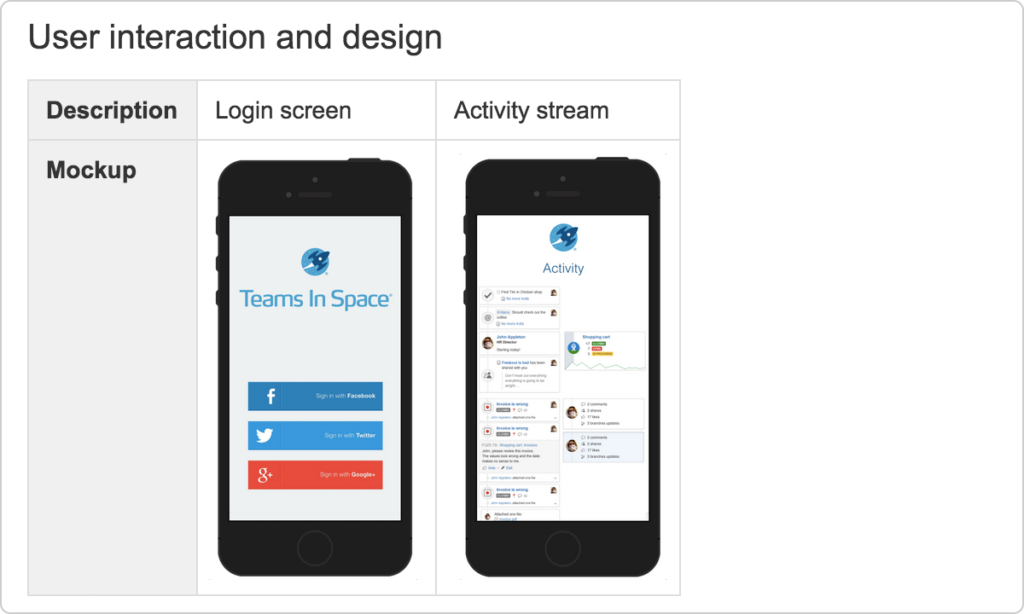
7. Questions
As the team understands the problems to solve, they often have questions. Create a table of “things we need to decide or research” to track these items.
8. What we’re not doing
Keep the team focused on the work at hand by clearly calling out what you’re not doing. Flag things that are out of scope at the moment, but might be considered at a later time.
PRO TIP:
The Agile Manifesto reminds us that we can be flexible with how we create requirements. Some teams do user story mapping exercises to identify problems and solutions. Sometimes the full product triad (product owner, developer, and designer) visits a customer and then brainstorms solutions to a particular problem that the customer mentioned.
No matter how requirements are born, it’s important that the team considers them to be one of many ways they can define and communicate customer problems. See our section on agile design to learn how product owners can use Keynote and Powerpoint to mock-up real experiences as requirements.
Example of a one-page PRD
Here’s a look at a fully fleshed out product requirements document that we created using Confluence. Remember, no two product requirements will be exactly the same. Use this example to understand the different elements that should be included in your PRD, but not as the definitive way to do it.
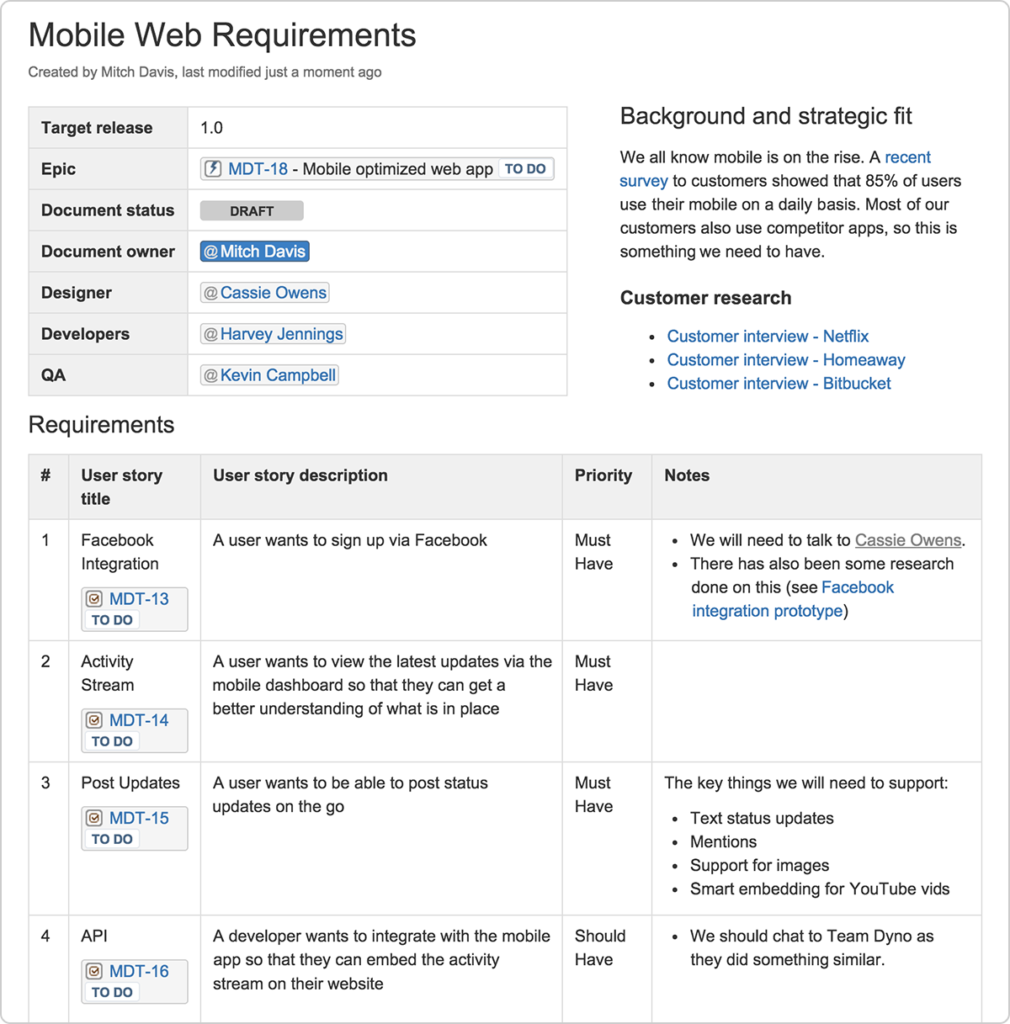
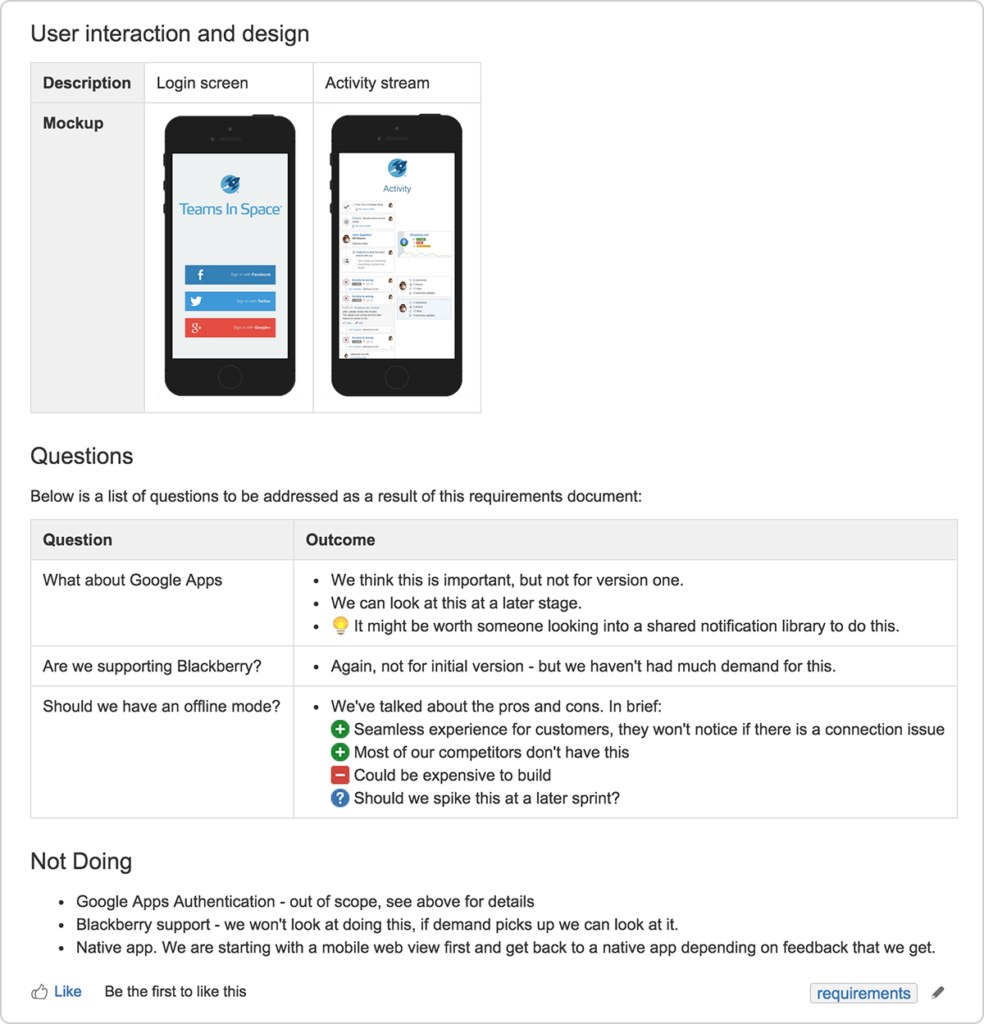
Want to give it a try? Sign up or log into Confluence >>
Once you’re in, choose the product requirements blueprint and then follow the tutorial below to help you get started setting up your requirements:
Key takeaways from the one-page approach:
If you are to take away anything from this blog, understand the “why” – the not “what” – because the “why” will help you explore what is best for your team. Here are the benefits and challenges we’ve observed with the one-page dashboard approach:
1. One page, one source
Keeping it simple. The product requirements document becomes the “landing page” for everything related to the set of problems within a particular epic. Having something that is the central go-to location saves your team members time in accessing this information and gives them a concise view.2. Extra agility
One of the awesome things about using a simple page to collaborate (verses a dedicated requirements management tool) is that you can be agile about your documentation! You don’t have to follow the same format every time – do what you need, when you need it, and be agile about it. Chop and change as needed.3. Just enough context and detail
We often forget how powerful a simple link can be. We embed a lot of links within our product requirements documents. It helps abstract out the complexity and progressively disclose the information to the reader as needed. Linking detailed resources may include such things as:- Customer interviews for background, validation or further context for the feature
- Pages or blogs where similar ideas were proposed
- Previous discussion or technical documentation and diagrams
- Videos of product demos or other related content from external sources
4. Living stories
I see a lot of customers do this as well. Once the stories have been roughly thought out and entered as issues in Jira Software, we link to them in our page (which, conveniently, creates a link from the issues back to the page as well). The two-way syncing between Confluence and Jira Software means we automatically get to see each issue’s current status right from the requirements page.5. Collective wisdom
Capturing product requirements in Confluence makes it easy for other people in different teams to contribute and make suggestions. I’ve been amazed at the number of times someone from another team jumped into the conversation with a comment providing great feedback, suggestions, or lessons learned from similar projects. It helps a large organization feel like a small team.6. Engaging “extras”
Diagrams made with tools like Visio, Gliffy, or Balsamiq better communicate the problems to your team. You can also embed external images, videos, and dynamic content.7. Collaboration!
The most important aspect of all this is getting everyone involved. Never write a product requirements document by yourself – you should always have a developer with you and write it together. Share the page with your team and get feedback. Comment, ask questions, encourage others to contribute with thoughts and ideas. This is especially important for distributed teams who don’t often get a chance to discuss projects in person.Challenges
With every approach there are down-sides. Here there are two main challenges we’ve experienced and observed from customers as well:
1. Documentation can go stale
What happens when you implement a story and get feedback and then modify the solution? Does someone go back and update the requirements page with the final implementation? This is a challenge with any type of documentation, and it’s always worth questioning whether such trade-offs are worthwhile. Talk to your team about what you would do in a scenario like this.2. Lack of participation
“What can I do to encourage people to comment?”, “How can I encourage people to write more specs and stories on our intranet?”. This is a tough nut to crack, and it comes down to various wiki adoption techniques in your organization. There are plenty of resources to help you here. There may be deeper cultural issues at play here, too.Now get to work!
When requirements are nimble, the product owner has more time to understand and keep pace with the market. And keeping them informative-but-brief empowers the development team to use whatever implementation fits their architecture and technology stack best.
Once a project’s requirements are reasonably well-baked, we recommend linking the user stories in section 5 above to their corresponding stories in the development team’s issue tracker. This makes the development process more transparent: it’s easy to see the status of each piece of work, which makes for more informed decisions from the product owner, as well as downstream teams like marketing and support.
PROTIP:
Don’t track the user stories that come from project requirements in one system and defects in another. Managing work across two systems is needlessly challenging and just wastes time.
Remember, be agile in your evolution of requirements for a project. It’s okay to change user stories as the team builds, ships, and gets feedback. Always maintain a high quality bar and a healthy engineering culture – even if it means shipping fewer features.
-

The 5 best morning routine ideas of highly-productive people
A good morning routine sets the productivity tone for the day. But is it really as simple as a morning ritual and a healthy breakfast? After analyzing the advice and morning routines of six top productivity experts, we’ve pinpointed the most common practices of successful people for a productive morning. No matter how much chaos happens when your eyes open, know this: A morning routine for better productivity is a learnable science.
1. Wake up at YOUR right time
“Morning people” are supposed to be the high achievers. The early bird is supposed to catch the worm, right? And a cold shower to wake up? Groan. Where’s the snooze button on that? Can the early (or late) hours you sleep really make a difference?
One 2021 academic study found that waking up just one hour earlier was associated with a 23% lower depression rate. While some people who wake up earlier are more productive, night owls can still have a perfect morning routine that leads to a productive day. Think of it like breakfast and brunch. They’re both delicious, and they both work if you’re hungry.
Mike Vardy, productivity author, speaker, podcaster, and blogger at Productivityist, wrote, “Look, I’m a night owl—and proud of it. Why? Because despite having many say that my sleeping habits make me less likely to achieve, I prove them wrong. I don’t just do that every once in a while. I do it every single day.” The most important thing isn’t what time you get out of bed. It’s getting in tune with your body’s clock for a good routine.
According to Sleep.org, your body knows what it should be doing and when. Don’t force yourself to be part of the 5:00 a.m. club if you can’t fall asleep before midnight. Forcing yourself out of bed is a recipe for burnout. If you’re not a morning person, your body will only work with you for a few days before it begs for mercy.
Good ol’ science can help you find your most productive time of day.
2. Prepare the night before to eliminate morning decision making

Many productivity experts and successful people spend evenings preparing for the next day. Their recommendation: It leaves mornings free for an early start on important work (and breakfast).
Subscribe to the idea that an a.m. routine can start in the p.m. Lay out your outfit for the next day. Pack your lunch. And create your checklist or a to-do list. Former American Express CEO Kenneth Chenault told Fast Company they end their evenings writing three things they want to accomplish the next day. We have a limited amount of willpower and decision-making ability. Too many decisions in the morning slow us down and drain our brain for the rest of the day. Eliminate morning decision-making for more energy and more time for productivity.
3. Create a morning routine to focus your mind

Erik Fisher is the voice behind the Beyond The To-Do List Podcast. He’s interviewed over 100 different productivity experts on topics like lifehacking, work-life balance, and creativity. He points out that if you analyze productivity experts’ morning routines, you’ll find a few things in common. Most focus on big picture goals, gratitude, and planning for the day.
Productivity coach Zack Sexton’s morning routine looks like this:
- Water (20oz. often w/ lemon)
- Cuddles (w/ fiancée Nikida)
- Coffee
- Meditation
- Read something inspirational (often in sauna)
- Shower (if sauna-ed)
- Look at calendar
- Start first journal entry (including prompts about something learned, things to be grateful for, and what to focus on for the day)
Set your mind on what you want to focus on for the day, and set your heart and mind with the right attitude. Kevin Kruse, author of 15 Secrets Successful People Know About Time Management, starts their morning with five minutes of yoga stretches that accompany:
- Mental recitation of their personal mission statement
- Listing three items of gratitude
- Repetition of their three goals: Health, wealth, and love
Kevin thinks of what tasks he’ll do that day to help achieve each goal. “All that takes about five minutes,” he says.
You don’t need a lengthy meditation routine. Yoga, meditation, journaling, reading, or a quiet walk can help you focus on a positive outcome for the day.
4. Move around and hydrate in the morning

When you feel great, it makes it easier to handle the morning alarm clock. If it’s hard just get out of bed, you probably won’t be excited to run to the gym—and that’s ok. Simply moving your body will get your blood flowing and help get your day started.
Many successful people start their mornings in motion. Follow their lead to add some health to your life:
- Kevin Kruse does a daily 20-minute HIIT session on the treadmill.
- Jack Dorsey, founder of Block, Inc., jogs every morning.
- Howard Schultz, CEO of Starbucks, bikes.
- Congresswoman and House Minority Leader Nancy Pelosi powerwalks before work.
- Entrepreneur Gary Vaynerchuk works out with a personal trainer.
- Shark Tank investor Kevin O’Leary gets on his elliptical or exercise bike.
- Multi-board member Frits Dirk van Paasschen runs 10 miles every morning.
While you’re moving, stay hydrated. What you put in your mug matters. Drink water in the morning to kickstart your day and give you lasting energy.
Jeff Sanders, author of The 5 AM Miracle and host of the podcast with the same name, says his favorite morning habit is to drink one liter of water within the first 45 minutes of bouncing out of bed. “Hydration is incredibly important, especially after waking up. I always find that this larger quantity of water provides incredible energy and prepares my body for the day ahead.”
5. Eat the frog—or tadpole—first thing in the morning
Brian Tracy, author of Eat That Frog! 21 Great Ways To Stop Procrastinating And Get More Done In Less Time, bases his morning philosophy off of a quote from Mark Twain. “If the first thing you do each morning is to eat a live frog, you can go through the day with the satisfaction of knowing that that is probably the worst thing that is going to happen to you all day long.”
The “frog” is your most important task or work—the one you’re dreading the most because it’s large and looming over you. Build the habit of doing your biggest task first for a huge boost of accomplishment first thing.
But procrastination is real, making it even harder to get your day started. Whether you eat the frog or tackle some small tadpoles first, find your ideal morning routine rhythm and get started.
Create your ideal morning routine for a productive day
Mornings don’t have to be rough, and you can learn to become more productive throughout the day. No need to overhaul your morning routine all at once; introduce one new practice a week and track your improvement. They say if you win the morning, you win the day.
-

4 reasons for project fails—and how to prevent each one
We’re living in the golden age of failure, where tech culture embraces a “fail fast” mentality and celebrates lessons learned from missteps. But when it comes to that upcoming project you’re leading, given a choice, you’d much rather succeed.
But the truth is, whether they’re delivered late, go over the budget, or they don’t meet expectations, many projects do end up failing. The 2017 Pulse of the Profession survey from the Project Management Institute (PMI) reports that poor project performance leads to $122 million wasted for every $1 billion invested.
Beyond monetary losses, there’s the negative impact on team morale and the time you can never get back. For these reasons and more, it’s wise to learn the main reasons for project failures—and how you can stop them in their tracks.
1. The project lacks defined goals and milestones
The PMI survey also found that the main cause of project failure was a “lack of clearly defined objectives and milestones to measure progress.”
Clearly defined goals boost team performance, according to a Leiden University study. And setting milestones helps your team know they’re making progress and keeps motivation from waning, especially when the project takes months or years.
How to fix it
Popularized by venture capitalist John Doerr, OKR stands for “Objectives and Key Results.” The objective is the goal (what do you want to do?). The key result is a milestone that shows progress (how will you know you’re making progress toward the goal?). Many organizations create company-wide and team-specific OKRs, and the same framework can be applied to your project.
For example, you might be working on improving your email marketing campaign. An OKR for this specific project might look like this:
Objective: Increase email campaign engagement to support sales initiatives
- Key result 1: A/B test all email subject lines to increase open rate by 10%.
- Key result 2: Invest $1,000 in paid email advertising to boost subscriber count by 10,000 by Q2.
- Key result 3: Spend 20 hours researching and analyzing top-performing CTAs to increase CTR by 5%.
And because we discussed the importance of accountability, take it a step further and assign an owner to each key result. They’ll be responsible for deciding the tasks that will lead to each key result.
Feeling motivated? Trello has a free OKR template to get you started.
2. There’s no real accountability
“If everyone is accountable, no one is accountable.” In social psychology, there’s a term for this: diffusion of responsibility. The higher the number of people present, the lower the chances that any individual will step up to the plate because they assume someone else will.
Gartner analyzed more than 50 IT projects and found that complexity without accountability often leads to project failure. “Complex projects with unrealistic goals, unproven teams and almost no accountability at all levels of the management and governance structure, means no one is responsible for failure,” writes Gartner contributor Susan Moore.
But contrary to popular belief, the fix is not to increase oversight. “When a project starts to stumble, increasing the volume and scope of upward reporting will only place more burden on the project and will be unlikely to improve the likelihood of success,” Moore writes.
This is also known as micromanaging, and it’s a productivity killer. In an Accountemps survey, 68% of employees said micromanagement hurt their morale, and 55% said it decreased their productivity.
How to fix it
Increase accountability by assigning an owner to each part of the project. That way, every team member knows what they’re responsible for and has autonomy over their decisions for that specific task. This is not micromanaging. By allowing each owner to control the decisions they make, you’re telling them you trust them.
By letting each team member know exactly which part they’re responsible for, you’ll boost the chances that the task gets done. Why? Because it removes confusion for your team, and now everyone knows who owns what, so it’s easier to identify who is holding a project up and who can give the best status update.
Build accountability in projects managed in Trello by adding members to a card or by assigning them tasks within checklists on a card. Once added, they’ll receive notifications anytime that card is commented on, moved, or assigned a due date.
3. Something went wrong in the planning phase
PwC found that insufficient resources, poor estimates, and scope changes are some of the top contributors to project failure. How do you prevent all of these? Proper planning.
While it’s not nearly as exciting as the doing part, the planning phase is necessary for scoping and gathering requirements for the upcoming project. Poor planning results in:
- Inaccurate estimates: A crucial part of project planning is estimating the time and cost of the initiative. While an estimate is never expected to be exact, if it’s rushed or too far off, it can derail an entire project.
- Scope creep: Failing to understand a client’s needs or setting boundaries before the project begins can lead to scope changes mid-project—leading to more work on your part.
- Insufficient resources: Part of project planning is calculating and assigning appropriate resources to the project, whether that’s team members, tools, or workspace. Insufficient resources can hobble an initiative, and render it incapable of crossing the finish line.
How to fix it
Don’t rush the planning process. While a bias toward action can be a good thing, if you’ve got a long and pricey project coming up, this is not the time to rush headlong into it. All of your planning should involve real-world data based on experience in similar projects, and you should consult with experts if possible.
Ensure nothing gets missed by creating a visual way to track tasks, project objectives, necessary resources, and timelines by mapping out your project in Trello. This will make it easier for team members and stakeholders to review and give feedback on the project before you begin the execution.
4. Your process can’t adjust quickly to change
Even if you conduct excellent planning, no one can predict the future—and you certainly can’t control everything.
You might deliver website designs that meet the project scope, but the client doesn’t like any of them. You might have forecasted the cost early on, only to find out a supplier has increased their prices. You might have used the smartest methods for estimating schedule—only to have that schedule upended by a global pandemic.
How can you adjust to change without ruining the entire project? By expecting change and remaining flexible. And lucky for you, there’s an entire methodology made just for that.
How to fix it
While there are many things you won’t be able to control, there is one way to mitigate risk and unearth problems before you get to the end of a six-month project: Agile methodology. Practically any project can benefit from this way of managing projects.
So, what is agile methodology? Originating in software development, agile methodology is “based on iterative development, where requirements and solutions evolve through collaboration between self-organizing cross-functional teams,” according to consulting firm Cprime. It’s a way of getting things built faster and adjusting to changes quickly while the product is still in development. Many frameworks exist for agile, but we’ll focus on scrum.
The Macmillan Dictionary defines the adjective “agile” as “able to move quickly and easily,” and that’s precisely what scrum, one way of implementing agile, is made to do. By breaking the entire project down into time-limited, narrowly-scoped “sprints,” teams are able to quickly gather feedback during the project, review what they’ve learned, and re-scope as needed before moving on to the next sprint.
This is in direct contrast to the rigidity of sticking to the project plan, no matter what—and delivering at the end only to find out that it’s not what you or the client actually needed.
With scrum project management, you get feedback as you go. This gives you time to readjust during the project before you’ve invested all your resources into something that needs to change.
And it’s beneficial for your entire company, too. According to PMI, highly agile organizations successfully complete more of their projects than less agile organizations.
Here’s a Trello Marketing Sprint template to get you started.
Become a project management pro
Failure is a fact of life, but that doesn’t mean your project is doomed to it. By establishing OKRs, assigning owners, planning sufficiently, and practicing agile project management, you can greatly improve your chance of project success.
-
Inclusivity Tip
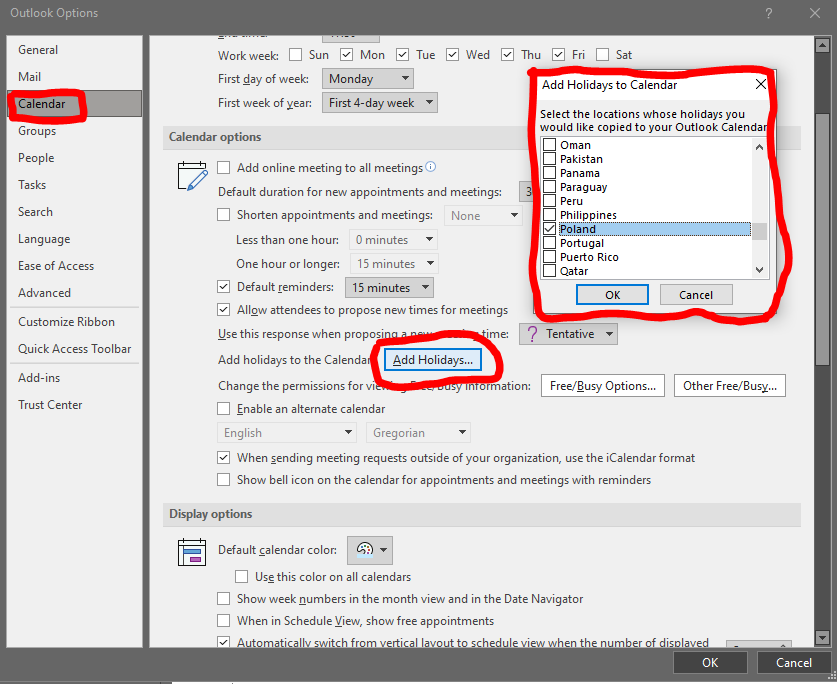
Within Outlook you can add holidays for the UK as well as other countries which can help give you visibility of holidays, festivals or religious events from around the world. This can help drive conversation about things that might matter to people in your team you otherwise might not know about. For example I recently learned about Fat Thursday or Tłusty Czwartek celebrated in Poland ahead of Lent. You can add them in Outlook by going File > Options > Calendar > Add Holidays…
-

Why Being Vulnerable And Sharing More Of Yourself Will Inspire Your Team
There are some things you’re probably fairly open about at work. Your go-to coffee order. The fact that public speaking makes you nervous. Maybe even your plans for your upcoming vacation.
But, for many of us, that’s the extent of just how much we let our team members in—we’re hesitant to go much deeper than that.
In fact, 41% of Americans say their coworkers are just that: coworkers. They’re people we’re on the clock with, but not necessarily the ones we’ll readily open up to.
Things are even more “strictly business” between managers and direct reports. 20% of managers admit that they’re uncomfortable demonstrating vulnerability. And, while 80% of leaders think they’re still able to be transparent with their teams, only 55% of their employees agree.
You’re A Whole Human: The Benefits Of Being Vulnerable At Work
Why the reluctance? Well, “vulnerable” is sort of a scary word. Evolution tells us that vulnerability means we’re fragile—we’re defenseless against attacks.
Here’s the truth: Vulnerability is no longer a sign of weakness or an invitation for people to walk all over us. Quite the opposite. Being even a little more open and honest with your team can lead to a number of advantages.
1. Vulnerability Builds Trust
Being vulnerable requires a certain level of honesty. You can’t sweep things under the rug or sugarcoat them—you need to be upfront about them.
It makes sense that transparency would boost trust between people, and research backs this up. One study concluded that vulnerability is an essential element of trust, although the researchers admitted that they’d need to dig in further to understand the full impacts.
Need more convincing? Research professor and author Dr. Brené Brown argues that vulnerability is at the very root of social connection. “In order for connection to happen, we have to allow ourselves to be seen—really seen,” she said in her well-known TED Talk.
So, showing more of yourself to the people you work with can be the catalyst you need to forge stronger, more trusting, and more beneficial bonds at work.
2. Vulnerability Boosts Psychological Safety
A high degree of psychological safety means that employees are willing to speak up about their opinions, ideas, and criticisms without any fear of reprimands or embarrassment. They’re encouraged to chime in—there are no stupid questions or dumb ideas.
It sounds like a dream for most teams, but how do you get there? While there’s no simple answer, demonstrating vulnerability certainly doesn’t hurt.
When employees see their leaders owning and learning from their failures, admitting their uncertainty, or opening up about challenges, they feel empowered to follow suit. That can shift the entire team culture to be one of openness and acceptance rather than criticism and competition.
3. Vulnerability Increases Engagement And Performance
A high degree of trust? Close and honest relationships? The support to confidently voice an opinion or an idea? All of them contribute to another major benefit: increased engagement and improved performance.
Our own research here at Atlassian found that among high-achieving teams, 55% have a culture of sharing who they are and what’s going on outside of work. And, employees whose managers are open and approachable are more engaged in their jobs.
Of course, there’s a lot that goes into both engagement and performance—from clear expectations to leadership styles. But, even so, focusing on being a little more unguarded can lead to a more committed and productive team.
How To Be More Vulnerable At Work: 3 Steps You Can Take
So, gone are the days when being “vulnerable” means being exposed and unsafe. Today, the opposite can be true—being vulnerable is seen as a positive trait that leads to ultimate authenticity.
Even so, it can feel unnatural, especially for people who are used to compartmentalizing their professional and personal identities and keeping their colleagues, leaders, or direct reports at arm’s length.
Rest assured that being vulnerable at work doesn’t have to mean opening up about your deepest insecurities and baldly stating every thought or emotion you have. Here are three manageable steps you can take to be a little more authentic and forthcoming with the people you work with—without feeling cringey about it.
1. Own Your Wins (And Your Failures Too)
Chances are, you and your team already have a number of built-in times for connection and reflection with each other. Retrospectives. Team meetings. Performance reviews. One-on-ones.
Those are great times to recognize and celebrate successes (which is important to do!), but they’re also an opportunity for you to model humility and vulnerability by openly admitting any of your own mistakes and disappointments—as well as what you learned from them.
Need an example? Let’s say that a recent team project managed to get over the finish line by the deadline, but it ran behind schedule nearly the entire time. Here’s how you could own the role you played in that:
“While I’m thrilled we ended up getting this done in time, I do want to acknowledge that I was a major bottleneck during the review process. This project showed me that I need to build more of a buffer in my own schedule and proactively allocate time for feedback so I don’t slow us down moving forward.”
It seems simple and is admittedly harder to do in practice (hey, calling out our own shortcomings is sort of brutal). But, proactively taking this accountability shows your team that you’re willing to be honest and forthright with them—even when it doesn’t present you in the best light.
2. Consider Your Audience And Your Intent
It’s easy to confuse vulnerability with relentless disclosure—as if you need to verbally state everything you think, feel, or struggle with. Not only does that feel uncomfortable for a lot of us, but it can also push you right into “oversharing” territory.
Effectively demonstrating vulnerability isn’t about no-holds-barred honesty and word-vomiting your way through every interaction. As Dr. Brené Brown explains, much like any other type of communication, it requires some boundaries.
“Vulnerability minus boundaries is not vulnerability,” she explains in an interview with TED Conferences. “Are you sharing your emotions and your experiences to move your work, connection, or relationship forward? Or are you working your s—t out with somebody? Work is not a place to do that.”
Before sharing something in the interest of being vulnerable—whether it’s a challenge you’re facing or even a personal problem you’re dealing with—Dr. Brown recommends taking a step back and asking yourself:
- What’s my intention behind sharing this?
- Why am I sharing it with this specific person?
- Is sharing this with this person the right thing to do?
In short, vulnerability doesn’t have to mean being an unstoppable open book. You can (and should) still be strategic about how, when, and with whom you communicate certain messages.
3. Ask Questions
What’s one of the easiest ways to demonstrate vulnerability? That was a hint. It’s asking questions.
That’s because seeking clarification is inherently a somewhat humbling activity. It requires that we call attention to the fact that we don’t know everything—that we need more information in order to understand a concept.
When a colleague or direct report shares something with you, you might ask:
- I’m not sure I’m grasping where you’re coming from. Could you elaborate?
- Could you provide an example or two to help me put that in context?
- Do you have resources where I could learn more about this?
Asking follow-up questions is a seemingly small change that can make a big impact in terms of showing that you’re more than willing to admit when you don’t have all of the answers. That is, in and of itself, an exercise in vulnerability—particularly when we often view knowledge as power and social currency at work.
Vulnerability: The Not-So-Secret Sauce For Deeper Relationships
You might’ve groaned or rolled your eyes at the first mention of vulnerability. That’s natural—it’s a word that still has some anxiety-inducing connotations, especially when we feel like we need to have it “all together” at work. But, take comfort in a couple of things.
First, being vulnerable doesn’t mean dragging your coworkers into your deep-seated tensions with your family or giving them the play-by-play of every emotion you experience throughout the workday. There’s still a line here, and there are certain issues and concerns that are better reserved for close friends, the HR department, or even a mental health professional.
Secondly, in the world of work, vulnerability is no longer synonymous with breakable and defenseless. Instead, it’s correlated with far more positive terms like authenticity and trustworthiness.
So, take a deep breath and figure out some ways that you can (comfortably, of course) share a little more of yourself—your feelings, experiences, goals, and challenges—with the people you work with. It might just be the push you need to unlock greater trust, more meaningful relationships, and ultimately, a high-performing team.