Women and girls are conditioned to believe success is “a seat at the table.” Creator, actress and author Lilly Singh thinks we need to build a better table. In this hilarious, incisive talk, Singh traces the arc of her career from up-and-coming YouTuber to history-making late-night talk show host, offering four ways to build a more inclusive society where girls are encouraged and empowered to do great things.
Tag: L&D Email
-
Why we have too few women leaders
Facebook COO Sheryl Sandberg looks at why a smaller percentage of women than men reach the top of their professions — and offers 3 powerful pieces of advice to women aiming for the C-suite.
-
The 7-day, science-backed experiment that can spark a culture of kindness
Cultivating kindness at work boosts productivity, motivation, and even retention, according to recent research. Use these simple strategies to inject some good vibes into your team interactions.
As one of the first lessons you learned in life, being kind to others may be something you take for granted. But research shows that kindness has tangible value across many aspects of life–and that value includes business value.
“There is now a plethora of data showing that when individuals engage in generous and altruistic behavior, they actually activate circuits in the brain that are key to fostering well-being,” explains Richard Davidson, author and founder of the Center for Healthy Minds at the University of Wisconsin.
When those positive feelings carry over to the workplace, things get even more interesting. A study reported on by KindCanada.org, found that employees who experienced frequent doses of kindness of work had:
- 26% more energy
- 36% more job satisfaction
- 44% greater commitment to their organization
- 30% greater motivation to learn new skills and ideas
The science behind kindness
When you’re kind to someone—even to yourself—your brain releases serotonin and dopamine. These are feel-good neurotransmitters, causing your brain to light up with satisfaction, pleasure, reward, and well-being.
Those reward signals are so powerful that they can trigger a chain reaction in interactions with other people. One study found that employees who were treated kindly were 278% more generous to coworkers compared to a control group. So if you’re thanked for a job well done, then you’re more likely to pay it forward by complimenting someone else.
The 7 days of kindness experiment
Oxford University and Kindness.org ran a study to quantify the value of kindness. They found that just seven days of small, random acts of kindness were enough to bring significantly more joy to the study participants’ lives. And the more acts of kindness people were exposed to, the greater the benefits.
Seven days of small, random acts of kindness bring serious changes to your life (and work life).
It just takes one person on your team to set the tone and model kind behavior for everyone. Once you’ve set that baseline, you can work together as a group to weave kindness into your meetings, daily work life, and workplace culture.
Challenge your teammates to commit to seven days of practicing random acts of kindness and see how it impacts productivity and morale.
Ideas for daily random acts of kindness:
Sunday Monday Tuesday Wednesday Thursday Friday Saturday Help someone who needs it Bring in office treats or send some to remote colleagues Buy someone’s coffee Thank a colleague for a job well done Lend a helping hand Compliment a stranger Volunteer Donate to someone in need Give kudos to a team member who deserves it but often isn’t recognized Tell someone something great about themselves Treat someone to lunch Email a colleague to say how much you appreciate them Give a recognition gift to a team member Say thank you every time someone does something nice for you Compliment someone Write a list of things you like about your boss and give it to them If someone seems down, ask them how they’re feeling Give someone 100% of your attention Hold a door open for someone Celebrate someone’s accomplishments Have a complaint-free day Hug someone you love Have your coffee break with someone—in-person or virtually Call someone you haven’t spoken to in a while Be kind to yourself by taking your next meeting outdoors Write three things you’re grateful for today Treat yourself to a random day off Tell yourself in the mirror that you love yourself Create a culture of kindness
Starting with seven days of random acts of kindness can be the first step toward creating a culture of kindness. To go even further:
- Get inspired by even more ideas for random acts of kindness from the Random Acts of Kindness organization
- Use Trello’s Guided Gratitude Practice template to document and share those positive feelings
- Assign and rotate weekly kindness leaders on your team
- Challenge yourself and your team to keep up the kindness at work and at home
- Dedicate a few minutes of team meetings to kindness (give kudos, treats, and progress updates)
- Start every one-on-one meeting by complimenting the other person on something that went well
- Have team members write down each daily act of kindness they did in a Trello note and make a Trello Board that showcases kindness in the office
- Show your appreciation to others through kudos, celebrations, gifts, and acknowledgement
- Inspire other teams and departments to do the same
- Write kindness into your company policies and philosophy
Thinking bigger than small, random acts of kindness
Entrepreneur James Rhee gave a powerful TED talk on the value of kindness at work, in which he shared how kindness became such an important part of his organization’s culture and business philosophy.
Inspired from the top down, goodwill and kindness connected his company leaders, employees, and customers. Kindness set the tone for their branding, customer service, sales, marketing, and internal communications. Everything. It was infectious and even saved the company from bankruptcy.
“We had the courage to establish a culture of kindness in the workplace,” Rhee said. “It was a strategic priority day in and day out—and yeah, there were moments as individuals we failed. But as a collective, we were very successful in changing attitudes about the transformative power of kindness at work.”
Make it your philosophy to be kind at work and in life. Be kind to yourself and to others. Start with just seven days of small, random acts of kindness and see if it inspires you and others to do the same.
-
Is life really that complex?
Can an algorithm forecast the site of the next riot? In this accessible talk, mathematician Hannah Fry shows how complex social behavior can be analyzed and perhaps predicted through analogies to natural phenomena, like the patterns of a leopard’s spots or the distribution of predators and prey in the wild.
-
The mathematics of love
Finding the right mate is no cakewalk — but is it even mathematically likely? In a charming talk, mathematician Hannah Fry shows patterns in how we look for love, and gives her top three tips (verified by math!) for finding that special someone.
-
How to stay calm when you know you’ll be stressed
You’re not at your best when you’re stressed. In fact, your brain has evolved over millennia to release cortisol in stressful situations, inhibiting rational, logical thinking but potentially helping you survive, say, being attacked by a lion. Neuroscientist Daniel Levitin thinks there’s a way to avoid making critical mistakes in stressful situations, when your thinking becomes clouded — the pre-mortem. “We all are going to fail now and then,” he says. “The idea is to think ahead to what those failures might be.”
-
How to save the world (or at least yourself) from bad meetings
An epidemic of bad, inefficient, overcrowded meetings is plaguing the world’s businesses — and making workers miserable. David Grady has some ideas on how to stop it.
-
Why you think you’re right — even if you’re wrong
Perspective is everything, especially when it comes to examining your beliefs. Are you a soldier, prone to defending your viewpoint at all costs — or a scout, spurred by curiosity? Julia Galef examines the motivations behind these two mindsets and how they shape the way we interpret information, interweaved with a compelling history lesson from 19th-century France. When your steadfast opinions are tested, Galef asks: “What do you most yearn for? Do you yearn to defend your own beliefs or do you yearn to see the world as clearly as you possibly can?”
-

20 team meeting ideas that will help your team bond in 2023
Did you know that your team meetings can be a great opportunity to build psychological safety?
Why does that matter? It turns out that psychological safety is a key factor in boosting team performance. In a recent study published in the peer-reviewed journal Frontiers in Psychology, researchers stated the importance of psychological safety like this:
Psychological safety is the engine of performance, not the fuel.
People who feel psychologically safe at work are more willing to be vulnerable in terms of contributing ideas or pointing out potential problems. Because they have plenty of support and encouragement to speak up, these folks are more comfortable taking risks without fear of judgment, finger-pointing, or punishment.
Your team meetings are a frequent and reliable outlet to create a foundation of psychological safety by helping your team form strong bonds. When people have a chance to get to know each other on a more personal level and form a closer connection, they don’t only build familiarity—they build trust.
Curious about how to go about incorporating a few bonding opportunities into your team meetings—without trust falls, human knots, and random questions about desert islands? Look no further.
Team meeting ideas for new or new(ish) teams
Whether you have a group of long-standing colleagues starting a new project or a cross-functional team of people who don’t know each other all that well, these team meeting ideas will break the ice, loosen people up, and help them feel a little more comfortable before you get into the nuts and bolts of your meeting.
1. Ask a few non-cringey icebreaker questions
We get it—icebreaker questions can sometimes inspire some groans and eyerolls. But there are some creative ones you can ask to help everybody learn something new about each other. For example:
- Given the choice of anyone in the world, whom would you want as a dinner guest?
- For what in your life do you feel most grateful?
- If you could wake up tomorrow having gained any one quality or ability, what would it be?
- In the event of a zombie apocalypse, what three items would you grab from your home? (This is actually one of our favorites.
You could even ask team members to submit icebreaker questions ahead of your meetings so that they have some control over what they share and learn.
2. Do a quick show-and-tell
This game reignites your childhood enthusiasm and also helps team members find out more about what everyone values.
If you meet in-person, give team members a heads up that they should bring in an object to your next meeting and be prepared to explain what it is and why it’s important to them. This meeting idea works just as well (or maybe even better) remotely, when people can easily grab and showcase something from their own home.
3. Play “name that tune”
Nothing brings people together quite like music. In your next meeting, play the first few seconds of a couple of different tunes and challenge team members to name the song.
You could even set a theme for each week, like holiday songs or ’90s hits. Prepare for it to become a beloved team tradition that quite literally gets people moving in their chairs.
4. Switch up your introductions
Tired of meetings that start with the same old, “Tell us your name and what you do…”? Flip introductions on their head by having people introduce someone else in the group, rather than themselves.
You can pair people up (ideally, they should already know each other) or ask team members to volunteer to introduce someone else. It’s sure to be a far more interesting spiel—and likely filled with some glowing compliments the person never would’ve shared about themselves.
5. Share some photos
Personal photos give team members a more intimate glimpse at the lives of the people they work with.
Set a theme for each meeting—like your favorite vacation photo, your most embarrassing yearbook photo, or a photo of your pet—and challenge team members to share a relevant snapshot.
Team meeting ideas for motivation
Of course, your team meetings are about more than fun and games. When it’s time to get down to business, these team meeting ideas for motivation will inspire everybody to buckle down for a productive conversation.
6. Plan a thoughtful agenda
A worthwhile meeting starts before the actual meeting. Your agenda loops people in on what you’ll discuss so that they can come prepared with their best ideas and burning questions. Then you can use your meeting time for meaningful conversations rather than getting everybody up to speed.
7. Celebrate your wins
Kick off your meeting on a high note by using a few minutes to highlight recent wins and accomplishments—whether you call attention to them yourself or ask other people to chime in.
Not only does this set a positive tone, but it also gives motivation a boost. It’s called the progress principle, which states that “of all the things that can boost emotions, motivation, and perceptions during a workday, the single most important is making progress in meaningful work.”
8. Understand team priorities
If you want everybody to walk out of your team meeting with a clear idea of what they should focus on, try the 5 things workflow.
Joel Spolsky, co-founder of Trello, came up with this format. Every team member is asked to share five things—either directly in a meeting or on the Trello board:
- Two tasks they’re currently working on
- Two tasks they plan to work on next
- One task that people might expect them to be working on but they weren’t actually planning on doing
It’s a straightforward way to cut through the noise and understand exactly what everybody is (and should) be working on.
9. Encourage fidgeting
Think intense motivation means sitting still in your chair? Think again. Research shows that fidgeting can actually help people feel more calm, creative, and even more focused.
Bump up the motivation level in your meetings by giving people opportunities to use their hands—like putting small toys, trinkets, doodle pads, or even Play-Doh in the middle of the table. Have a remote team? Gifting everybody a branded fidget spinner could be a good surprise.
10. Keep a detailed history
It’s tough to feel motivated if every single meeting feels like Groundhog Day—like all you’re doing is constantly rehashing a previous conversation.
Prevent this repetitive feeling by setting up a weekly team meetings board. Not only will it help you plan a successful meeting, but it also has space for you to keep a log of all of your previous meetings. That means everybody can get the context of what’s already been discussed, so you don’t need to keep hitting the “replay” button.
Team meeting ideas for communication
For your meetings to be as positive and productive as possible, people need to know how to successfully interact with each other.
These team meeting ideas for communication can help your team members understand how to better relate to one another—and how to more effectively share their message.
11. Clarify roles
If your meetings currently involve a lot of toe-stepping, it’s time for you to clarify who’s responsible for what. The DACI framework requires that you categorize your team members by:
- Driver: Who’s leading the team, project, or decision
- Approver: Who has ultimate sign-off
- Contributors: Who is involved or chipping in
- Informed: Who needs to be kept in the loop
This straightforward system helps people understand where and how they fit in so they can communicate more effectively.
12. Identify your 4 L’s
Understanding and empathy are crucial for successful communication. The 4Ls retrospective asks team members to identify what they loved, loathed, learned, and longed for in a recent project, event, or sprint of work.
This exercise is a simple way to reflect back on your work together, get better insight into other peoples’ experiences, and improve as a team moving forward.
13. Create team user manuals
Personal user manuals are another effective way to increase understanding. This isn’t about a technical booklet to help you unjam the printer—these user manuals help team members understand what makes each other tick.
Use this template from Confluence to get started.
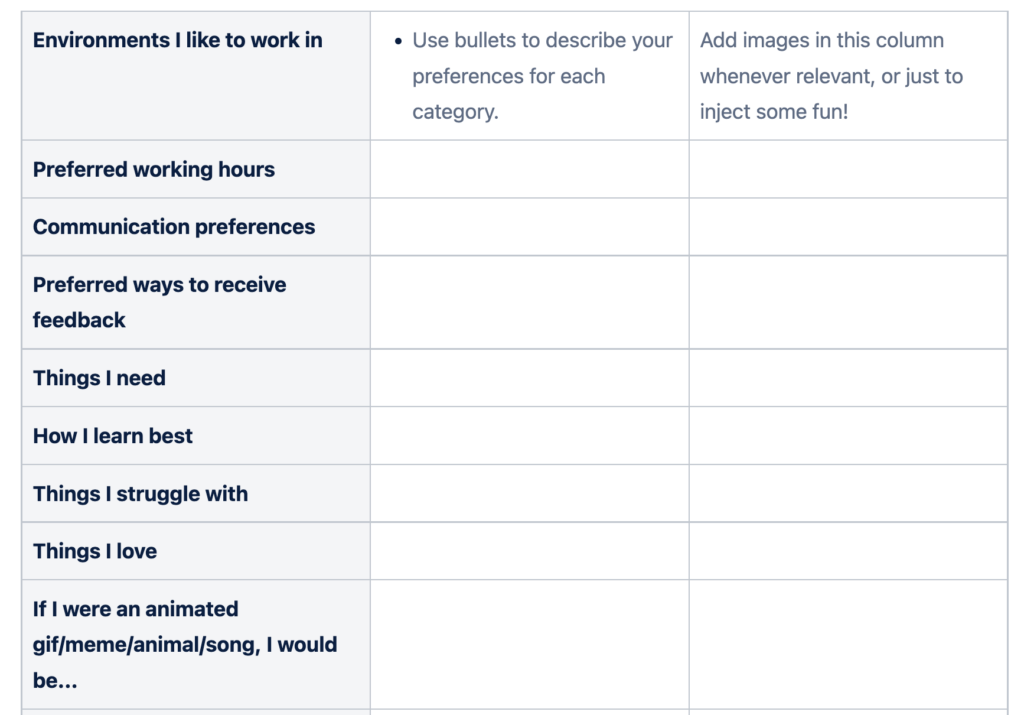
Everybody can fill out their own document, listing everything from their communication preferences to how they prefer to receive feedback.
Have everyone discuss their pages during a team meeting. Then, retain the pages on Confluence to create a handy reference for new teammates, as well as longtime coworkers.
14. Understand strengths and weaknesses
All of your team members are unique. Figuring out what everybody brings to the table helps build even more shared understanding.
With this Superpowers and Kryptonite exercise, each team member adds their name to the list. Then they write down two or three of their superpowers and one to three things that prevent them from performing their best. It’ll help them relate to the experiences of other team members and approach conversations with more empathy.
15. Run an experiment (or several)
The way your team communicates is as unique as your team members themselves. It might take you some trial and error to find the best ways to facilitate productive conversations—so it can be helpful to maintain an experimental mindset.
Maybe you’ll try asking everybody to close out Slack during your meeting time. Or perhaps you’ll test out a meeting where everybody needs to ask at least one question about an idea before providing any constructive criticism. When your meeting is done, send out a quick survey to find out if people thought it was more valuable. You might’ve landed on an idea worth repeating.
Team meeting ideas for Zoom
Nearly all of the above team meeting ideas can be used or adapted for video conference meetings.
But if you’re looking for some remote-specific suggestions, here are a few tips and exercises you could incorporate into existing meetings—as well as ideas for a few additional meetings that can help your distributed team connect even more.
16. Measure the mood
Remote meetings don’t always lend themselves to nonverbal cues, and it’s challenging to get a sense of how team members are feeling. Yet, our emotions provide important context, as research shows our emotions bias our perception.
There are simple ways you can get a feel for the overall mood of your team members ahead of a meeting, like asking them to share a GIF to describe their day or use an emoji reaction to summarize their current frame of mind.
Fun fact: The same part of our brain that processes human facial expressions also processes emojis.
17. Set up a collaborative space
Your remote team might not gather around a physical whiteboard, but they still need a centralized spot where they can plan meetings and work through conversations together.
This remote team meetings template brings focus and transparency to your team meetings with a collaborative approach (anybody can add cards to the “this week” list), a structured agenda, and helpful notes.
18. Encourage casual watercooler chat
Small talk might seem pointless on the surface, but that friendly chit-chat is exactly what helps your team members feel connected to one another. Unfortunately, that casual chatter often gets lost on remote teams.
At Trello, we set up specific Slack channels just for non-work chat. We also utilize Zoom to connect team members who may not know each other during a regular meeting we call “Mr. Rogers,” (yes, as in the TV show “Mr. Rogers’ Neighborhood”).
Want to try it? Use this watercooler video chat planner to regularly assign people to groups for an impromptu call where they can talk about anything they want. Groups can take a screenshot of their call and add comments about the random things they discussed so everybody can see what topics are bringing people together.
19. Unite distributed team members
You might not be able to walk past someone’s desk and see their recent vacation photo as their screensaver, but that doesn’t mean there’s no way for your team to share their travels.
The remote team bonding template offers a board where team members can add a card to highlight a recent excursion. They can share a photo and even offer some tips or must-see spots as a comment on the card. It helps unite your team, even if they’re spread across the globe.
20. Switch up locations
People probably have their default spots for your team meetings, but a change of scenery can help boost motivation and creativity. So, ahead of your next team chat, encourage everybody to sign in from a new place.
Whether they head out to a local coffee shop or soak in some afternoon sun on their own patio, that change can reignite their inspiration and give a fresh backdrop to your team Zoom calls. You could even ask people to share more about where they’re joining from, if they’re willing to.
Better meetings, better team
Your team meetings are your most frequent and regular chance to pull everybody together into one conversation. Don’t waste that opportunity on roll call and bland status updates.
Put these team meeting ideas into practice to build stronger bonds, boost motivation, and improve communication. You’re well on your way to not only better meetings, but a better team.
-

Sh*t happens! Use the 5 Whys analysis to make sure it happens less often
Listen, nobody’s perfect. Sometimes mistakes are made. Goals go unreached. Big swings turn into big duds.
It’s painful. And it can be especially painful when it happens to your team. As a leader, it’s important to know how can you help your people recover, regroup, and refocus.
That’s where the 5 Whys root-cause analysis exercise can save the day.
Think about it this way: Most things, from nuclear fission to your underperforming ad campaign, happen as the result of cause-and-effect relationships.
In a 5 Whys analysis, you’ll follow those relationships to identify the root cause of a problem so you can reach a better outcome next time. It’s a simple but powerful technique that helps your team get past surface-level answers and improve how you work in a lasting, meaningful way.
What is a 5 Whys root cause analysis?
A 5 Whys root cause analysis is an analytical technique pioneered by Toyota for investigating the root cause of a workplace problem. By asking “why” five times, your team will dig deep to uncover the true source of an issue, rather than latching on to obvious answers that may merely be symptoms of underlying issues.
With a deeper understanding of what caused the issue, you can better prevent reocurrences and also create a foundation for resilient, future-proofed ways of working.
When to use a 5 Whys analysis
A 5 Why analysis works best for simple to moderately complex problems that are within your team’s sphere of control.
For just-right problems (not too basic, not too complex)
Super-simple problems with a clear fix don’t need this level of analysis. For example, if people keep forgetting important passwords, you could get everyone access to a secure password manager and see if that solves the problem.
And if you’re dealing with a nuclear meltdown or company-wide failure, a 5 Why analysis won’t cut it. To understand big, complex problems like these, you’ll need to take a multi-pronged approach, likely collecting data independently and working with multiple different groups. However, you could certainly make 5 Whys part of that larger analysis, or use it as a starting point for further investigation.
But if you need to figure out why the latest ad campaign was so underwhelming, a 5 Whys exercise is the way to go.For problems your team understands
Obviously, asking why is only going to work if your team actually knows why!
If the problem’s root cause is beyond their knowledge and control, no amount of brainstorming will uncover it. That’s why you should save the 5 Why analysis for outcomes your team was heavily, if not solely, responsible for.
For example, if your underperforming campaign was created by an external design team, asking why it flopped isn’t going to get you very far. But if you dreamed up the whole thing yourselves, you’ll probably learn a lot from this method.
How to run a 5 Whys analysis
Running a 5 Whys root cause analysis might sound like intense detective work, but it’s actually pretty easy.
If you’ve done a team retrospective or brainstorming session, you can run a 5 Whys meeting. All you’ll need is a whiteboard and markers if you’re meeting in person, or a collaboration tool like Trello if you’re meeting virtually.
1. Start with a problem
Start with one problem statement you’d like to investigate. This could be something you’re dealing with right now, or something that’s already over, but still needs to be addressed and unpacked.
You’ll use this meeting to dig into why this situation happened. What was the root cause?
Example: Our fundraising campaign missed its goal.
2. Set up your meeting
If you’re meeting in person, divide your whiteboard into five columns. Label the first column with your problem statement, phrased as “Why did [problem] happen?”.
3. Get your team ready
Explain the 5 Why analysis method to your team. Share that by asking why together, you’re trying to look into the problem more deeply, beyond the most obvious causes.
Make sure everyone understands that this is a collaborative exercise, and there aren’t any wrong answers. The goal is to improve next time, not blame anyone for what already happened.
4. Brainstorm your why
Jump off from your first problem statement into five minutes of brainstorming. Ask everyone to consider what contributing factors led to the outcome.
Ask people to contribute possible answers in the column below this first question.
People should toss out as many ideas as they can here—it’s important not to overthink it. You’ll edit and evaluate their answers in the next step.
Examples:
- Our click-through rate was too low.
- Our digital leads didn’t convert.
- The campaign wasn’t engaging for our followers.
5. Follow one answer
Together, single out one of the answers. Choose one that seems especially interesting, or worth investigating further.
6. Repeat this 3 more times
Rephrase the winning answer as the new problem statement. Just like you did in step three, ask your team, “Why did this happen?” and come up with possible causes in the exact same way.
Go through the process again, repeating steps four and five until you’ve asked why a total of five times.
The fifth problem statement should be your root cause.
Example: The campaign wasn’t engaging because the copy didn’t feel emotional enough.
7. Brainstorm solutions
Before you wrap up the meeting, ask everyone to brainstorm some ways to address the root cause.
Choose one or two solutions that seem the most promising, and assign each to one person, who will oversee putting them into practice. Come up with a plan to check back in and see how things are progressing at scheduled intervals in the future.
Example: Jason will research some ways to make copy more emotionally compelling. He’ll report back with examples in two weeks.
Tips for a great 5 Why analysis
The 5 Whys technique is just a framework—there are plenty of ways to adapt it to your team’s individual needs. But if the problem had serious negative impacts on your team, customers, or business goals, you might find these steps extra helpful.
Bring in a facilitator
If the problem is sensitive or emotionally-charged (like a team conflict) try finding an external facilitator to run the meeting.
Because they have a more objective viewpoint, they’ll be able to keep things neutral and make sure no one feels upset, attacked, or blamed.
Run it backwards
To double check if your root cause makes sense, try running it backwards.
Start with your final statement, then use “therefore” to connect it with previous causes in the chain. Do you still have a reasonable sense of causality?
Steer clear of blame
Never use carelessness, human error, or other blame-y statements as your root cause.
Even if errors did happen, they’re nearly always a symptom of something greater. For example, maybe people didn’t get adequate training or were assigned an unrealistic amount of work.
Go beyond 5
If you’re not satisfied with your final statement, it’s OK to ask ‘why’ more than 5 times, or run through the meeting more than once to identify more than one root cause.
This can also help you use 5 Why analysis as one part of your strategy to tackle large, complex problems.
Try breakout style
If you have a large group, try a ‘breakout style’ analysis to get even more answers.
After the first brainstorming session, split into groups, and let each one select an answer to start with. Then, have each group follow the steps on their own, allowing you to find more root causes and dig exponentially deeper.
Keep asking why
It’s disappointing when things don’t go how you wanted at work. But these unwanted outcomes can be powerful opportunities for learning—if we approach them with the right tools.
Frameworks like 5 Why analysis show your team that problems aren’t personal failings, nor are they anything to stress over. Instead, they’re an opportunity to dig deeper, look more closely, and figure out how to create a different cause and effect next time.